
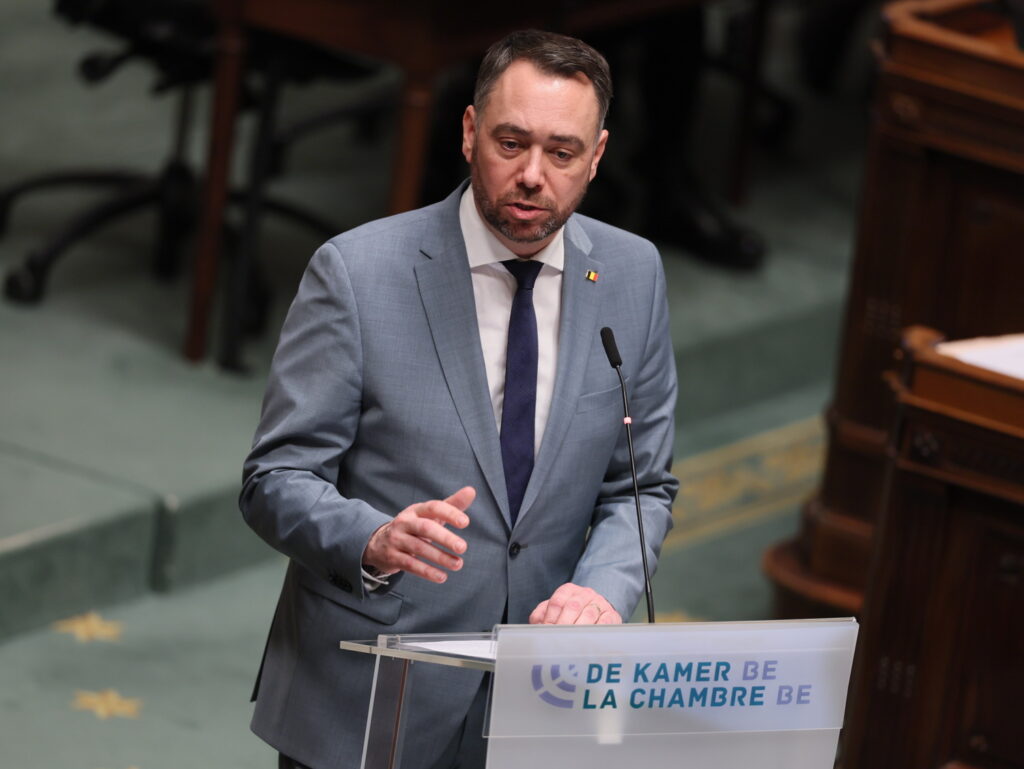
The Russian claim that mines were placed on a gas tanker in the port of Antwerp that subsequently sailed to Russia is "hardly credible," Foreign Minister Maxime Prévot (Les Engagés) has stated.
"At this moment, there is nothing to demonstrate a connection between the port of Antwerp and the alleged presence of the so-called device on the ship," Prévot said.
Russian authorities claimed earlier this week that they found two mines on a gas tanker arriving from Antwerp.
The explosives were discovered on the vessel's hull upon arrival in Ust-Luga, southwest of Saint Petersburg.
The Russian security service FSB said it had "thwarted a terrorist attack".
Russia claims that the gas tanker Arrhenius, sailing under the Liberian flag, entered the port of Ust-Luga on the Baltic Sea on Wednesday, 20 May.
From there, the ship was supposed to sail on to the Turkish port city of Samsun.
According to Prévot, there is no evidence whatsoever of a connection between the port of Antwerp and "the alleged presence of the so-called device" on the ship.
The available images even point in the opposite direction, according to Prévot. "They show that the ship left Antwerp without such an element being visible. This suggests that it was very likely not present during its stay in Belgium," the minister said.
Prévot pointed out that caution must be exercised with the disseminated information, which cannot be independently confirmed.
"Even the question of whether it is actually a naval mine remains unanswered for the time being," he said, adding that there is "not a single concrete basis for the hypothesis that the device was placed in Antwerp. That line of inquiry, therefore, seems hardly credible, especially since the established situation points just as easily to a later installation, after the ship departed from Antwerp."
