
Belgium's teenagers are the most likely in the EU to grow up in households where adults barely work, according to figures published by Eurostat. Growing up in such households increases the risk of being poor in adulthood.
In Belgium, 10.6% of 15 to 19-year-olds live in a household with very low work intensity, where adults did little or no work in the previous year. This figure is the highest in the EU, ahead of an average across member states of 7.7%.
Ireland (10.4%) and France (10.1%) join Belgium at over 10%, with Germany (9.6%) and Lithuania (8.6%) completing the top five.
For Belgium, the figure has been coming down, from 12.3% in 2022 - but despite progress, Belgium has topped the table since 2022.
Eurostat defines low work intensity households as those where adults have often been excluded from the job market over the long-term (excluding students and those retired).
Eurostat data shows that between 2022 and 2024, Belgium topped the EU list for the share of persons living in these homes, before falling to second worst in 2025 at 11% (for all ages, compared to 10.6% for 15–19 year olds).
Low intensity work households
While the youth-specific data is not available at regional levels, figures covering all ages can show where the problem is most concentrated. For example, Brussels is the second worst region in the EU, with 22.1% of people living in a low work intensity household.
Long-term sickness is one factor of Brussels' high proportion of low work intensity households, with a high number of people off work on health grounds, Mart Leys from Decenniumdoelen, a platform of civil society organisations working on poverty, told The Brussels Times.
Previous analysis by Belgium's Ministry of Social Security in 2024 on quasi-jobless households (their definition of low work intensity households) corroborates this.
It found that while low work intensity households have been declining in Belgium, the key challenge when compared to other EU countries is among vulnerable and at-risk groups, these include groups with activity limitations and health issues, as well as those born outside the EU.
A recent study by Ghent University and Vrije Universiteit Brussel (VUB) found that ethnic background remains a significant obstacle to entering the labour market, with people with foreign-sounding names facing discrimination in finding a job. One suggestion put forward by the researchers was for anonymous recruitment procedures.
Leys also points specifically to Belgium's education system, which she claimed entrenches inequality and discrimination by making some young people repeat grades or choose streams "far too early," locking them off from better opportunities in the future, and with it entrenching intergenerational poverty.
Low work intensity is one of three components the EU uses to measure poverty and social exclusion, and those who grow up poor in Belgium are at an increased risk of being poor in adulthood, the so-called social reproduction effect.
One of the reasons for this is the general observation that "early exposure to joblessness can increase the risk of longer-term exclusion from employment", Minh Huy Lai, COO of Generation, an education NGO, told The Brussels Times.
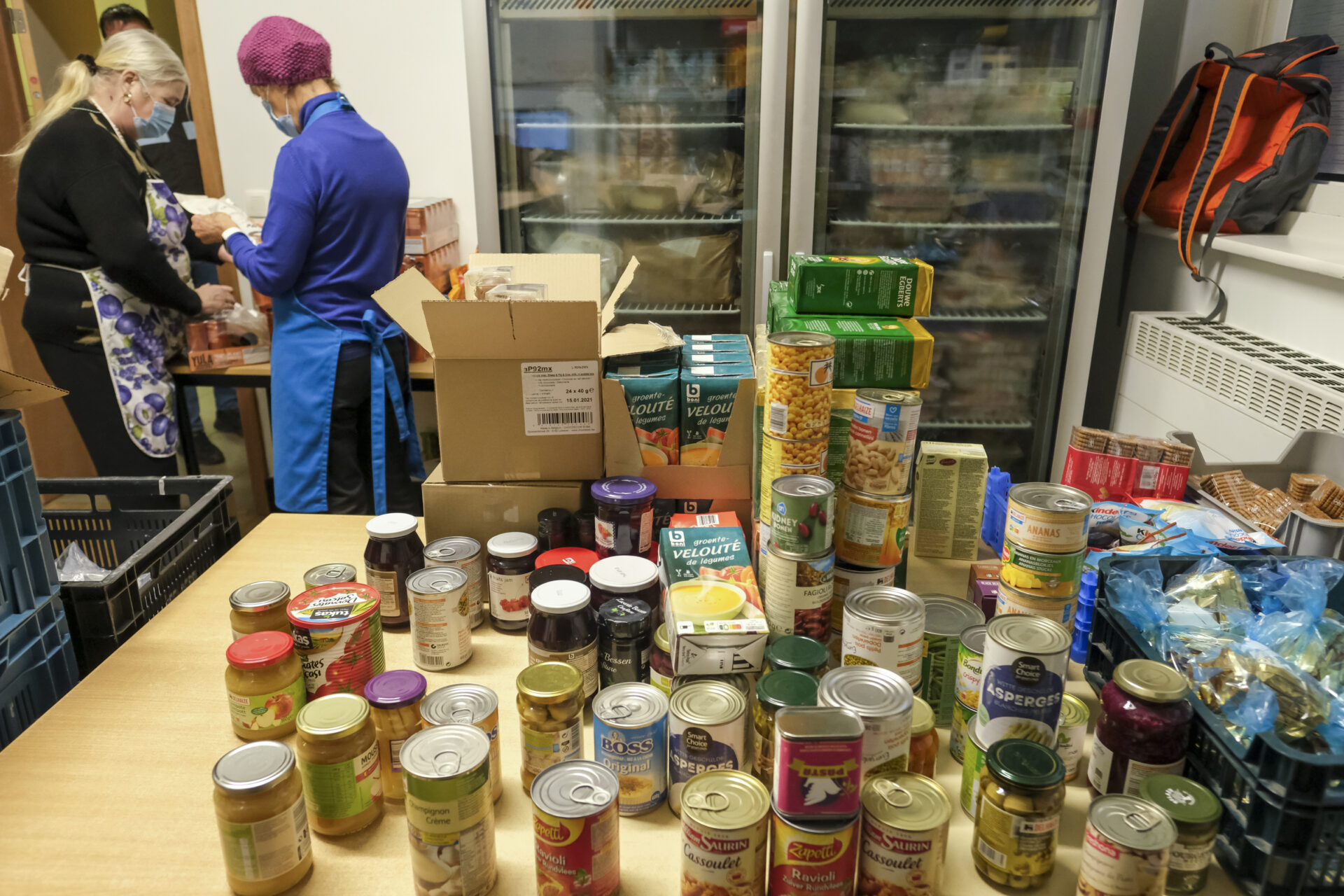
Volunteers at work in the Openplaats.be foodbank in Ghent. Credit: Belga / Nicolas Maeterlinck
According to Statbel, "one in two people who experienced poor or very poor financial circumstances as teenagers are at risk of poverty or social exclusion in adulthood", this compares to less than one in ten (8.6%) who lived their teenage years in a good or very good financial situation.
"Social mobility is something very difficult to achieve", stressed Massimiliano Mascherini from Eurofound. While education and access to work are important, policymakers need to move beyond this to think about livelihoods overall, he told the Brussels Times.
Young people "need support to ensure they have an independent adulthood, otherwise they will remain trapped in parental homes", including in homes with low work intensity.
Claudia Pinto from the European Youth Forum argues that policymakers need to decouple welfare from work to break the cycle of poverty in youth, resulting in poverty in adulthood.
"Poverty is not a choice", she stressed when speaking with The Brussels Times. "With the cost of homes outpacing wages, unstable work, alongside ageism when accessing social security, young people have a lot to navigate to stay afloat financially."
Related News
- Belgium is seen as a strike-prone country – but how does it compare with others?
- Youth unemployment has fallen across the EU – how does Belgium compare?
- My unemployment benefits have ended in Belgium – what now?
- People with foreign-sounding names face more discrimination in finding a job than a house
