

Three years of disruption. Tens of millions of euros in public money. The symbolic heart of Europe's capital. And yet the redeveloped Schuman roundabout has become less a showcase for Brussels than a monument to political dysfunction.
Instead of the elegant public square promised by architects, officials and politicians, visitors arriving at the European quarter are greeted by a vast expanse of pale concrete – derided online as a "frying pan" during last month's heatwave and criticised by its own architect as "the square nobody wanted".
The recriminations are now in full swing.
Former Brussels mobility minister Pascal Smet (Vooruit) accuses his successor, Elke Van den Brandt (Groen), of failing to make the project a political priority.
Van den Brandt argues that institutional paralysis left Brussels unable to approve extra funding, while the federal authorities refused to find money elsewhere. Beliris, the federal agency responsible for delivering the project, insists it merely implemented political decisions.
The blame game intensifies
Everyone agrees on one thing: the result is a calamity. More importantly, there are now tentative signs that, after months of stalemate, a solution may finally be within reach.
Few public spaces carry as much symbolic weight as Schuman. It sits between the European Commission, the Council of the EU and the European External Action Service. It is where television correspondents broadcast live, visiting presidents arrive for summits and diplomats, civil servants and tourists pass through every day.
As Smet puts it: "This is a carte de visite for Brussels."
"It is the ugliest square," he told The Brussels Times. "The only reason you want to be there is to break up with your girlfriend and then run away as quickly as you can."
His ambition, dating back to around 2014, was to transform it into a destination rather than a transport interchange.
After an international competition, architects Brut and Danish firm Cobe produced a winning design centred around a striking circular canopy with a planted roof. It would provide shade, shelter and become the visual focus of the square.
Without it, critics argue, the entire design has lost its purpose.
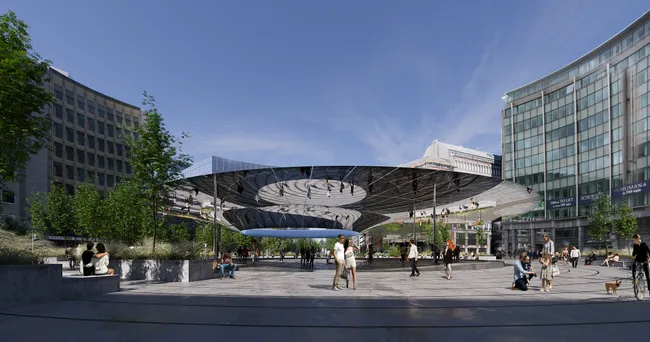
What Schuman Square would have looked like with the planned canopy. Credit: Cobe/Brut
Who is to blame? That question depends entirely on whom you ask.
Smet lays responsibility squarely at the feet of Van den Brandt. "I guess that Elke Van den Brandt didn't want it," he says. "When the Region had to pay more of the costs, she said she didn't have the money. But, of course, she had the money. It's a question of choosing your priorities."
He alleges that money originally available for the canopy was instead used to absorb cost overruns elsewhere in the project. "There is money," he says. "It's a question of political will."
Abandoning the canopy fundamentally undermines the entire architectural concept, Smet says. "The square is simply too big," he says. "You have to build something that gives shade, gives shelter to people, humanises the square and becomes an object in itself."
Beliris partially supports one element of Smet's account. Chief executive Cédric Bossut confirmed to The Brussels Times that, after the main roadworks contract had been awarded, around €7.15 million remained available within the project budget for both the canopy and any overruns.
"At the Region's request," he said, "this remaining balance was allocated to the roadworks contract."
But Bossut rejects suggestions that Beliris itself chose to abandon the canopy.
Van den Brandt does not dispute that the current square is a failure. "Yes," she told The Brussels Times. "The current situation is intolerable. We need to change it."
Yet even as she condemns the finished product, she repeatedly distances herself from the project she inherited. Far from defending the original design, she argues it was fundamentally flawed long before the canopy disappeared.
"I already knew it was too mineral and not future-proof," she says. Even if the canopy had been built, she argues, the square would still have been "greenery on concrete" rather than the sort of climate-adapted public space Brussels should now be creating.
"I was sceptical even with the canopy," she says. "This is not how a 21st-century project should be designed."
Towards a solution
That ambivalence runs through much of her account. While she insists losing the canopy was "a great loss" and made an already imperfect project significantly worse, she is equally clear that she does not see rebuilding the original design as the only answer.
Instead, she argues that Brussels should either construct the canopy or seize the opportunity to create something greener and more ambitious – even if trees are out of the question, because of the roundabout’s relatively thin floor, above the Schuman metro and train station.
Both Van den Brandt and Smet broadly agree on why the square was completed in its current form. The works financed through the EU recovery fund had to be completed by June 30, 2026.
The funding milestone related to the number of square metres of completed public infrastructure. Failing to finish on time risked losing the European financing altogether, making completion of the paved surface the overriding priority.
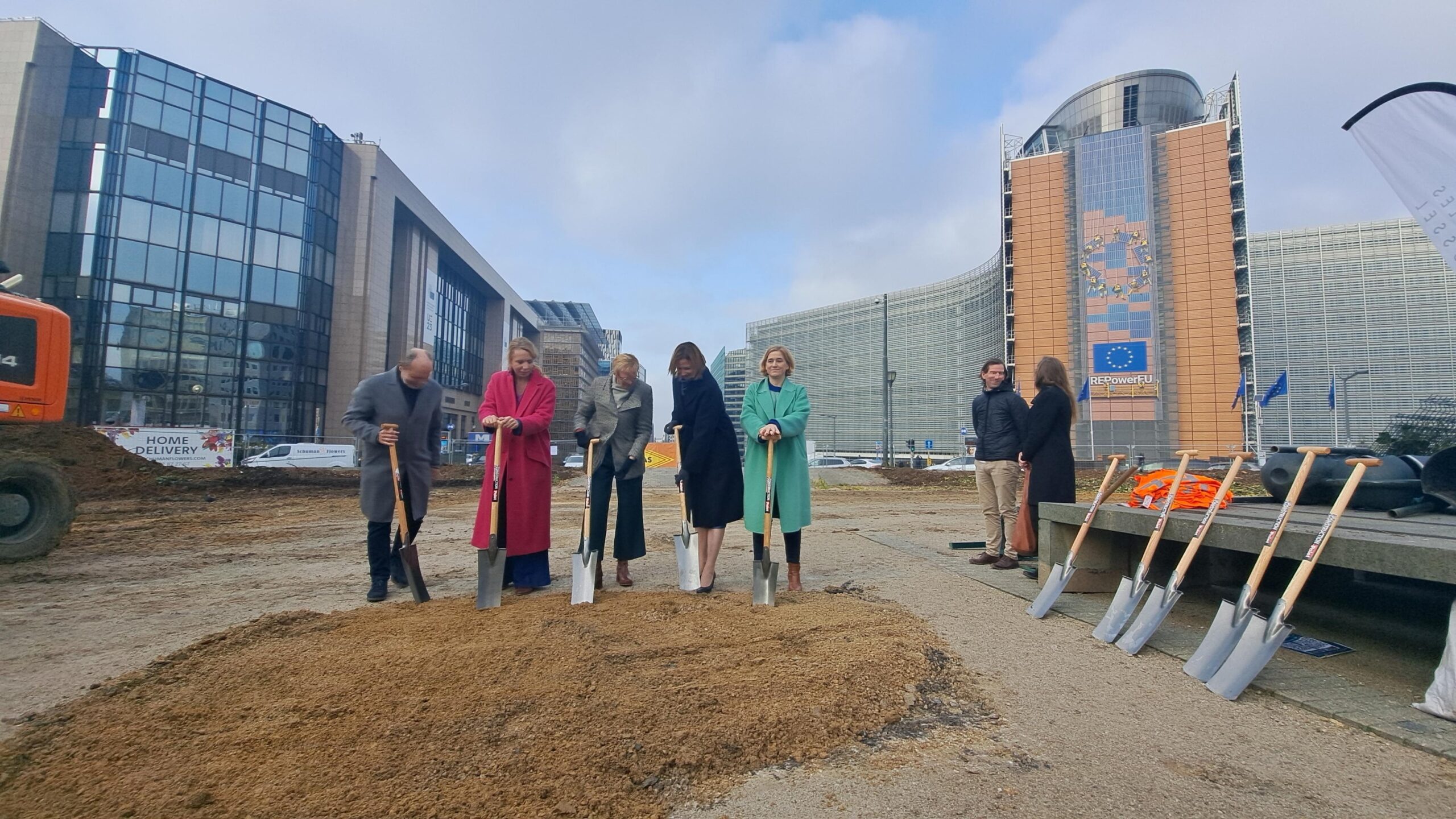
Officials pictured at the start of the works at Schuman Square in November 2023. Credit: Timon Ramboer/Belga
Beliris’s Bossut says no extension was available under the rules governing the Recovery and Resilience Facility, leaving no option but to complete the works by the deadline. He also warns that installing the canopy later would mean reopening parts of the newly completed square, increasing costs further.
Despite the increasingly bitter blame game, there are reasons for cautious optimism.
Van den Brandt says the project "will not stay like this".
"We will do everything possible," she says. "Everybody is looking at it now. We need to find a solution."
Her preferred outcome remains a "Plan B": a redesigned public space incorporating significantly more greenery, shade and, potentially, water features.
Importantly, the Region has now reopened discussions with the original architects. Architect Francis De Wolf has agreed to work with Brussels Mobility and the Brussels Bouwmeester on a revised proposal aimed at making the square far more climate resilient. That process is already under way.
Reviving the canopy?
Smet remains convinced the original canopy should still be built. "It can be done," he says.
He says much of the technical work has already been completed and construction could potentially be finished within a year if political agreement is reached quickly.
If politicians reject the canopy altogether, he argues, Brussels should immediately launch a fresh international design competition rather than settle for what he dismisses as "greenwashing" through scattered planters.
Van den Brandt is more cautious. "If it is the canopy, who should pay? That has to be discussed between the federal government and the Brussels government," she says. "If it is a Plan B, it will certainly be less expensive."
Her office says an alternative redesign could begin in spring 2027, allowing improvements to be completed before next summer's expected heat.
For Brussels, the stakes extend well beyond one disappointing public square. What should have become a confident symbol of Europe's capital instead became an illustration of Belgium's fragmented decision-making, where overlapping governments, divided responsibilities and prolonged political deadlock proved capable of derailing even one of the country's highest-profile public spaces.
Whether the answer is the long-promised canopy or a redesigned greener alternative, the consensus among almost everyone involved is now remarkably clear: leaving Schuman as a sun-baked concrete expanse is no longer politically, architecturally or symbolically acceptable.
