
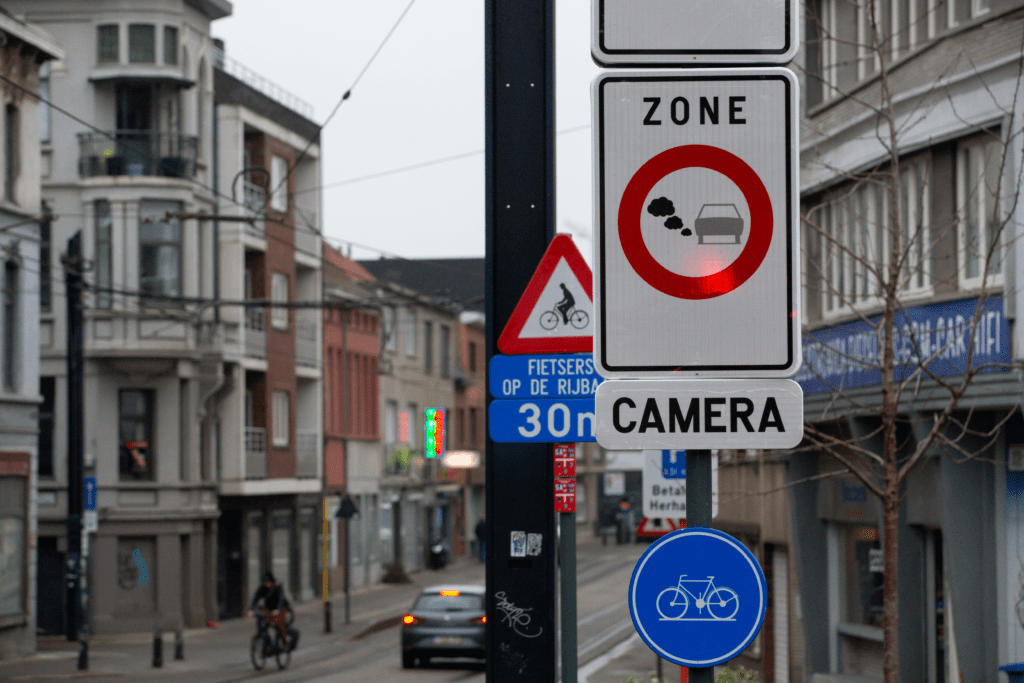
The Flemish government has agreed on a new air quality policy plan, with a review due next year, as Antwerp and Ghent are still not on course to meet EU 2030 targets under current measures.
The plan, approved on Friday, updates the text drawn up by the previous Flemish government. Under the revised European air quality directive, Flanders must systematically monitor the effects of its policy, with formal assessments planned for 2027 and 2029.
Based on current measurements and modelling, the plan forecasts that nitrogen dioxide limits will still be exceeded in 2030 at several locations in Antwerp and Ghent. If the 2027 review confirms that outlook, additional local and regional measures will be considered.
The future of the low-emission zones (LEZ) in Antwerp and Ghent will also be examined. According to the plan, tightening those zones would have a clear impact, reducing concentrations by more than 4 micrograms per cubic metre in the worst-affected areas.
Those hotspots are mainly the busiest street canyons, where heavy traffic is hemmed in by tall buildings. It is in these locations that current policies are proving least effective.
The plan also sets out other measures Flanders could use to cut pollution levels. These include changes to traffic taxation, a toll system in the Scheldt tunnels and lower speed limits on regional roads.
It also looks beyond road traffic. Flanders is aiming for at least 28 berths with shore power connections in the ports of Antwerp and Zeebrugge, allowing ships to switch off their engines while docked and use electricity from the shore instead.
The plan says the biggest challenge remains seagoing vessels, as the main tools for further emissions cuts are decided at the international level.
In agriculture, the continued rollout of the Flemish nitrogen programme is expected to make the biggest contribution. Flanders is also continuing to back the use of air scrubbers. Together, those efforts are intended to reduce ammonia emissions by just over 40% compared with 2015 levels.
“The air quality in Flanders has improved significantly over recent decades, but we are not there yet,” said the Flemish Environment Minister Jo Brouns (CD&V) on Wednesday. “With this updated air quality policy plan, we are raising the bar again. We are choosing a realistic and ambitious path to meet the stricter European requirements by 2030.”
