
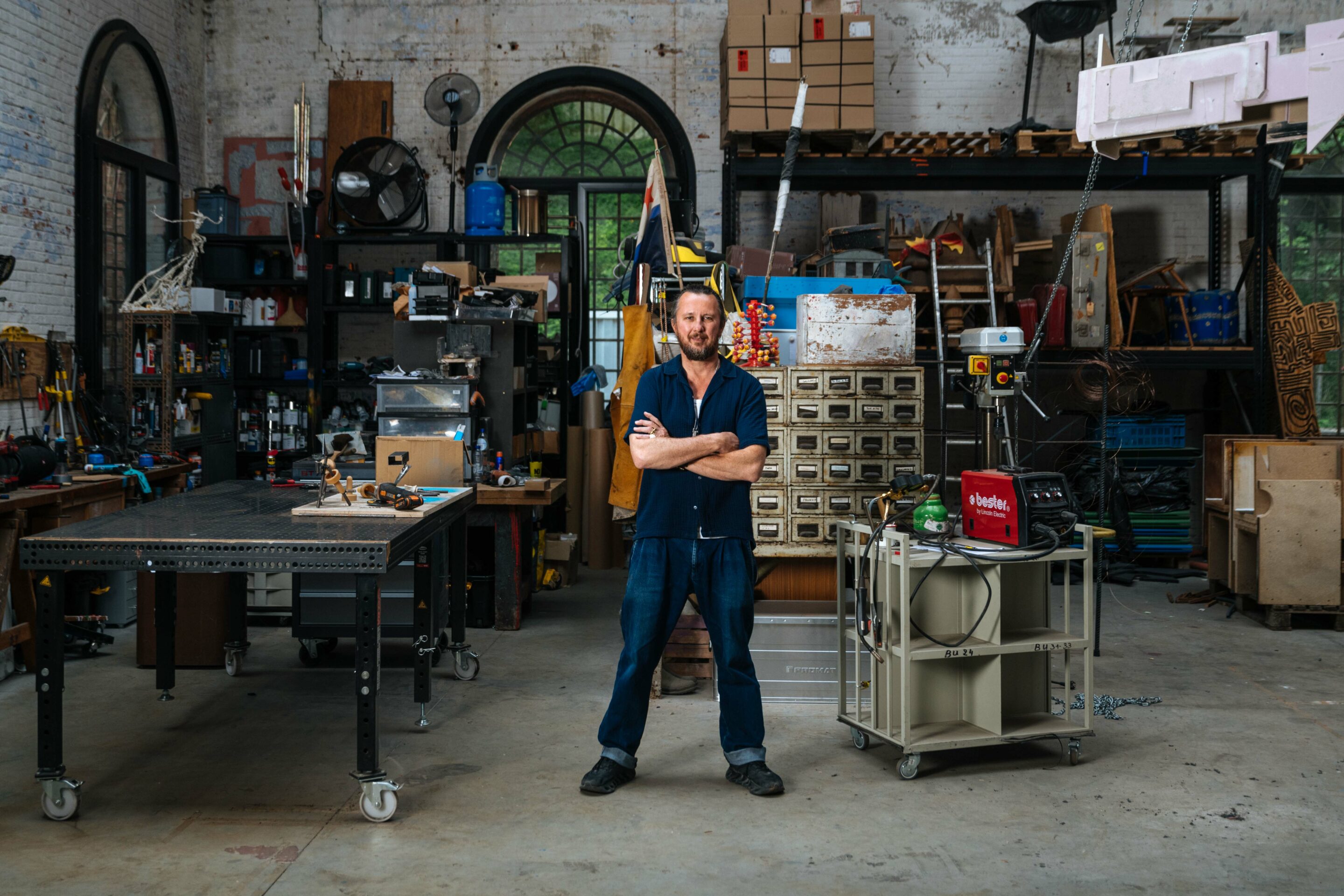
Lionel Jadot’s workspace at Zaventem Ateliers, part experimental playground, part cabinet of curiosities, hums with activity. His team shifts between desks, meetings, and whiteboards mapping out ongoing projects while three friendly dogs wander through the former paper factory.
Jadot transformed it into a multidisciplinary hub bringing together more than 25 workshops of designers, craftspeople and creatives under one roof.
Named Designer of the Year 2024 by the trade fair Maison & Objet, Jadot has become almost impossible to avoid in Brussels. His work shapes some of the city’s best-known contemporary interiors, from the Jam Hotel (which recently opened an offshoot in Ghent) and the Wolf food market to Café Flora and the sprawling Mix Brussels complex near the Sonian Forest.
Despite the growing international profile, he resists easy categorisation. Self-taught, Jadot moves between interior design, collectible furniture, hospitality projects and art, distinctions he has little interest in maintaining. “I don’t like labels,” he says.
Behind his desk sits a small stool made from beech wood and orange velvet, which he built when he was only seven years old. Raised in his parents’ workshop – he hails from a family of six generations of furniture makers – Jadot grew up surrounded by scraps of wood and fabric, learning early on to make things with his hands. He still approaches design with that same instinctive freedom, whether creating art exhibitions or bringing together dozens of local makers and designers for large-scale interior projects like the Mix hotel, the renovation of the Royale Belge insurance company building and a masterpiece of 1960s brutalist architecture.
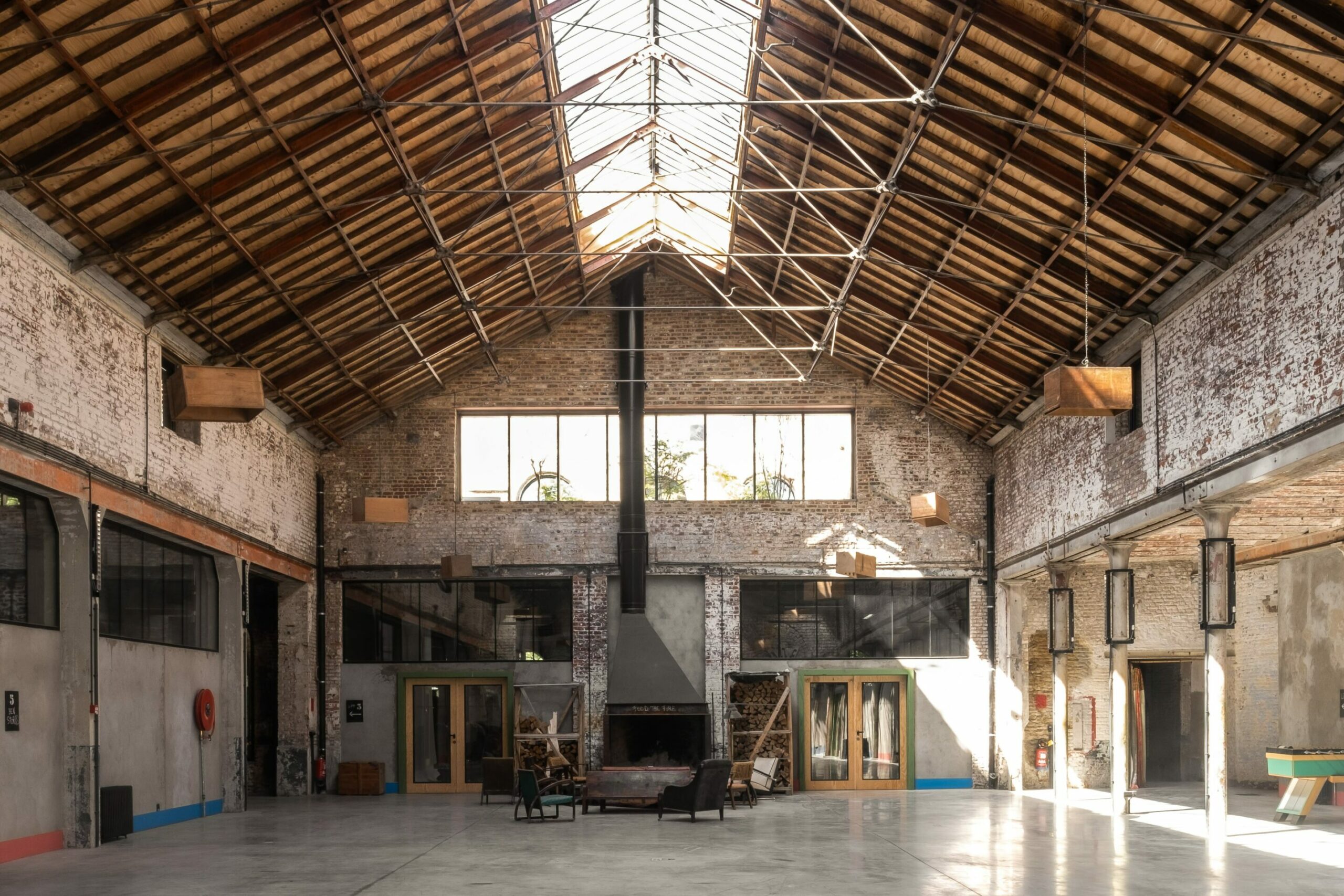
Inside Lionel Jadot's studio warehouse in Zaventem
This collaborative spirit lies at the heart of Jadot’s practice. The cliché of a solitary artist might have him working in his studio in isolation, but Jadot speaks about collective energy and what happens when different people, creative universes and ideas come together. “I know how difficult it is to produce pieces alone in a workshop: having to face every single morning the question of what you are going to make and handling absolutely everything on your own,” he says. “Together, we are stronger.”
Working under the same roof enables them to share experiences, networks, troubleshoot technical challenges, navigate uncertainties and map out creative directions. They even travel together, to the Milan Design Week, for example, and exhibit as a group, as recently at Villa Empain in Brussels.
“Ultimately, Zaventem Ateliers acts as an accelerator and a platform for debate and exchange,” Jadot says. “Everyone here is an adventurer. Each person is truly fighting for their own vision.”
When people work this closely together, there must be a certain common denominator, which is why residents are selected through a rigorous process overseen by a board. Jadot says this curatorial dimension gives the place its identity and is the key to its success.
“We actually prefer to leave spaces empty rather than fill them poorly,” he says. “Taking the time to select unique individuals – people with a highly relevant vision of how they want to create – is what injects quality.”
Sacred fire
What he looks for above all is what he calls “the sacred fire”. “I want to see it in their eyes,” he says. For Jadot, talent alone is not enough. What matters is the determination to pursue an idea despite uncertainty or scepticism. “Those who truly want to bring something new to the table,” as he puts it, are the ones he seeks out. Passionate people who carry the mindset “Everyone might say I’m crazy, but I’m going for it anyway.”
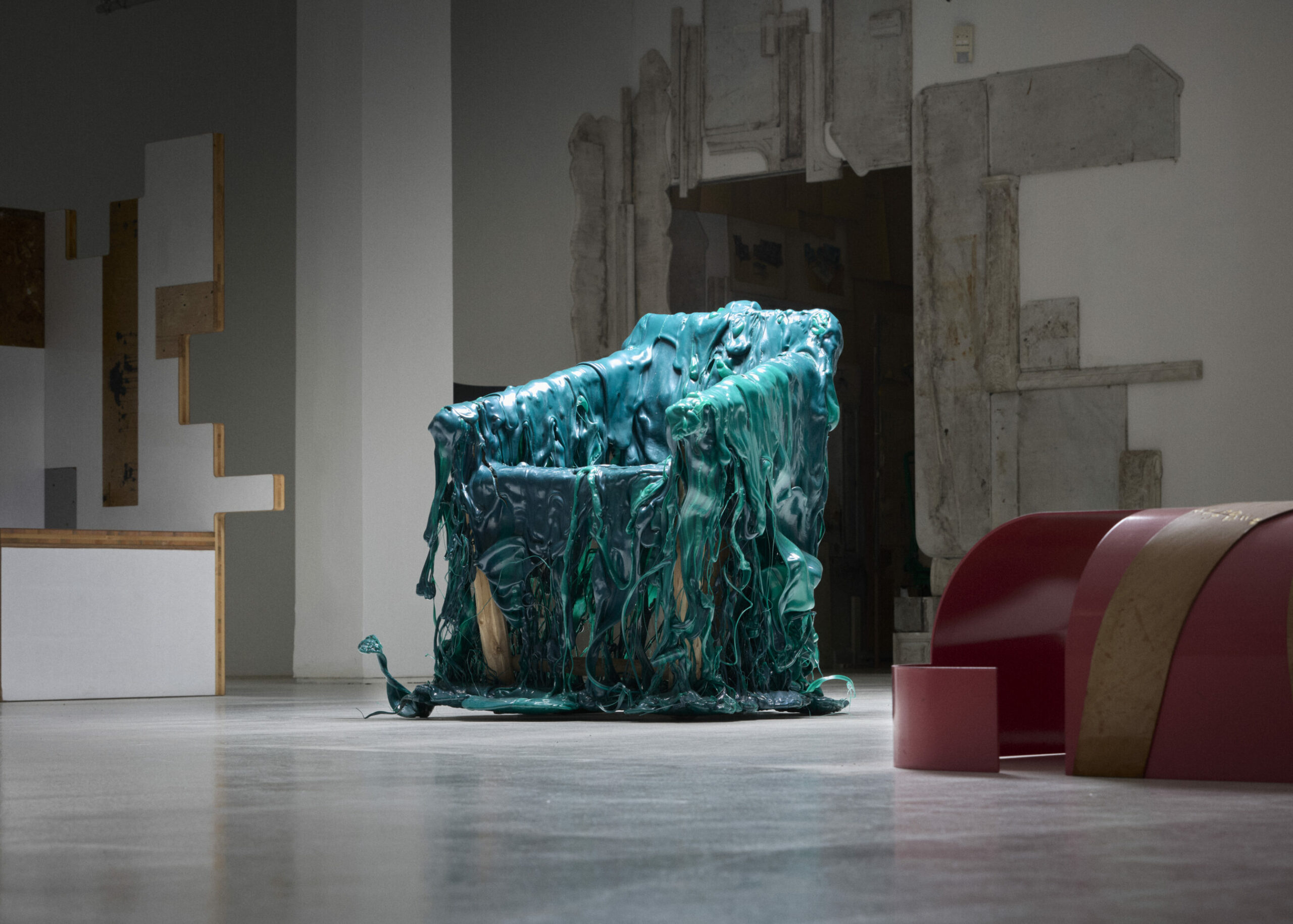
Lionel Jadot’s Green Chair
Jadot values obsession, perseverance and a willingness to take risks. Design, he says, is a daily act of conviction. “It is not easy to start with an idea, decide to manufacture it, build it, sell it, and make a living from it. Every single day, you have to tell yourself, ‘Okay, today I am going to shape my own destiny with my hands.’”
That ethos recently took shape at Villa Empain, where all members of Zaventem Ateliers teamed up to occupy the historic building with an exhibition showcasing their creations. Rather than presenting isolated objects, the exhibition attempted to create an immersive environment. “We managed to show that when we settle into a place entirely with our work, a unique energy takes over,” he says.
Belgium’s design advantage
A special spark can also be felt in the Belgian design scene as a whole. Jadot believes Belgium's design scene benefits from an unusual freedom. "There is no academic pressure,” he says. “No heavy history weighing it down.” Combined with the country’s cultural diversity and relatively accessible studio rents, these circumstances have given rise to a flourishing underground design scene, especially when it comes to the growing field of collectible design. “You can feel there’s something fresh, something disruptive,” Jadot says.
Over the last decade, Brussels has become a bit of a hotspot for collectible design, thanks in part to the success of the Collectible Fair, which has established itself as a global meeting point for 21st-century limited-edition design.
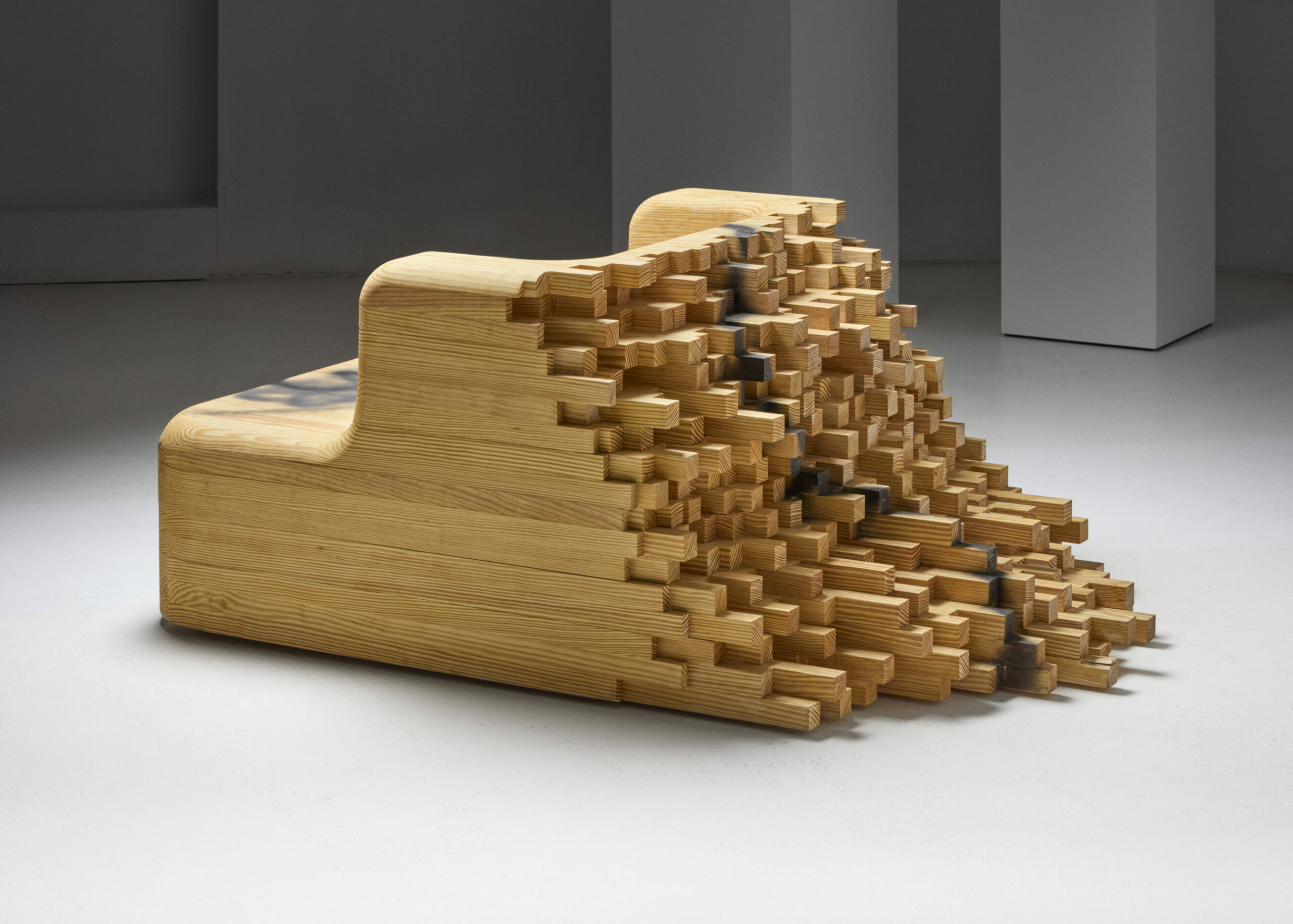
Lionel Jadot's Erased Armchair
Jadot has helped drive the rise of what he calls "functional art", reimagining everyday objects as collectible design. Projects such as Mix Brussels are part of an effort to bring those pieces out of galleries and into everyday life. "The Mix Hotel shows that collectible design is not just for collectors," he says.
Creating collisions
Asked whether there is a common thread linking his many different projects, Jadot speaks less about aesthetics and more about process. He describes his preferred way of working as a form of “losing control”: he shares the initial idea, then encourages collaboration without knowing the outcome. “The accidents, the rough edges, the imperfections: that’s what makes projects stand apart,” he says. “Here at the agency, we create collisions, and then we just see what happens.”
He speaks enthusiastically about the element of surprise. “I like to be shaken up when I visit a place,” he says. “I like to be struck and taken aback, telling myself, ‘Wow, I wouldn’t have made that association.’”
Another recurring element in his practice is questions around reuse and sustainability. One ambitious dream he still has is to one day repurpose an entire large-scale building. The idea reflects his belief that waste should be treated as raw material for reinvention. In his ideal scenario, the obsolete building itself becomes the quarry for its own transformation. “We would reimplement everything right back into the building, using absolutely everything we find inside,” he says.
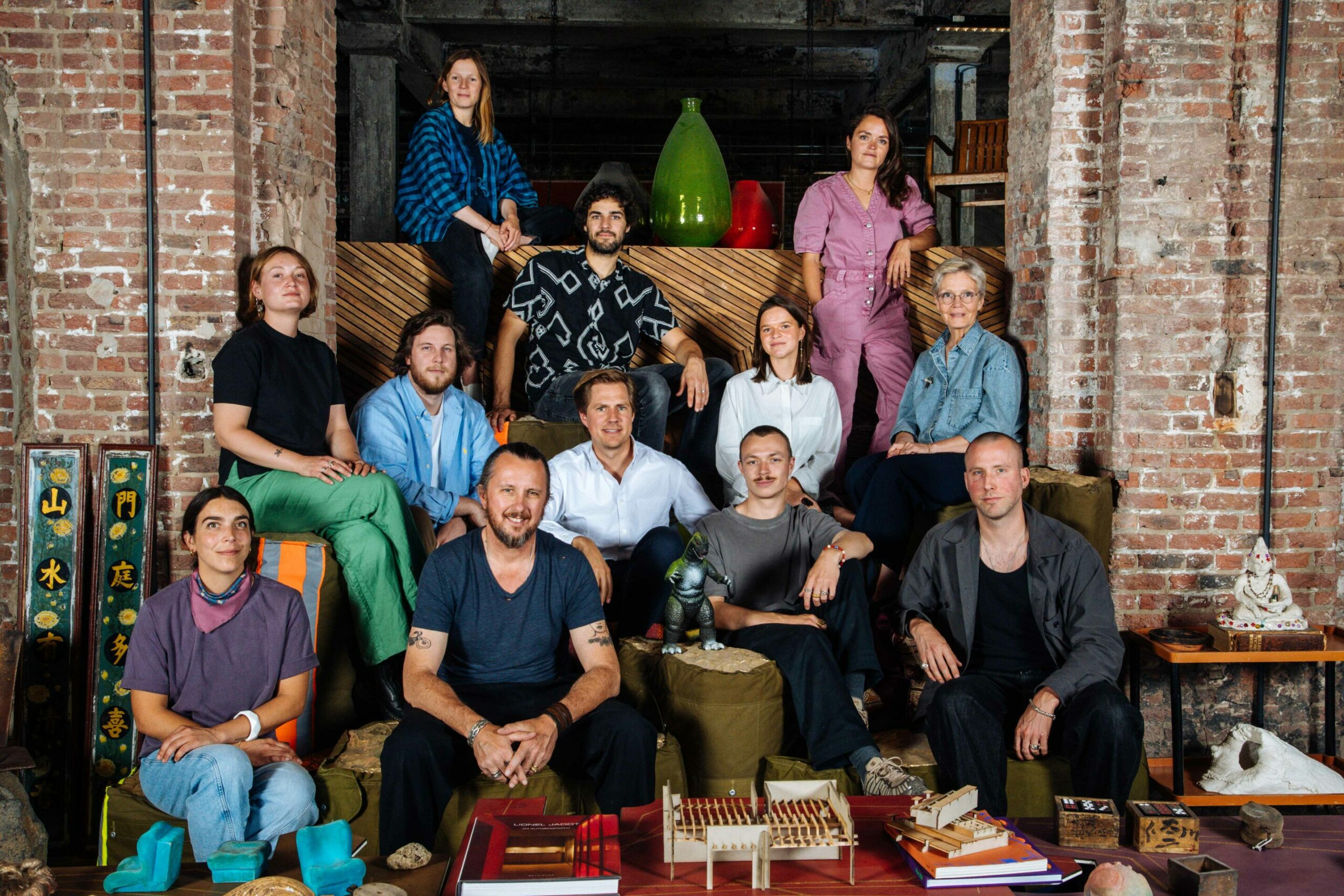
Lionel Jadot with his team (left)
New furniture, lighting fixtures, handles and architectural elements would be the result of melted-down aluminium, recycled plastic, or crushed concrete. “We already manage to do this on small-scale projects,” Jadot says. The challenge is convincing developers and investors to embrace such an innovative circular approach. So far, he admits, several large-scale proposals were rejected because the idea scared people. Still, he sees it as an inevitable direction for architecture and design. “I think it would send a very powerful signal.”
Despite the visibility of his work, Jadot seems uninterested in legacy. “I don’t really care about leaving a mark,” he says. Buildings change hands and interiors are redesigned. “I just don't see my job as something meant to leave a permanent stamp,” he says.
He is noticeably resistant to the mythology that often surrounds star designers or architects. Rather than imagining his work as lasting, he sees it as temporary and alive – something shaped by the people passing through it. “What truly interests me is the present moment,” he says. “What happens inside these spaces afterwards, how they live, and how they can bring energy to people at a given time.”
Public projects especially appeal to him for exactly that reason: “I love that people actually use them,” he says.
Bruxellois through and through
Deeply rooted in his native city, Jadot was born in Brussels’s Saint-Gilles neighbourhood and never left, rejecting the idea that it’s necessary to be located in one of the traditional design hubs like London or New York to make a career: “I’m a Bruxellois through and through.”
For all his international visibility, Jadot still speaks about Brussels with the affection of someone deeply rooted in the city. “I’ve never had the mindset of feeling stuck or limited just because of where I am located,” he says.
Geography has never felt like a constraint, he says. “The great advantage of the world we live in today is that you can post a single image on Instagram, connect with someone on the other side of the planet, and establish a meaningful relationship. That has completely changed the game.”
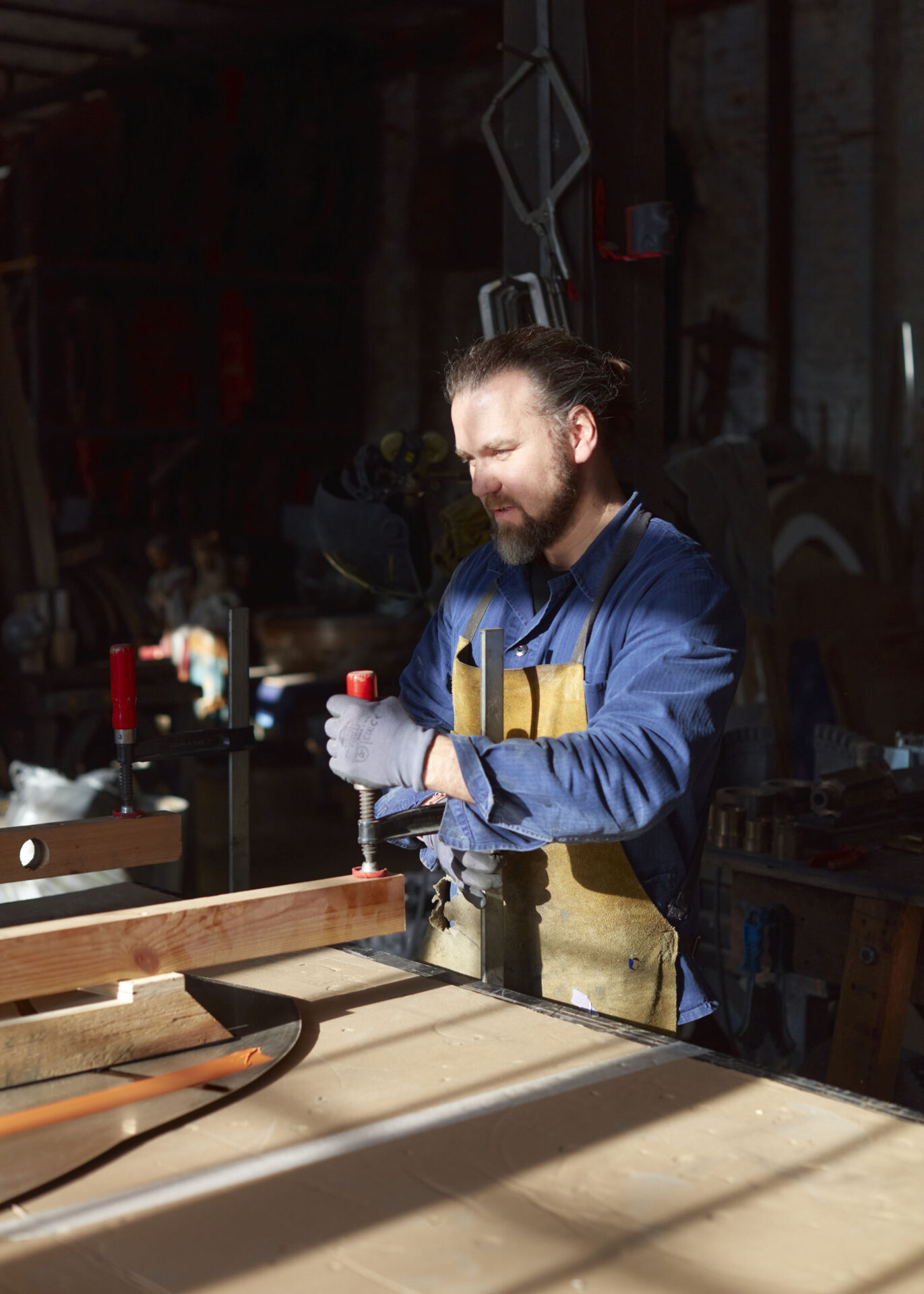
Lionel Jadot
Today, his work is represented by galleries in Brussels, Geneva and New York, and international projects regularly take him abroad. “I truly believe we have everything we need right around us to disrupt the system – we just need to push the walls, make some noise, and people will naturally come to see us,” he says.
That philosophy recently accompanied him to Mexico City, where he spent a month preparing for an exhibition in a local gallery. Rather than shipping his pieces overseas, Jadot decided to create everything from scratch, only using materials he found on site. Metal, wood, silicone moulds and broken car parts he scavenged formed the basis for a series of 12 chairs, a dining room table, a lamp, a hanging light, and two floor lamps. Friends lent him tools and workspace. The experience confirmed his sense about design and creativity more broadly: that resourcefulness matters more than financial means or infrastructure.
“These resources are virtually the same everywhere in the world,” he says. “When you are creative, you can go anywhere, even without a lot of money, and make something happen.”
