
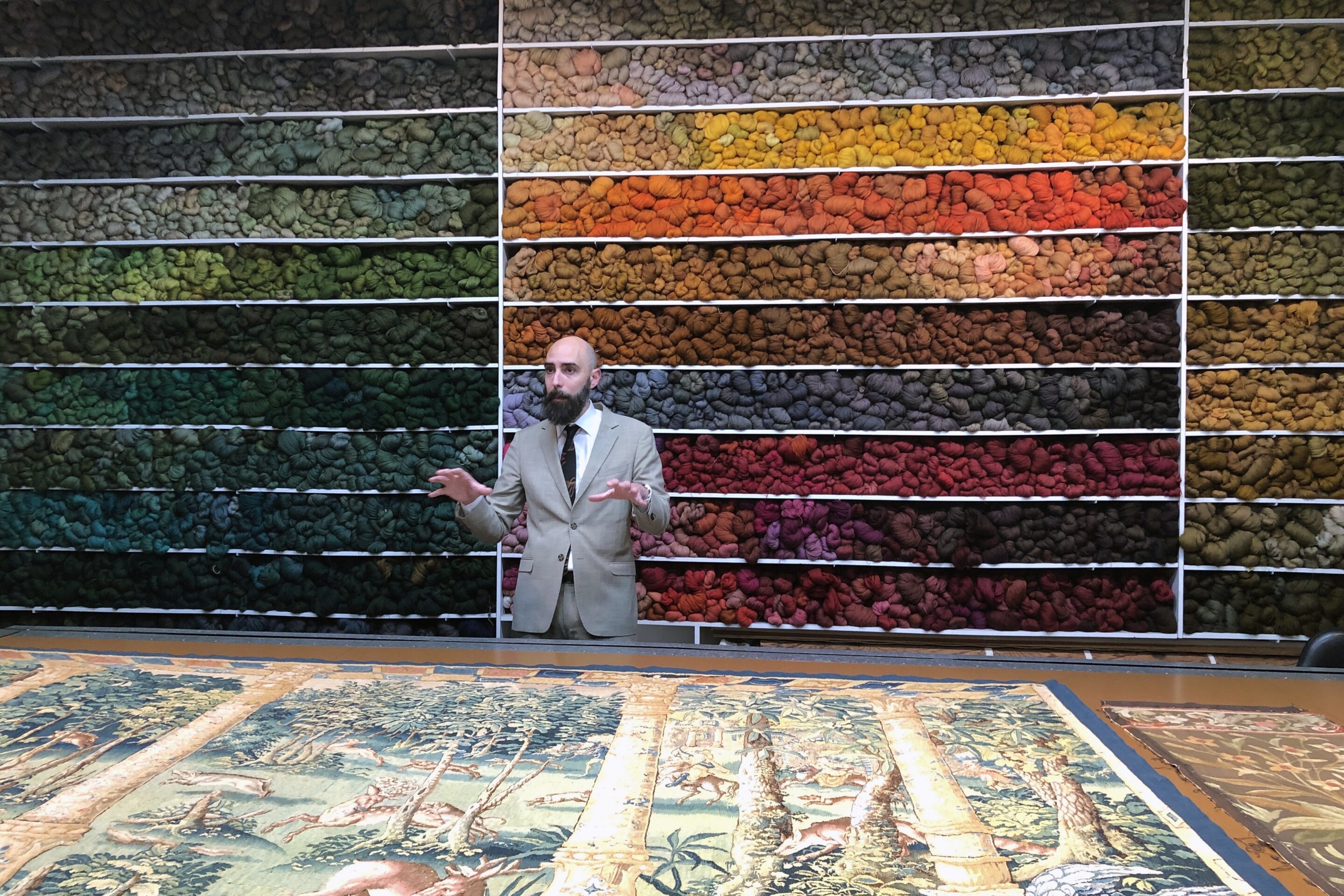
The room is so quiet you could hear a pin drop – and there are an awful lot of pins about in the large workshop at the heart of Belgium’s world-renowned tapestry restorer, De Wit.
In fairness, none of the colour-tipped pins appear to have fallen on the floor.
Located in the magnificent 15th-century Refuge of Tongerlo Abbey, next door to the Archbishop’s Palace in the historic centre of Mechelen, the workshop and other rooms in the building are open to the public when the conservation team is not at work.
But The Brussels Times Magazine is being treated to a private tour with Pierre Maes, the fifth generation of the same family who have run De Wit since it was founded by his great-great-grandfather, Theophiel, in 1898. (Maes is not a De Wit himself, as the business passed down through the female line at one stage).
Inside the first-floor workshop, accessed via a curved stone staircase, six restorers, all women, are busy working in complete silence at long, separate benches. They barely look up to see who has disturbed them. Bathed in light from large windows on one side of the room, each bench holds a centuries-old tapestry, wrapped around a sort of giant spindle.
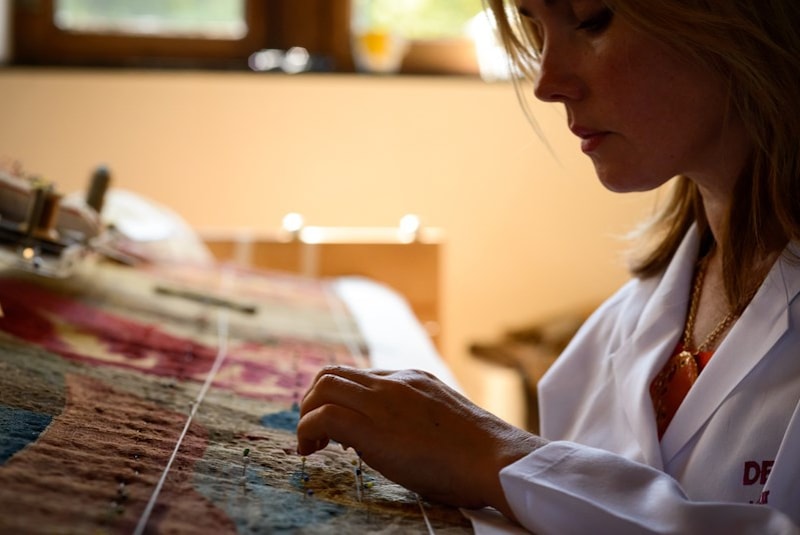
The women are carefully measuring and pinning out sections on each tapestry, which will require the most intricate threading to repair wear and tear.
Asked if the room is always this quiet, Maes nods. "Yes. The work demands intense concentration.” Men, he confirms, very rarely apply for the job.
Feeling almost guilty to interrupt, I move towards one of the benches for a closer look. Emma Damen, the workshop’s head restorer, is examining a tapestry in minute detail, her face centimetres from its surface. Seeing us approach, she smiles and gets up to say hello.
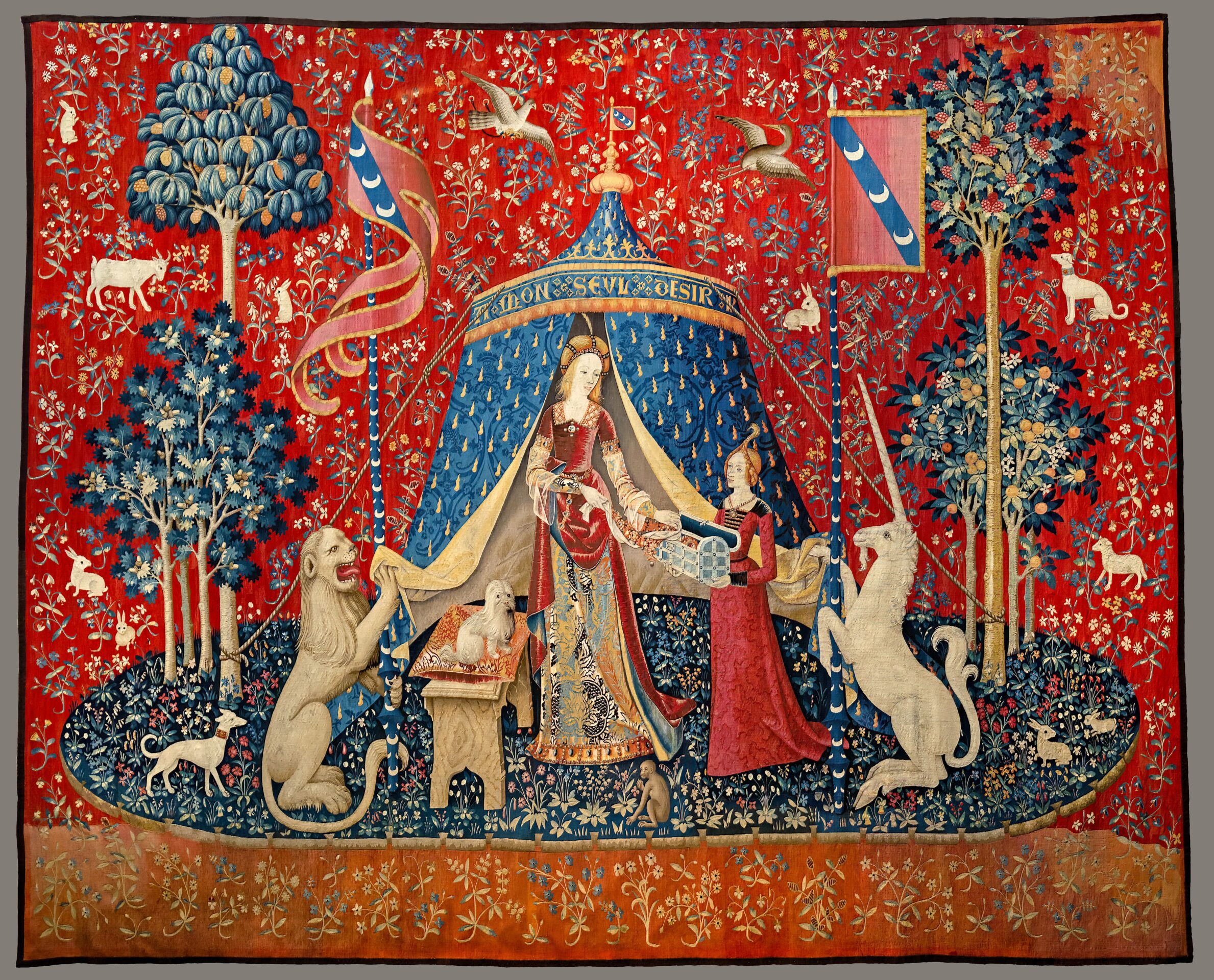
(Toulouse) Mon seul désir (La Dame à la licorne) - Musée de Cluny Paris
A graduate in conservation-restoration from the University of Antwerp, with a specialisation in textiles, the 33-year-old joined De Wit in 2022 after developing her expertise at the Royal Institute for Cultural Heritage (KIK-IRPA) in Brussels.
She pulls over a small box on wheels with a mirrored top and gently slides it under the tapestry. “When we are restoring a section, you need to see both sides of it,” she explains, holding the tapestry in place with her right hand stretched over the top and the left below.
The near-invisible mending, all done by hand, only takes place after a piece of consolidating material is fixed on the back of the tapestry to ensure everything stays neatly in place. The work looks extremely fiddly and tiring, both mentally and physically. No one suggests otherwise.
Repairing a single tapestry can take four months to more than two years to complete, depending on its condition.
Washing process
Maes continues with the tour. “We train everyone who joins us in-house,” he says, leading me to another room, where the tapestries are cleaned by wassers (washers), working barefoot in pairs.
This cleaning cannot begin, however, until the lining at the rear of the tapestry and any former restoration work is removed. “We do this because some of the old restorations have damaged the tapestry and do not match the standards of today. They can create uneven tensions in the textile, and uneven tensions are bad for long-term conservation. Sometimes they're just not aesthetically pleasing either.”
The washing process is crucial. The tapestry is unrolled and placed on a raised mesh-like floor, which covers most of the room. “First of all, it will be sprayed with aerosols, containing water and a special detergent designed for historic textiles. Then motors below, working like hoovers, suck the mist of water through the tapestry, removing any deposits of dirt,” says Maes.
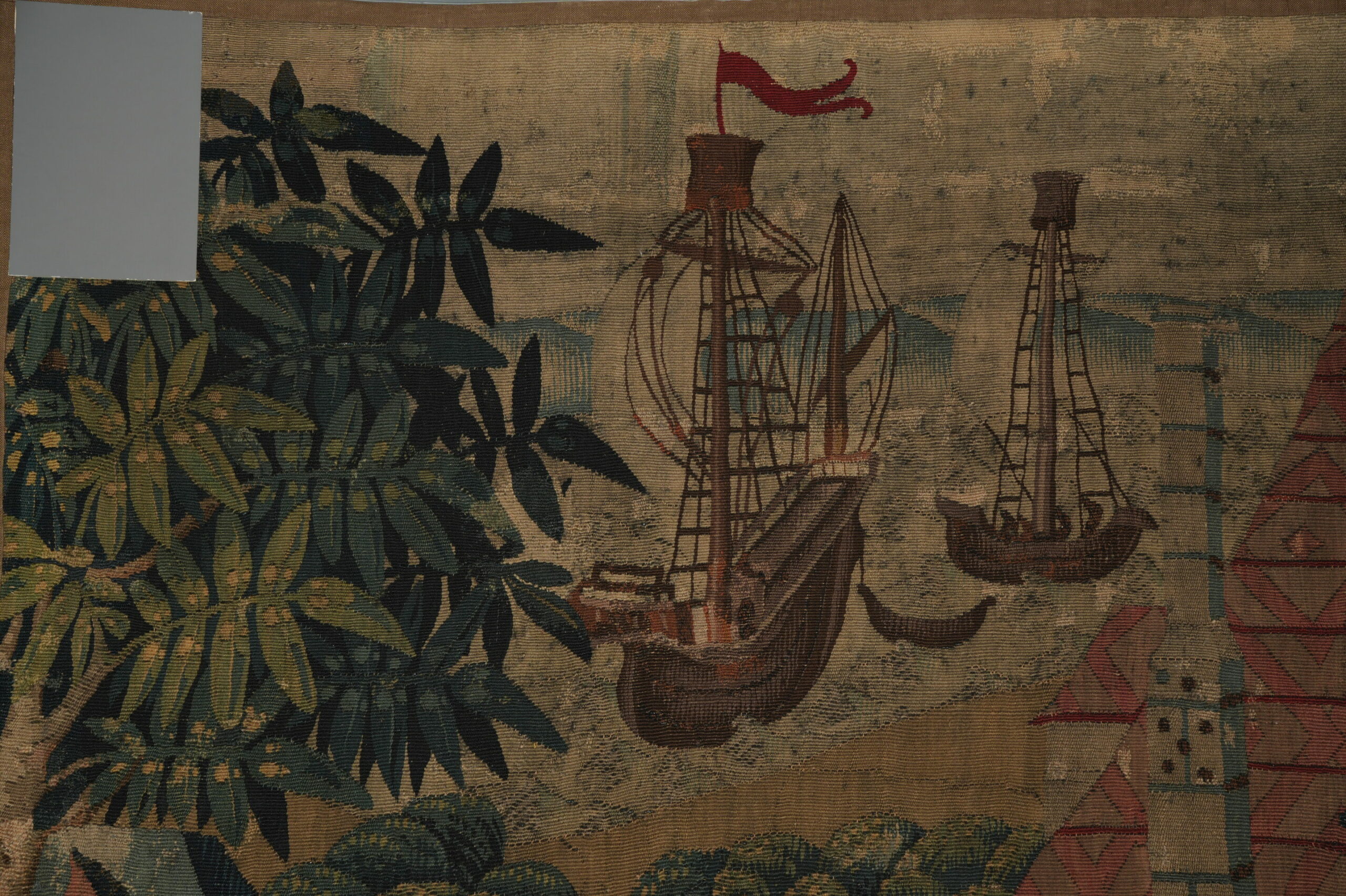
A tapestry before
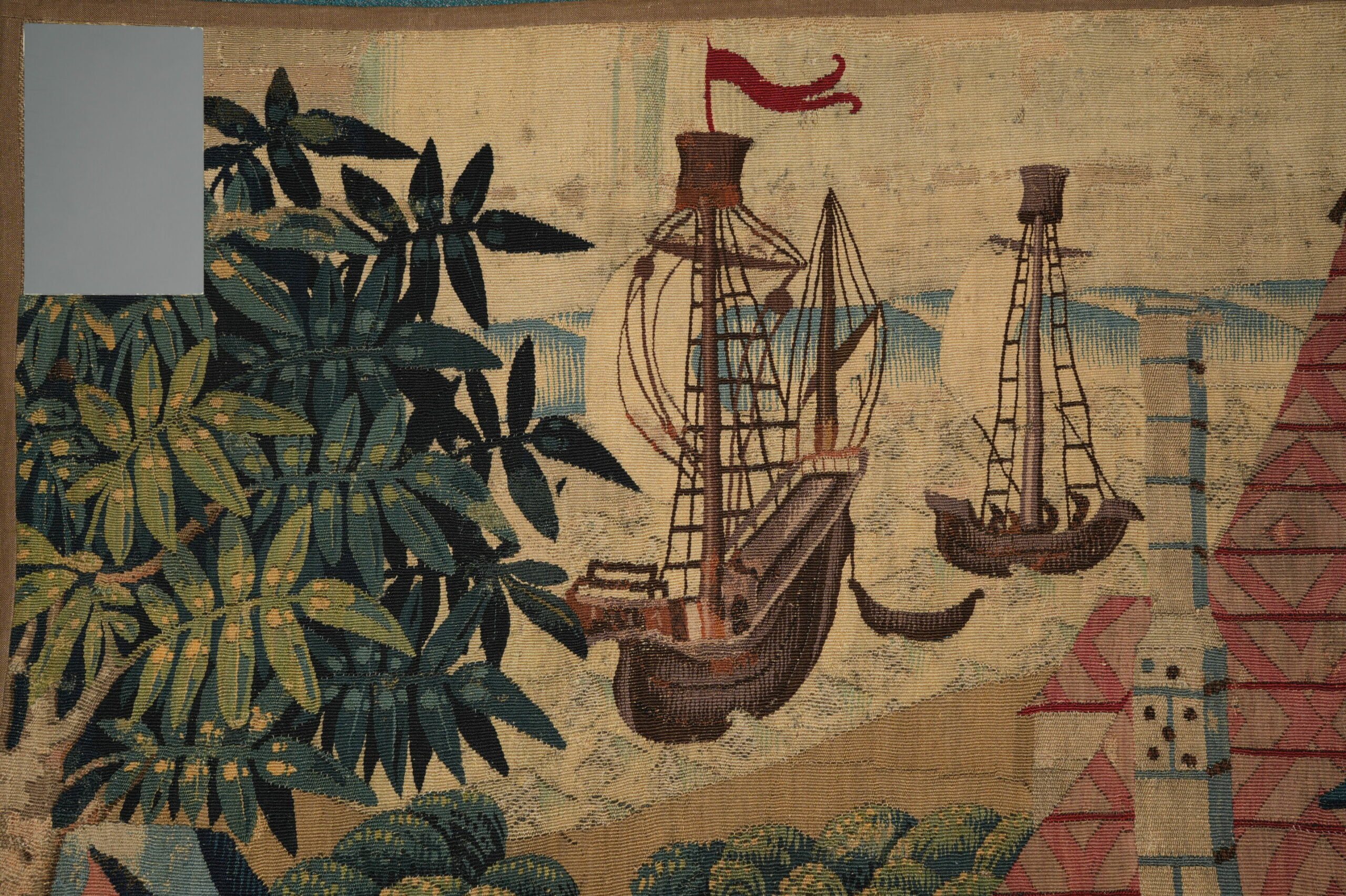
A tapestry after restoration at De Wit
A remote-controlled camera monitors the patented process in microscopic detail. Samples of the water are taken throughout, and the pH value, showing the level of acidic content, is measured until it is negligible.
The tapestry is finally thoroughly dried with towels and absorbent paper before being rolled up and moved to the workshop.
Maes next takes me back to the ground floor rooms to see some of De Wit’s extensive collection of tapestries in its own private museum. There are around 30 on display, about a third of the company’s inventory. The rest are held nearby in a high-security vault behind reinforced doors. “It’s like a giant safe,” Maes says.
The tapestries, ranging in age from the 15th to the early 19th century, are breathtakingly beautiful. Most depict stories from the Bible, mythology or ancient history, everything from the conquests of Alexander the Great to the Apocalypse.
They are also extremely valuable. Some of the tapestries would easily fetch a million euros if placed on the market. But that would be a snip compared with their original price.
Superyacht
“Back in the 16th century, if you were the Duke of Burgundy, you wouldn't buy one tapestry. You would order a set of six or 10 at a time, measuring up to five metres in height and 10 meters wide. They would cost the equivalent of a fully equipped battleship.
“Tapestries projected your power, wealth and prestige. In the inventories of kings and the dukes, tapestries were right at the top because they were their most valuable possessions. Today, they would be a bit like Jeff Bezos’s superyacht [cost $500 million]. He bought one of the biggest yachts in existence, not because he needed it but because he wanted it to show it off to everyone. It’s a statement.”
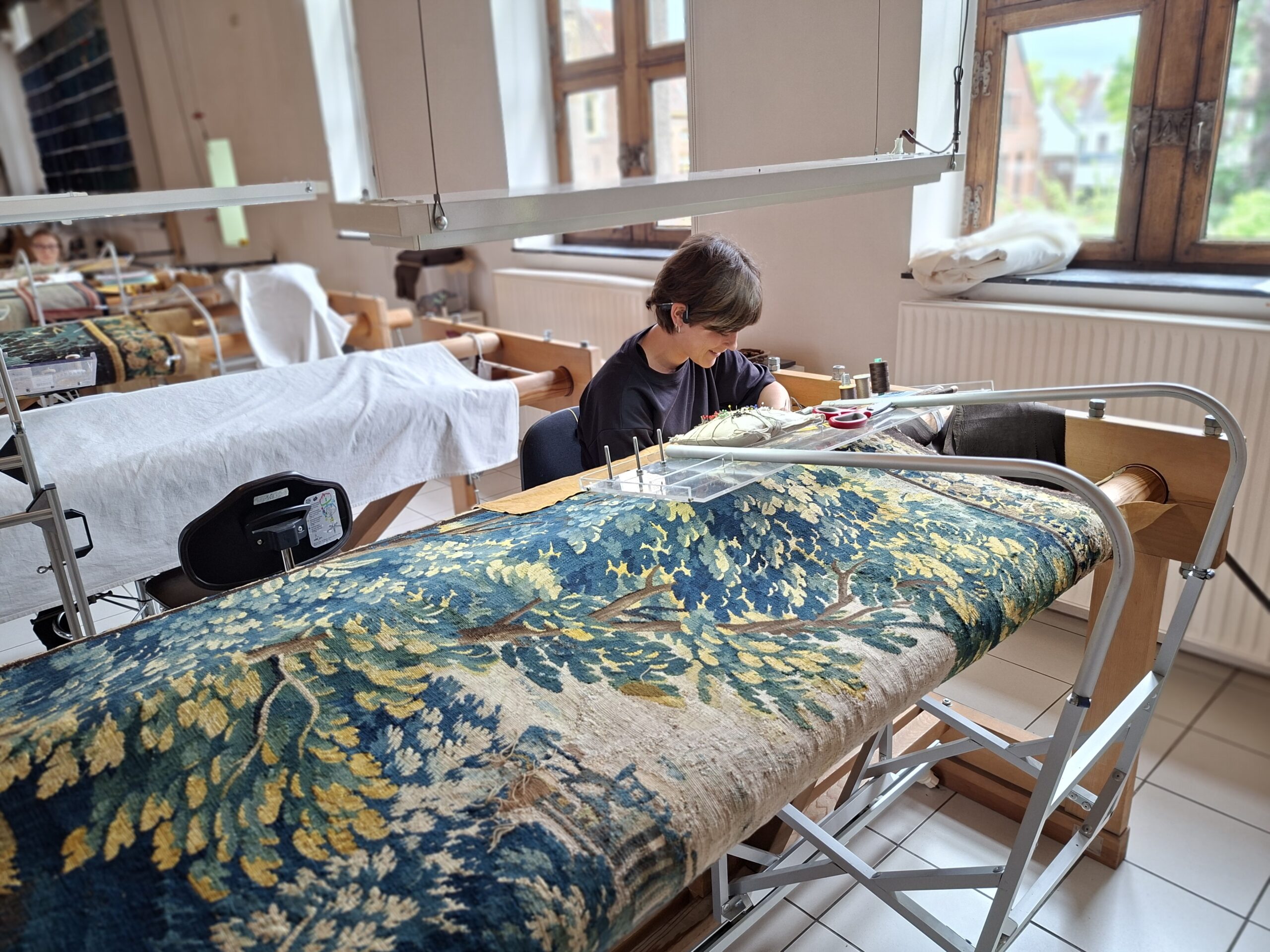
Emma Damen at work
Brussels and its surrounding area were the main hub for such statements during the golden era of tapestry production in the 16th century.
“The Flemish had a long tradition in the drapery industry but were forced to diversify due to strong competition from England. They specialised very deeply in tapestries and became the best. It was the main activity in Brussels at the time, with about 25% of the city’s population involved in the business in one way or another,” Maes says.
“The most expensive tapestries, bearing the letters ‘BB’ for Bruxelles-Brabant, were exported all over Europe,” he adds. “When Pope Leo X commissioned Raphael in 1515 to design the tapestries for the Sistine Chapel, he knew that they would be sent to Brussels for weaving.”
Frustrated
Maes admits, however, that he is often frustrated that this glorious past is not always widely appreciated, even among his compatriots.
“A lot of Belgians don’t realise just how important Brussels was during this era. I think sometimes we are not proud enough of what we do and of our history.”
In another room in the museum, there’s a low-level loom on which one of the firm’s staff has nearly completed a tapestry. “It’s to show visitors and not a commercial project,” he states.
It’s fascinating to see close-up how a tapestry is made. Lines of strong yarn, thinner than guitar strings, are stretched out under tension in a frame. This is known as the “warp”. Different coloured threads, made from dyed sheep’s wool, mixed with silk or strands of silver or gold for the most luxurious pieces, are the “weft” which is interwoven horizontally, over and under the warp.
The weavers of the past would copy a design known as a cartoon, often based on a popular painting, which was fixed below the warp. Although the production of tapestries ended in the Low Countries long ago, warp and weft are still used as metaphors to describe opposites or the ups and downs of life.
Passion
Speaking earlier in his office, in the rafters of the building, Maes’s passion for the business is palpable. It was certainly not a given that he or his brother Frederic would one day run the firm when their father, Yvan Maes De Wit, who is now its chairman, retired.
“We were not bred to take over the business. It’s not something you do because you’re the son of the owner. It’s something you have to really want to do because it’s a very difficult business. You have to work very hard, and to innovate, and to develop continually, because otherwise this business can very quickly go down. My father is my mentor and closest advisor.”
Maes, who graduated in art history from the University of Liège and dedicated his thesis to the study of the French tapestries restored at De Wit, took over at the helm in 2020, when he was 34. Frederic, meanwhile, also has a key role in the firm, responsible for the technical side of the operation.
Art dealing
Today, De Koninklijke Manufactuur De Wit or la Manufacture royale De Wit, to give the firm its full name, employs 15 staff, eight of whom are specialist restorers.
The business is not solely focused on conservation and restoration. “We are also art dealers,” says Maes. “We acquire, restore and sell tapestries. Because of our reputation, we are also in contact with a lot of people who own tapestries and who sometimes ask us to market them. We also work with two art fairs, BRAFA in Brussels and TEFAF (the European Fine Art Foundation) in Maastricht.”
Asked what proportion of the firm’s revenues comes from conservation compared with art dealing, he replies: “It varies a lot, but I would say it's about 50-50 in general. The art dealing side of the business started more than 20 years ago, so it’s now well developed.”
However, De Wit’s restoration work is the main reason for its global reputation and biggest calling card.
Its international clients include museums such as the Louvre in Paris, the Victoria and Albert in London, the Rijksmuseum in Amsterdam, the Mobilier National in Paris, the Art Institute of Chicago, and the Cleveland Museum of Art.
Closer to home, De Wit works with the Royal Museums of Fine Arts of Belgium, the Royal Museums of Art and History, the Royal Palaces of Brussels and Laken, as well as museums in Antwerp, Bruges and Mechelen.
Commissions are tackled in the order they arrive, to the greatest extent possible. “It doesn’t matter who the client is or how well-known they are. Everyone is important for us,” says Maes.
Some of the firm’s recent major projects include the restoration of nearly 40 tapestries from Malta, 29 of them for St John’s Co-Cathedral in the island’s capital of Valletta, and another 10 for the Grand Master's Palace, the official residence of the president. I think we have done every tapestry in Malta at this point,” he quips.
“We restored 12 tapestries, which have just gone on display at the Hospice Comtesse in Lille (see separate box), and 10 tapestries for the Musée Saint-Remi in Reims. They are beautiful, measuring almost five by five metres.”
The team is halfway through a project for the Louvre, restoring four tapestries made in Bruges during the 17th century. “They represent the liberal arts. Two are already done and we have two in the workshop now. We are also working on eight tapestries from a school at Tournon-sur-Rhône.”
A school? “Yes.”
It turns out that the Lycée Gabriel-Faure, based in a former military academy and Jesuit college in the Ardèche, boasts an exceptional collection dating from the Renaissance and 18th century.
The firm’s latest commission concerns a group of rare, 17th-century European tapestries owned by a museum in Boston, which won funding for a year-long restoration thanks to a grant from the Bank of America.
Maes is taken aback that I know about this as the ink is barely dry on the contract. Wonderful thing the internet, sometimes.
Nowadays, few firms have the crafts(wo)manship available to create majestic tapestries on a commercial basis. “It is so labour-intensive and way too expensive,” Maes laments. On the other hand, it does mean that he can likely count on a plentiful pipeline of restoration work for years to come.
Asked if he has children and hopes that they will one day follow in his footsteps to become the sixth generation to run De Wit, he smiles.
“My son is two, and we have another on the way, so it’s a bit soon for that discussion.”
