
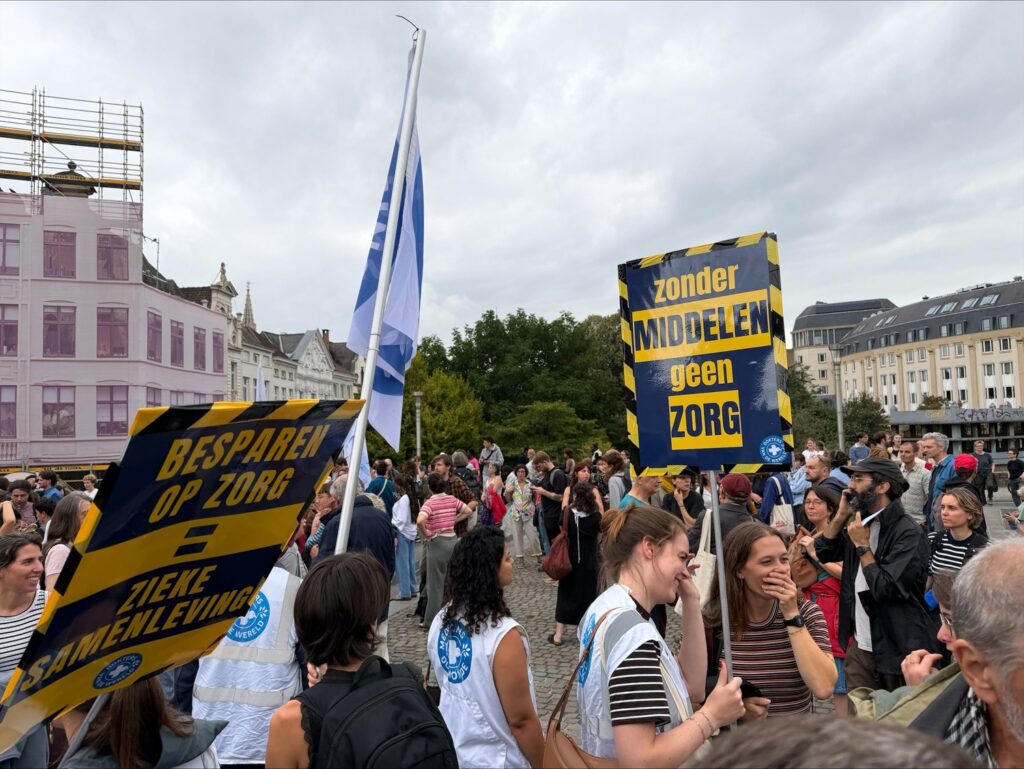
Various Brussels welfare groups and associations working with homeless people and refugees took to the streets of the capital on Tuesday evening to criticise a plan to cut 1,000 shelter places in the region.
According to the Brussels-based homeless group Samusocial, the number of applications for shelter in Brussels is rising sharply, particularly from families with children.
The latest figures from Samusocial show that in July alone, even before the cuts came into effect, more than 244 of the 299 families who applied for accommodation could no longer be helped due to the shelter network reaching capacity, Samusocial and its partner organisations stated on Tuesday.
The figures show an 83.5% increase in the number of families turned away compared with the previous month, accounting for more than four in five applications. Among them are 238 children, 65 babies under two years of age and 15 infants younger than six months.
“The removal of the 1,000 accommodation places will only exacerbate an already critical situation, leaving even more families, children and vulnerable people without a place to stay,” the organisations state.
According to Samusocial, BelRefugees and the other groups, there are currently 1,555 people on the waiting list for accommodation at the refugee organisation BelRefugees.
'People forced to wander the streets'
The closure of the BelRefugees Amran reception centre, which provided accommodation for 66 unaccompanied refugee minors and young adults, was also denounced during the Brussels protest on Tuesday.
“These people are forced to wander the streets, in metro stations and parks for weeks on end. But these are not dignified living conditions,” BelRefugees said, adding that it fears the emergence of new tent camps in Brussels.
The organisations are calling on the Federal Asylum and Migration Minister Anneleen Van Bossuyt (N-VA) to reverse the decision, which comes into effect on 1 September, given the potentially serious consequences for Brussels and human rights.
To reinforce their demand, the organisations launched a petition last week, which was signed more than six thousand times within a few days.
'Shockwaves' in the social sector
Samuel Cogolati, from the organisation Caritas, is also critical of the plan. “For us, cutting reception places means creating additional problems. More and more people are coming to us with serious mental health issues. We need a reasonable reception model.”
According to Cogolati, “people keep arriving” despite the cuts to reception places. “It is not by cutting reception places that we can put an end to misery, dictatorship or political persecution. We must make our voices heard; a large part of civil society is united on this. We must listen to what those on the ground have to say.”
Synova, Belgium’s independent trade union, also believes that Van Bossuyt’s decision “is sending shockwaves through the social sector”. They are also championing the cause of support workers, who face the threat of redundancy once the decision is implemented.
“This measure is brutal, irresponsible and socially unacceptable,” the union states. “In a context where needs remain high, this decision will only exacerbate an already very worrying situation.” The trade union emphasises that “human dignity must remain the top priority”.
Asylum and Migration Minister responds
In response to some of the concerns, Minister Van Bossuyt said she “fully understands the high pressure of homelessness that Brussels is facing”.
“The issue is very complex, but as Minister for Asylum and Migration, I am not responsible for providing shelter for the homeless. Until further notice, that remains the responsibility of the Brussels Region,” she said.
According to Van Bossuyt, the Federal Government is indeed taking responsibility for asylum seekers who are entitled to accommodation.
“We recognise that migration has a significant impact on Brussels and therefore wish to work together constructively," she said. "We are sitting down with the Brussels government to examine how we can better channel specific profiles towards the right support, and where possible, towards sustainable return. We are now continuing to work on clear agreements to reach a workable solution.”
