
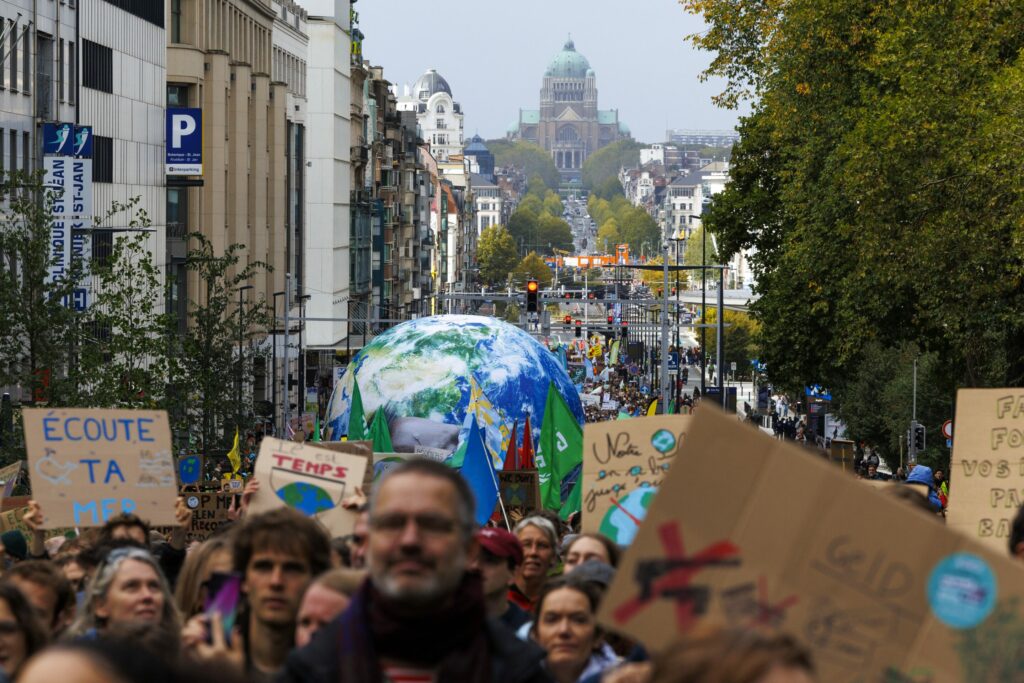
At least 1,000 people are expected to march through Brussels on Sunday in a protest aimed at pressuring the Belgian and European authorities over climate policy.
Artists, teachers, students, environmental activists, feminist campaigners, healthcare workers, farmers and other citizens are set to join what organisers describe as the first major demonstration of the new political season.
The protest, organised under the banner Rise for Convergence! Stand Up for Our Social and Environmental Rights!, seeks to unite a wide range of social movements around what campaigners say is the central issue of the climate crisis.
Related News
- 'Love isn't a finite resource': Meet the polyamorous Belgians of Brussels
- Why did I become Belgian?
- 30 reasons not to say goodbye to Belgium
“If the climate struggle is dead, all the others will be too,” said singer Getch, one of the protest’s initiators. He said the aim was to show that without a habitable planet, issues such as education, culture and social justice lose their meaning.
Kim Le Quang, co-founder of the citizen collective Rise for Climate Belgium, which is behind the event, said organisers wanted to increase pressure on both the Belgian government and the EU after what he called the disastrous handling of this summer’s heatwaves and widespread budget cuts.
Organisers say a “climate genocide” is under way, pointing to at least 2,000 excess deaths recorded in Belgium during the June heatwave and about 25,000 across Europe.
They accuse the authorities of denial, inaction and introducing pauses in environmental policy, and say the protest is intended to bring different causes together in the hope of creating a snowball effect.
The gathering is due to begin at 14:00 on Sunday 6 September at Place de l’Albertine in Brussels. The programme includes speeches on global warming, artistic performances and a citizens’ assembly.
Organisers said the current generation was the last that could still halt the continued rise in temperatures and prevent the Earth from becoming uninhabitable, with the risk of causing millions or even billions of deaths. They added that this was not inevitable, but a political choice.
