
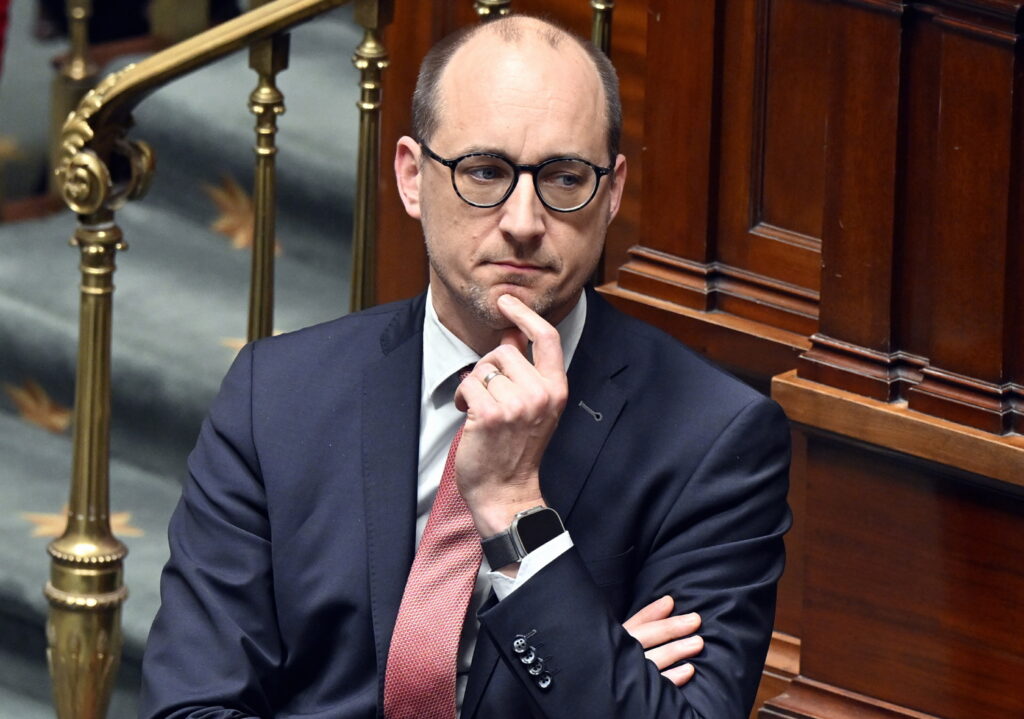
The gap between the Federal Government coalition's expected benefits from austerity measures and reality will be €2.9 billion adrift by 2029, according to an analysis by Federal Budget Minister Vincent Van Peteghem (CD&V).
Van Peteghem's analysis, revealed by La Libre Belgique, shows that despite heated debates over how to close Belgium's budget deficit, reality can sometimes turn out worse when savings or revenue fail to materialise.
"A budget is always a prediction, a forecast of expectations. You take measures, but reality catches up," Philippe Ledent, a senior economist at ING, told The Brussels Times
He gave the example of pension reforms which put a higher penalty on people retiring before 66. The measure was introduced to dissuade workers from retiring, but "it is not that easy to forecast" how people will react.
Reality catching up
According to Van Peteghem's analysis, these pension reforms are now expected to deliver €385 million less than initially forecast.
In some areas, such as reforms to unemployment and the labour market, meanwhile, the budget benefits are now forecast to be greater than expected.
According to La Libre Belgique, several reforms, notably the introduction of a cap on the duration of unemployment benefits, are now expected to deliver "an additional €316 million compared with the initially budgeted figure."
However, a recent Constitutional Court ruling that extends the cap for some unemployment benefit recipients may dent the figures.
The budget gaps identified in Van Peteghem's report are also partly due to areas where information on the impact of policy measures is incomplete, or where a budget envelope has been set but no action has yet been taken.
These include a savings envelope of €650 million for healthcare, and €500 million for the Regions.
Related News
- Why so many Brussels residents are moving to the Flemish periphery
- 'Communities change history': A snapshot of Brazil in Saint-Gilles
- Breathing in cancer: How Belgium's asbestos legacy still torments the country and the world
The Federal Planning Bureau recently highlighted the unsustainable debt trajectory in the French-speaking community, Walloon and Brussels-Capital Region.
Ledent reinforced the size of the challenge. He noted that budget reforms in the French-speaking education system are proving difficult amid protests.
These difficulties stem from the fact that so much of the budget is, in reality, teacher salaries; "it is not that easy to make economies elsewhere."
Identifying savings is the easy part; the reality is more difficult on the ground. A combination of resistance and often required reorganisation delivers an injection of reality once measures are taken.
