
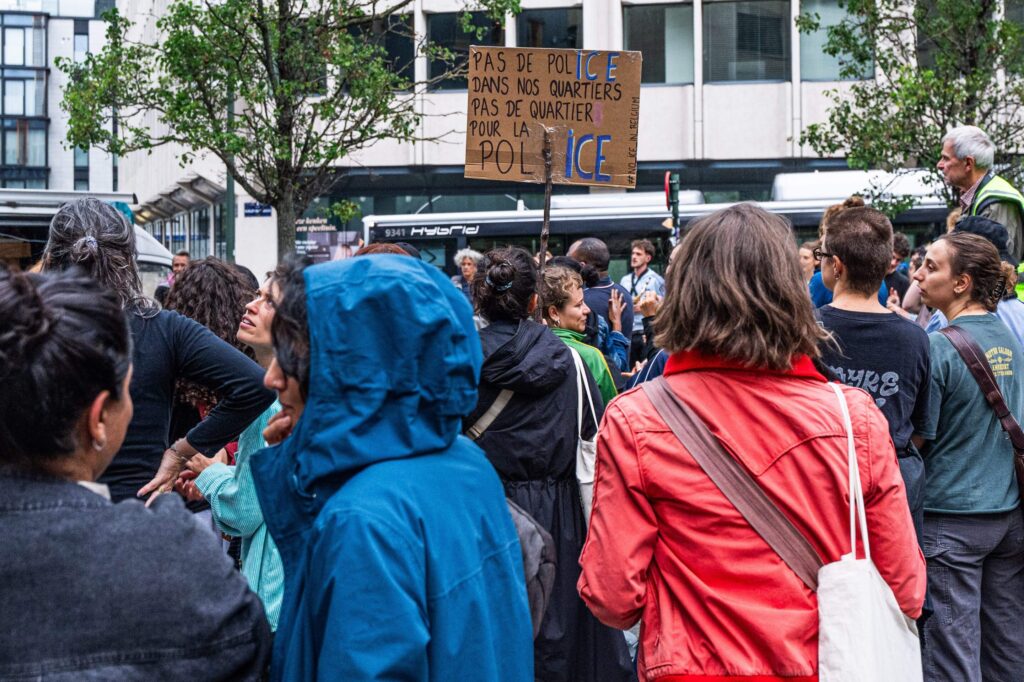
Could Belgium soon have its own ICE? Some critics think so, though supporters and opponents of a proposed deportation bill have drastically different beliefs about what the legislation would accomplish.
The proposed bill, drafted by Belgian Asylum and Migration Minister Anneleen Van Bossuyt (N-VA) and Justice Minister Annelies Verlinden (CD&V), would allow authorities to enter private residences under specified conditions to detain people subject to removal decisions.
Opponents of the bill have compared the legislation to US Immigration and Customs Enforcement (ICE), the American federal law enforcement agency responsible for immigration enforcement and removals. Since President Trump took office in January of 2025, ICE’s enforcement methods have been routinely criticised, particularly over the department's use of force.

ICE’s Enforcement and Removal Operations (ERO) officers knock on a door in New York City. Credit: Department of Homeland Security
The Ministers dispute this criticism
However, both ministers have repeatedly rejected the comparison, calling it a “distortion of the truth” and an “entirely inappropriate and disrespectful comparison.” In a press release sent to The Brussels Times by Minister Van Bossuyt's office, both politicians clarified what they believe the bill achieves.
“This is not a witch hunt against people who have been granted international protection, nor against people simply because they are staying in the country illegally,” Van Bossuyt stated. “That impression has been wrongly created in recent months. The law sets out clear conditions, and a home can only be entered with the authorisation of an investigating judge.”
Minister Verlinden added that the legislation is designed to help authorities carry out return orders while still protecting the fundamental rights of the individuals subject to them.
“A credible return policy requires not only clear rules, but also the ability to apply those rules effectively,” she said. “With this law, we ensure that these decisions regarding return are enforceable. We do so with respect for the rule of law, with regard for human dignity, and with clear safeguards.”
While speaking about the policy earlier this year with BRUZZ, Van Bossuyt acknowledged that the exact number of people who could be targeted under the bill is unknown. She, however, stressed that the bill's scope won't be expanded to target everyone living in Belgium illegally.
"I cannot put an exact number on that. But do you know who we are talking about? Rapists, drug offenders, terrorists. People who have raped minors. Not just someone peacefully participating in a demonstration. These are people in illegal residence about whom an investigating judge says they pose a danger to public order or national security."
Van Bossuyt added that she believes some critics of her migration policies have unfairly vilified her, arguing that some of the opposition refuses to listen to any differing opinion.
"I am often portrayed as inhuman, certainly on the French-speaking side," she said. "What bothers me is that for many activist groups, only their compass is the right one. And every other opinion is wrong. I am sorry, but I cannot formulate policy based on blind emotion. I have to make rational choices," she added.
Why critics see parallels with ICE
Most of the concerns being raised don’t suggest Belgium is creating an identical immigration agency to America. Instead, they worry that if the bill passes, it will bring Belgian immigration enforcement closer to practices associated with ICE.
The No ICE in Belgium collective argues that giving Belgian authorities the power to enter private homes to detain people facing deportation would be a significant step in that direction. A spokesperson for the collective explained why the organisation believes this.
“We believe there is a clear parallel between ICE—which carries out raids on people on American streets without meaningful judicial oversight—and the raids on private homes, also lacking proper judicial oversight, that are envisioned by the bill on home searches,” the spokesperson told The Brussels Times.
“This text represents another step toward a situation like the one in the United States,” they added. “While things will obviously never be exactly the same, the philosophy behind the text—and its concrete consequences for the people it targets—are clearly very similar to the approach that led to ICE being unleashed on American streets, with the dramatic consequences we are all aware of.”
On 4 November, ahead of the bill's final plenary vote, the organisation has planned gatherings outside of the town halls of 40 different Belgian municipalities to voice opposition to the legislation. The collective hopes these nationwide gatherings will persuade several MPs to rethink their vote.
The mobilisation aims to demonstrate the strong opposition to the proposed law across Belgium, and the collective hopes to persuade members of the governing majority to reconsider their stance, especially since some had previously pledged unconditional opposition to such legislation.
Several NGOs, including the Platform for International Cooperation on Undocumented Migrants (PICUM), CIRÉ and 11.11.11 have also publicly opposed the bill. Chiara Catelli, PICUM’s Advocacy Officer, outlined the NGOs concerns about the proposed measure to The Brussels Times.
“The Belgian government may call them ‘home visits’, but that doesn’t change what they are: police forcibly entering private homes and traumatising families and children to arrest people who simply lack the right papers,” Catelli said.
“We've all seen the devastating consequences of home raids in the US, where they fuel fear and violence and tear families apart. It's deeply alarming that an EU member state is now moving in the same direction," she said.
However, the No ICE in Belgium collective believes the government’s “refusal” to reconsider or withdraw the bill after hearing concerns from citizens, NGOs and other politicians is a deliberate political choice, not the result of a lack of information.
“The government is clearly and willfully ignoring the facts,” they said. “Many diverse voices have spoken out to explain why this law is both unnecessary and dangerous, yet the government has deliberately chosen not to listen. It would be a mistake to assume that the debate simply lacks facts—that the government is acting out of a lack of information.
“The facts are known; the governing parties are choosing to ignore them so they can pursue their inhumane policies,” they added. “This is a political choice on their part, and it must be treated as such.”
