
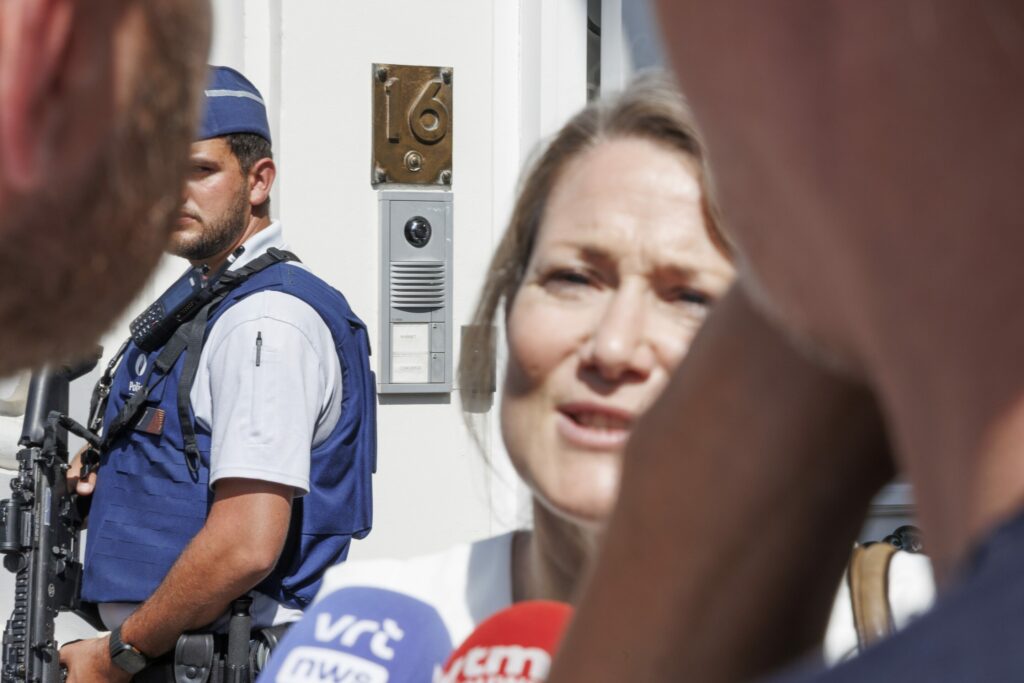
Belgium has all but approved a controversial new law as part of its increasingly strict migration policy that will allow the authorities to enter the homes of people without valid documents to deport them.
The Federal Government and the Asylum and Migration Minister Anneleen Van Bossuyt (N-VA) call the law "crucial" for a more robust asylum policy, but investigating judges, the police and NGOs are highly critical of it.
"Our authorities must be able to do their job. Anyone residing here illegally who poses a threat to public order or national security must be able to be removed from the country," Minister Van Bossuyt told The Brussels Times.
"This must no longer be a taboo subject when the safety of our people is at stake. It is unacceptable that 'illegal' criminals can still evade deportation today by hiding behind their front doors," she said. "With this draft bill, our authorities will no longer be powerless."
What is in the bill?
Van Bossuyt's office stressed that the criteria for these home searches are very clear.
This measure targets people residing in Belgium irregularly who systematically refuse to cooperate with their return and who pose a threat to public order or national security, for example due to involvement in extremism, radicalisation or serious criminal offences.
A home search only comes into consideration when less drastic measures have failed to result in the person leaving the country.
This can be done without that person's consent and, if necessary, by force. Currently, with the principle of the inviolability of the home firmly enshrined in the Belgian constitution, this is not possible without a search warrant.
"It is therefore a last resort, used only when all other options have been exhausted or are not feasible," the minister's office said.
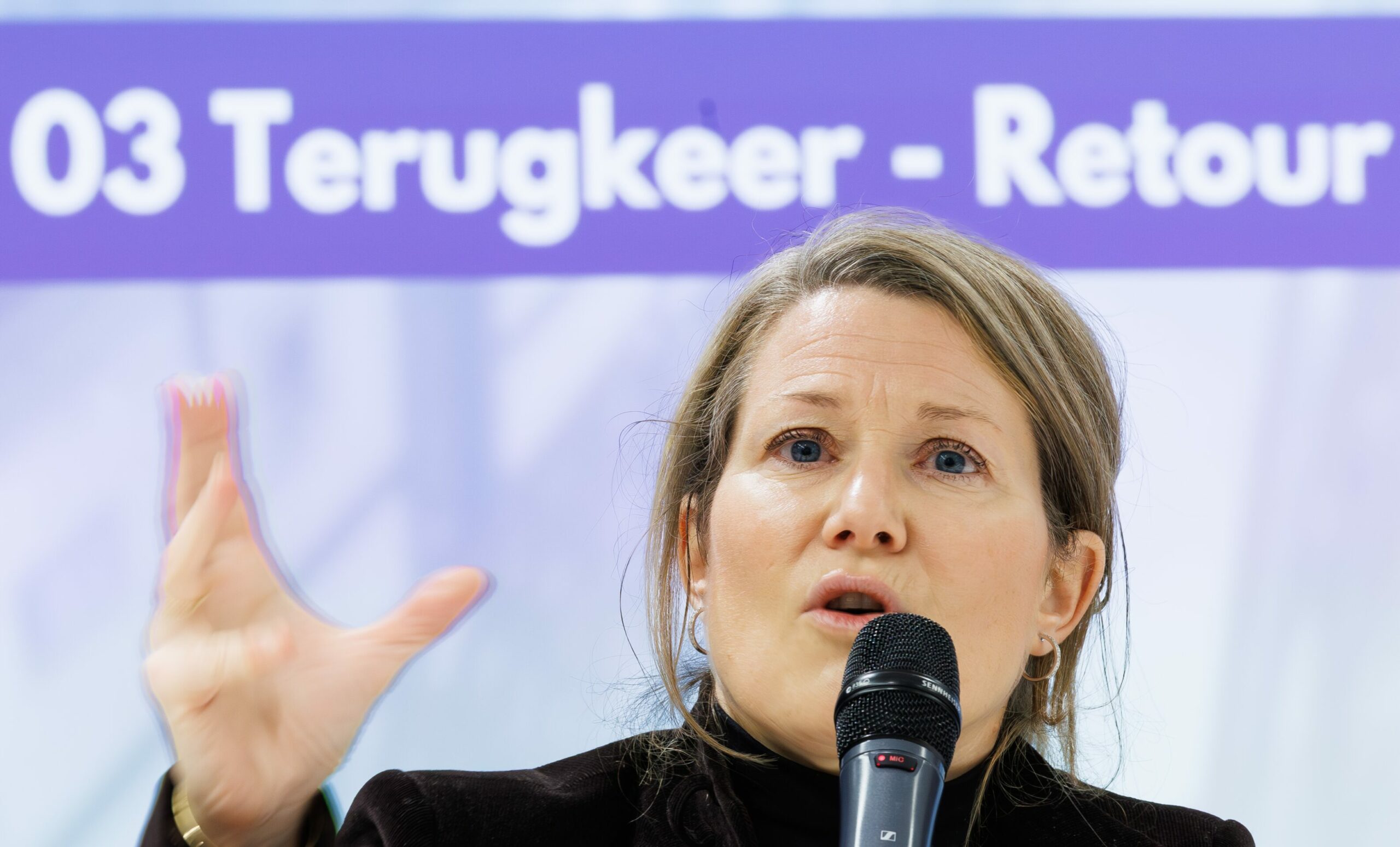
Minister of Asylum and Migration Anneleen Van Bossuyt (N-VA). Credit: Belga/Benoit Doppagne
Additionally, this measure always applies to individuals who are actually subject to removal; places are reserved for them in the federal detention centres.
Before such a home search is approved, an investigating judge must assess the proportionality of the measure – making this the only measure under the Immigration Act subject to prior review by the judiciary.
A home raid is only allowed to be carried out between the hours of 05:00 and 21:00.
Belgian ICE?
Critics consider home searches to be "disproportionate" and "in breach of fundamental rights".
They argue that the conditions laid down by the Federal Government are too vaguely worded, and claim that authorities have not given sufficient consideration to the security risks involved in a home search.
However, the strongest criticism comes from NGOs such as Vluchtelingenwerk Vlaanderen (Refugee Work Flanders) and 11.11.11. They recently shared a campaign video re-enacting a home raid on a family. The organisations refer to "raids" and "deportations".
They also called for action against "ICE in Europe" –referencing the violent raids by the United States' Immigration and Customs Enforcement (ICE) agency earlier this year.
However, Van Bossuyt reacted angrily to the video, which she labelled as "fake news" and "demagoguery".
"This draft bill is nowhere near an ICE, and it is therefore outrageous that activist organisations are deliberately spreading fake news about it," she said.
View this post on Instagram
Her office stressed that there will be no violent raids or round-ups of innocent families whose only 'offence' is that they are undocumented, as is often implied.
"This is about the apprehension and removal of individuals who are residing in the country illegally and who pose a threat to public order or national security, such as hate preachers, rapists or drug offenders," Van Bossuyt's office said.
They clarified that the police will knock on the door, and if the person in question does not open it, a locksmith may be called in. There is "no question" of violent raids involving the breaking down of doors.
"It is the police who carry out the operation. No special immigration police force or Belgian 'ICE' will be established," she stressed.
This draft bill also addresses situations where, for example, a person who is residing in Belgium irregularly commits an offence, is convicted of it and is serving their sentence in prison.
If the agreement on return is only reached once that person is back on the streets, they can no longer be arrested because no criminal investigation is ongoing at that point. With the new bill, that will change.
"Anyone who turns this into an ICE story is distorting the truth. This is about protecting our citizens from dangerous individuals," Van Bossuyt said, stressing that the bill has "passed all judicial scrutiny".
Broad criticism
However, the criticism is much broader than only NGOs. In the Federal Parliament, investigating judges, lawyers, the police and the Myria migration centre came to provide clarification on the draft bill.
They were unanimously critical of the bill and highlighted fundamental shortcomings, such as insufficient safeguards, overly broad and arbitrary application, and potential conflicts with European rules such as the principle of proportionality.
Investigating judges said that there is no clear definition of what constitutes a "threat to public order or national security". Additionally, they said, searches of such individuals are already being ordered under current legislation – rendering a new law superfluous.
Meanwhile, the federal migration centre Myria is concerned about the fate of vulnerable individuals and children. "Neither vulnerability nor the presence of minors constitutes an obstacle to entering a home. While the draft states that the separation of family members is to be avoided, it is not prohibited."
The police – who will be required to carry out the home searches, together with officials from the Immigration Office – have many questions about the bill as well.
According to them, the law is too vague, which could cause many problems in practice. "In an emergency, one cannot expect the police to interpret the law and fill in the gaps themselves," they said.

Police action against illegal migration, on Monday 07 July 2025 in Mons. Credit: Belga/Eric Lalmand
Meanwhile, the Belgian Data Protection Authority (BDPA), for its part, has warned against the unlawful processing of personal data.
The socialist union ABVV-FGTB also published strong criticism of the bill. The "vague description" of the threat to public order is "a step towards a dangerous slippery slope of arbitrariness," said union chair Bert Engelaar. "Arbitrariness that could affect us all and undermine our rule of law and democracy."
The union stressed that the draft bill "trivialises violent infringements of privacy" and leads to the further criminalisation of newcomers, as well as those who show them solidarity and support.
According to Van Bossuyt, however, the terms "public order" and "national security" are very common in Belgian and European immigration legislation, with the Criminal Code and the Civil Code containing dozens of offences that undermine public order.
Last year, the Council of State once again confirmed the criticism that had already been voiced in 2020, concerning the disproportionate infringements of fundamental rights.
They reiterated the inviolability of the home, the right to privacy and to family life, and the right to a fair trial. The Council pointed to insufficient protection of children and third parties, a lack of effective ex post facto oversight, and the risk of covert searches without the safeguards that apply in criminal proceedings.
When will it come into force?
The 'home entry' bill has already passed the Council of Ministers and has now also been approved by the Committee on Home Affairs, Security, Migration and Administrative Affairs.
Considering that the draft has already been approved by the government, it will almost certainly also be approved by Parliament. As the governing parties together hold a majority in parliament, the majority is as good as guaranteed.
However, there is some unease amongst the governing parties – MR, Vooruit and Les Engagés – regarding the proposal and the strong criticism it has attracted.
MPs from those parties emphasised in parliament that changes to the bill are still possible, although these mainly concern details.
The second reading and final approval are not expected until the autumn.
