

Amazon workers told MEPs that the company’s opaque algorithms continuously raise performance expectations, according to a report from the European Parliament presented by MEP Li Andersson (Left Alliance), though Amazon management denies monitoring individual employees.
The report showed a stark difference between how Amazon represented the working conditions in its fulfilment centres and the experiences reported by workers' representatives. It also described demanding working conditions observed by the delegation and the impact automation has by increasing the pace of work.
At the event, Andersson argued for stronger EU rules on algorithmic management and the use of workplace AI. "The faster you perform, the higher the performance target will develop. So it's kind of like the faster you work, you are rewarded with having to work even faster," she told the Brussels Times.
Andersson presented the report at the “Whose rules – Amazon’s or Europe’s” symposium last Thursday, a symposium co-hosted by the union federation group UNI Europa and the political NGO Friedrich-Ebert-Stiftung, which examined Amazon's growing influence in the European economy and the impact this has on workers and public institutions.
The EMPL Mission Report
The report was written by the European Parliament's Committee on Employment and Social Affairs (EMPL) and described their fact-finding mission to two Amazon warehouses in Germany and one in Poland at the end of October. The mission consisted of a delegation of seven members of the EMPL led by Andersonn.
The mission report was sent to the European Parliament earlier in November, and concluded that there was a stark divergence between Amazon management's account of working conditions and the conditions as described by workers and union leaders, who raised concerns about algorithmic management and surveillance, and rising productivity targets.
"Direct observations by delegation members confirmed demanding physical working conditions and an intensified pace of work linked to work automation," the mission report concluded, adding that the evidence and testimonies gathered will directly inform the upcoming EU legislation.
The report comes ahead of a new package of EU labour legislation by the European Parliament. On 15 December, the European Commission is expected to release the Quality Jobs Act, which will address topics related to quality of working life, including algorithmic management and AI in the workplace.
According to Andersson, these conditions demonstrate the need for EU-wide rules governing AI and algorithmic management in the workplace.
"We don't have to be anti-technology, but we need to think about how it's done," Andersson said.
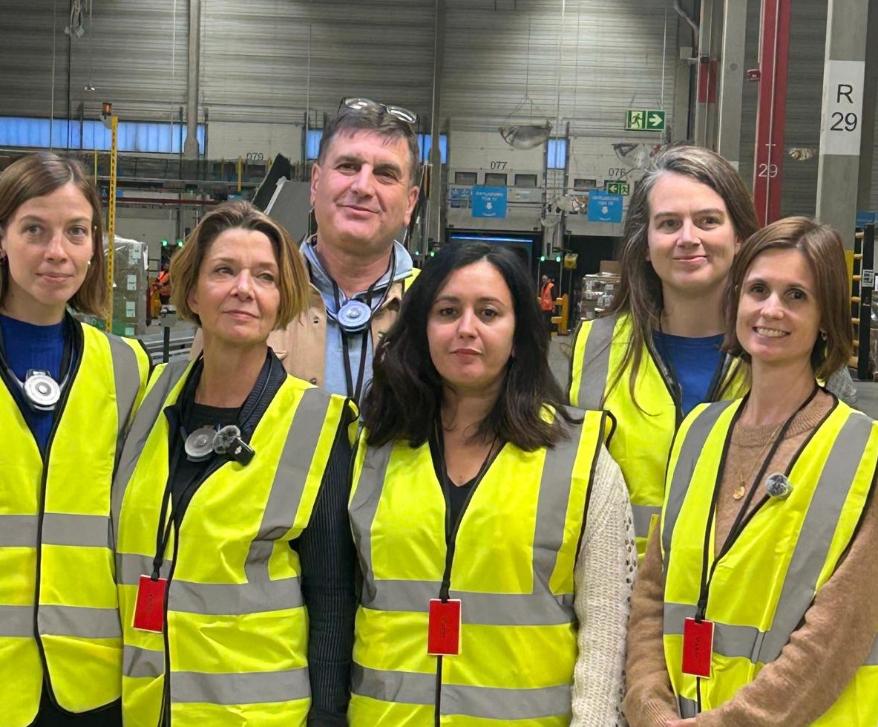
The EMPL fact-finding mission. MEP Li Andersson is on the left. Credit European Parliament
Amazon urges EU to consider the full picture
While Amazon was glad to welcome MEPs to its facilities, the company told The Brussels Times that it's a common misconception that it doesn't allow its employees to join a union. "We are proud of the working conditions, pay and benefits we provide to our employees across Europe," an Amazon spokesperson said.
"We would encourage policymakers to consider the full picture: Amazon directly employs hundreds of thousands of people across the EU, and we engage constructively with works councils and employee representatives every day," they said.
"We are confident that our workplaces are modern, safe, and offer competitive pay and benefits from day one. We welcome any good-faith scrutiny of our operations and are always happy to engage directly with elected officials."
In December 2023, a scheduled parliamentary mission to visit Amazon fulfilment centres in Poland and Germany never took place. Previously, in May 2021 and January 2024, Amazon declined two invitations from the European Parliament's Employment Committee to attend hearings on working conditions.
In 2024, after Amazon failed to send senior executives to hearings on workplace conditions, the European Parliament withdrew the access badges of Amazon lobbyists "specifically because of this unwillingness to engage with democratically elected officials," Andersson said.
The European Parliament reinstated their access in May 2026.
