
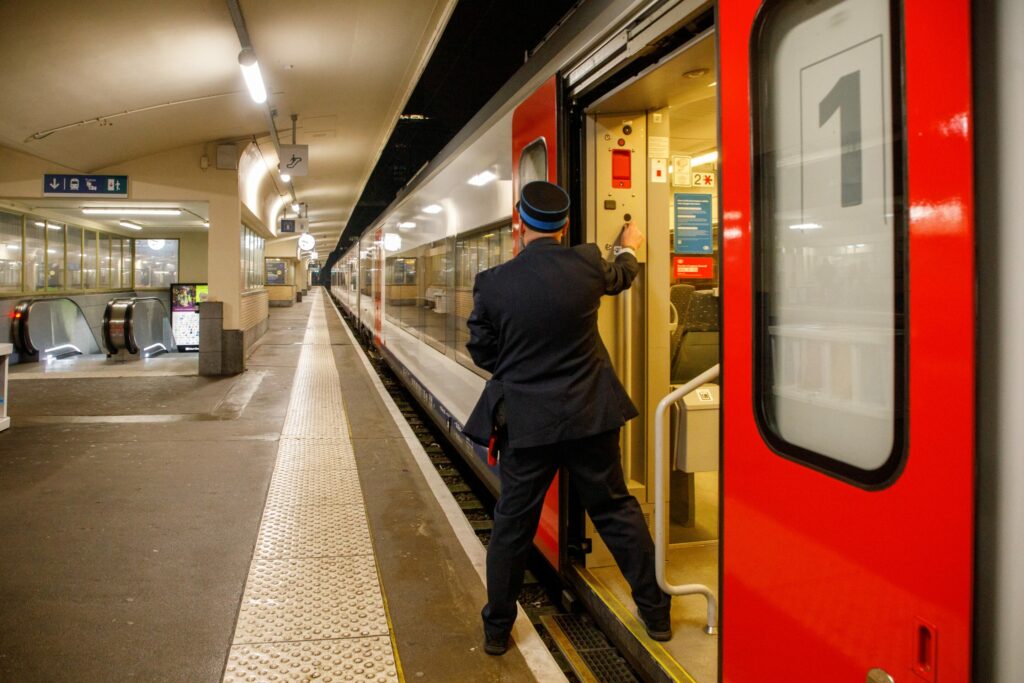
Belgium is a complex country. Nowhere is this more evident than in Brussels' metro and train stations, where announcements are made alternately in Dutch and French, depending on the location, the year - or even the native language of the speaker.
Attention, voie 2, le train à destination de Liège arrive à la voie 2. Aandacht spoor 2, de trein met bestemming Luik komt aan op spoor 2.
On a grey afternoon, passengers waiting for the Intercity train to Liège may not realise that the announcement they hear follows a carefully balanced set of rules. Belgium is a predominantly bilingual country where French and Dutch are considered equal under language legislation.
This must be strictly respected in public services, including trains and buses. To make that work in practice, the public transport companies in Brussels, the SNCB (railways) and STIB (metro and bus), have devised some surprisingly creative solutions.
How it works in train stations
In train stations, this works as follows: at Brussels-South, the message is first delivered in French, then in Dutch. At Brussels-North, it is the other way around. At Brussels Central, which is located between the two, a creative solution has been found.
In even-numbered years, the voice starts the announcements in Dutch, and in odd-numbered years in French. This is "a system that has been in use for decades", Dimitri Temmerman tells The Brussels Times, spokesperson for SNCB. "You have to start in one language first, and this way Dutch and French are used equally."
How it works elsewhere on the rail network
On board the train, announcements are made in the language of the region where the train is located. When entering Brussels, passengers hear a voice addressing them in both Dutch and French. The train conductor's mother tongue takes priority in that case.
The same applies in 'facilities municipalities' - places where both languages must be provided by law. In that case, the language of the region in which the train is located is used first. On trains to and from Brussels Airport, located in the Flemish Region, announcements are made in Dutch, French, German and English.
There is only one exception, says Dimitri De Temmerman: "A train conductor may deviate from this in the event of a safety situation, for example in the event of a fire. In that case, he may supplement the planned announcement with communication in a language that is understood by the other passengers."
Language use on the STIB network
The Brussels public transport company STIB follows a similarly intricate system. ‘
"If there is an interruption on the network, passengers will hear the announcement in an even-numbered year in this order: Dutch, French, followed by English," spokesperson Laurent Vermeersch explains to The Brussels Times. "In an odd-numbered year, French takes precedence over Dutch, followed by English."
STIB also ensures that Dutch and French are always treated equally at stops and stations. "Every stop or station has a number at STIB. If that number is odd, you will hear and see Dutch first. At a stop with an even number, it is the other way around.’
Everything that the company writes in its vehicles or stations follows the same principle: Dutch is printed in italics, whereas French is not, for the simple reason that this allows people who are not fluent in both languages to distinguish between them. In short, Brussels public transport carefully balances Dutch and French, with ingenious rules designed to ensure fairness without confusing passengers.
Language rules are not to be taken lightly
If this all sounds rather elaborate, that’s because language rules are not taken lightly in Belgium. This was evident at the end of last year, when an SNCB conductor in Vilvoorde greeted passengers with a friendly ‘goededag, bonjour’, only to find himself in hot water. One customer thought his use of language was unacceptable. The train was still in Flemish Brabant, so passengers had to be addressed in Dutch.
A few kilometres further on, it was possible to speak French, but not there. The customer lodged a complaint and was proved right by the Permanent Commission for Language Supervision, the institution that monitors compliance with language legislation in Belgium.
Train conductors must address passengers in Dutch as long as the train is travelling in a Dutch-speaking area. Only when a passenger addresses the conductor in French may the conductor respond in French. According to the language commission, the complaint was justified, especially since, according to the complaining customer, the conductor had also said ‘s'il vous plaît’ a few times.
The case caused a stir, but the conductor faced limited consequences. The Permanent Commission for Language Supervision only gives advice to the SNCB and to the person who filed the complaint. It is mainly intended as a warning to the SNCB to properly apply the language rules on the train.
The railway company complied with the decision, it said, but is calling for more flexible, customer-friendly language rules.
"There will be no further legal action," says Temmerman. "Dismissing the conductor is also not an option here. After all, we ask every train conductor to be flexible and adaptable when it comes to language legislation, so that our train conductors can focus on their important job, which is what he did."
A matter for the state
There is a historical reason why language is a matter of state in Belgium. In the past, there were long-standing political and social tensions between Dutch and French speakers.
For a long time, especially when Belgium was first established, French speakers were politically and economically dominant. French was the official language in education and public administration, which made many Dutch speakers feel disadvantaged.
These tensions – the language struggle – resulted in, among other things, the complex language legislation that was ratified in 1966. It also led to various state reforms, with Flanders and Wallonia becoming increasingly autonomous.
Next time you hear an announcement in Brussels, consider the decades of history and rules behind each word — it isn’t just communication; it’s a carefully orchestrated dance.
