
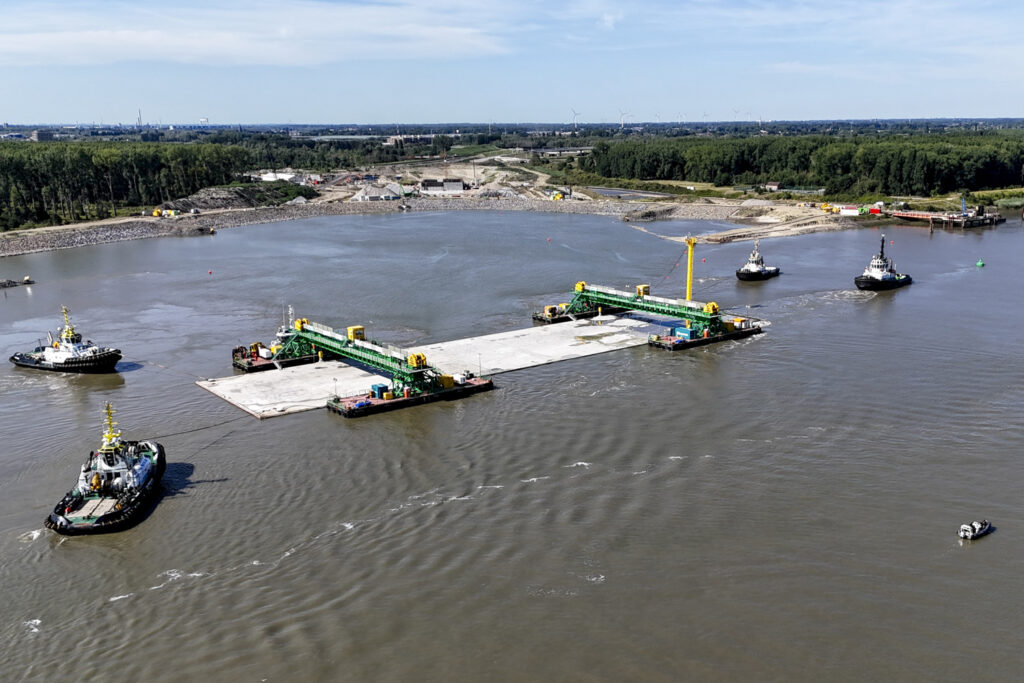
The fifth of eight elements for the future tunnel under the River Scheldt has been successfully submerged into the riverbed, announced Lantis, the Oosterweel project’s contractor, on Saturday.
The tunnel is being constructed using prefabricated concrete structures. These elements are first assembled in a dock in Zeebrugge, then transported by sea to the Doeldok in the Port of Antwerp, where they are submerged one by one into the Scheldt’s bed.
This delicate operation is complicated by tidal movements in the river. Submersion can only occur at low tide and under suitable weather conditions.
A previous attempt to submerge one of the elements failed due to an unexpected accumulation of sand, which required the tunnel component to be lifted back up.
The Scheldt tunnel is a key component of the Oosterweel connection and a crucial step in completing Antwerp’s ring road. If work continues as planned, all eight elements of the tunnel will be installed by the end of the year.
Afterwards, the tunnel will be finished and connected to the road network. Cyclists are expected to be able to use it by 2028, with automotive traffic following in 2030.
Once completed, it will be the third tunnel crossing under the Scheldt for road traffic in Antwerp, complementing the Kennedy Tunnel and the Waasland Tunnel.
