
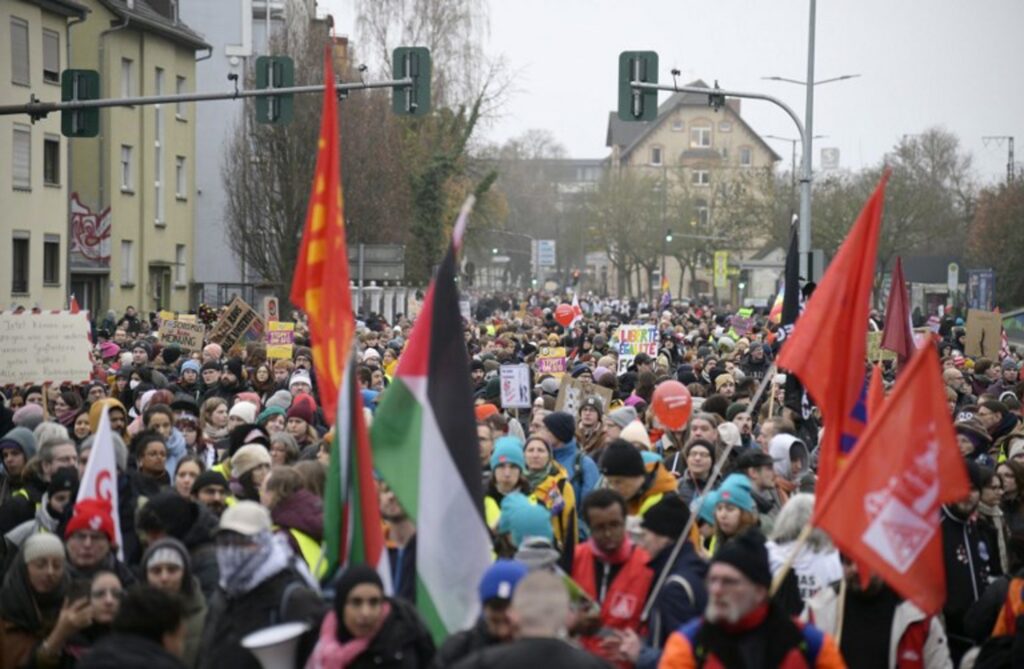
Protests against the far-right forced the Alternative for Germany (AfD) party to delay its congress on Saturday aimed at forming a new youth organisation.
The congress was scheduled to start at 10:00 in Giessen, near Frankfurt, but AfD members struggled to reach the venue due to street blockades by critics of the anti-migrant and pro-Russian party.
A party spokesman, Michael Pfalzgraf, confirmed to AFP that the delay was “a result of the protests.”
More than 15,000 people, according to an anti-AfD coalition, and “several thousand,” according to police, gathered in Giessen early Saturday morning.
Protesters carried rainbow flags and banners with slogans such as “fight fascism,” while some set off smoke flares. The demonstrations were met with heightened police presence.
The AfD, Germany’s second-largest party after gaining significant ground in last February’s federal elections, is preparing for key regional elections in 2026, focusing on consolidating support in its strongholds in the East.
Earlier this year, the party was forced to dissolve its previous youth wing, “Junge Alternative” (Young Alternative), which faced a potential ban for promoting xenophobic ideas and being embroiled in scandals, including racist chants and paramilitary-style training events.
Around one hundred participants gathered to establish the structure of the new youth organisation, including electing its leaders, drafting statutes, and deciding on its name and logo. The party had anticipated drawing up to one thousand attendees.
The AfD leadership intends for the new youth wing to be more tightly controlled while maintaining ties to some of its more radical elements.
While the party hopes to broaden its appeal in Germany’s western regions, where far-right ideologies face greater resistance, it continues to rely heavily on its eastern base.
Although Germany has historically resisted the political rise of far-right movements due to its Nazi past, the 2015 migration crisis, Islamist attacks, and crimes committed by foreigners have contributed to the AfD’s increasing popularity.
