

At the high-altitude training camp in Iten, Kenya, life for extreme athlete Matthieu Bonne seems a breeze. On a normal day, he gets up around 9am after a good 10 hours’ sleep, consumes the first of five or six meals and does a couple of sessions of running between naps and maybe a massage.
But this normal day, it should be noted, still sees him clock up around 30 to 40km. And then, of course, some days he goes big. “Two days ago, I did a double marathon run,” he says. “So, 84.4km at four-and-a-half minutes per kilometre pace, which is very, very fast.” It’s not for nothing that the camp, which has been used by a host of glittering Olympians, is known as the Home of Champions.
Bonne, a 31-year-old former lifeguard from Ostend, is the record-holder for the farthest distance run over 48 hours and over six days. At the camp, he is now focusing on increasing his speed ahead of an attempt in France to also hold the record over 24 hours. The world record is currently held by Lithuanian Aleksandr Sorokin, who ran 319.6km in a single day in 2022.
Now a professional athlete, Bonne is no stranger to the task, having broken the Belgian record over 24 hours as part of his training for the longer six-day challenge. It seems like he was born to run. “My body is very strong, I must admit. I have only had a few injuries over these past seven or eight years, which is extraordinary because I push it to the limit…My body is really made for this.”
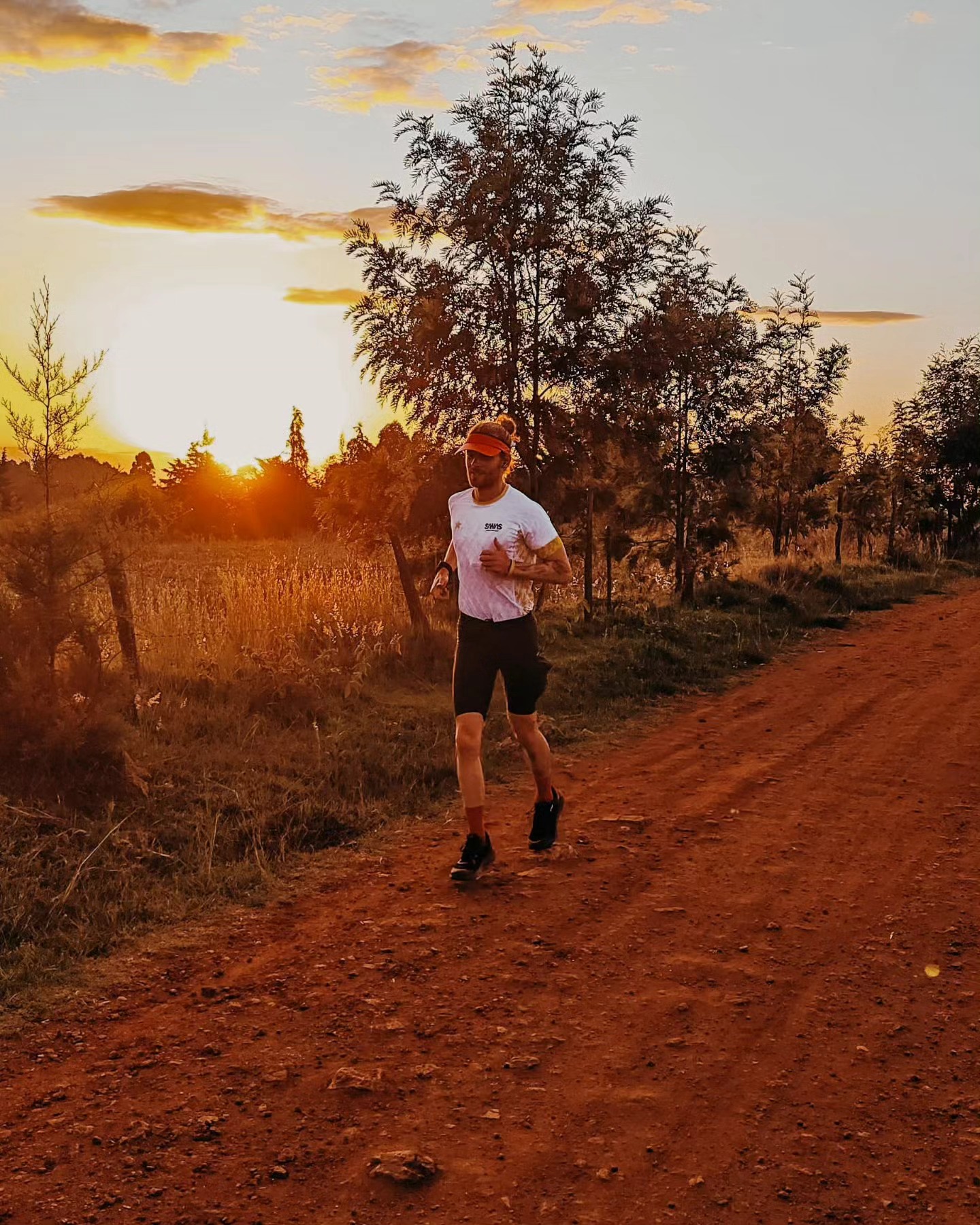
Matthieu Bonne
Bonne was also born to swim and will switch focus in the new year. In 2023, he set a world record for open water swimming in the Gulf of Corinth, totting up 131km in 60 hours, 55 minutes and 43 seconds. And that same year, he also cycled a record 3,619.72km in seven days.
The records could keep falling: he says he can stay competing at the same level for another 15 years. When asked whether starting a family would change his priorities, he becomes a little taciturn. “We'll see. I don’t really think about the future much. I just live in the moment.” Although he comes across as very open and personable, he describes himself as not especially sociable, saying he has just a small circle of like-minded friends.
Bonne also comes over as quite modest, despite dismissing the Marathon des Sables as “nothing”. This is, after all, the gruelling seven-day, 250km challenge in the Sahara Desert that many amateur athletes aspire to complete – and that was his first main endurance challenge seven years ago. “I would run the distance in one day now,” he says. “It was a huge challenge for me, but now, so many years later, I'm just a different person and a different athlete who's done so many things already.”
Asked to name a highlight, he equivocates but eventually offers up an insight into the appeal of life at the extremes. “If I have to choose one, it would be the eight full-distance triathlons I did on the eight Canary Islands in eight days; and after every triathlon I took a sailing boat over the Atlantic. It was amazing! Not only because it was a hard physical challenge, but also because it was a massive adventure. And I'm an adventurer at heart. I'm not only an athlete; I like to explore new things.”
Marathon woman
Many of us start the year with ambitions to be more active, but few, if any, begin with the intention of running a full marathon every day. Yet that was the plan of 55-year-old Flemish ultrarunner Hilde Dosogne at the dawn of 2024, knowing that the Guinness World Record of 150 consecutive days of marathoning for a female runner was within her reach.
She had been building to this point, but slowly. Dosogne only completed her first marathon 12 years ago. After having had four children, she says she and her husband were able to pursue their mutual interest in long-distance running. However, her first attempt at 26.2 miles – or 42.125km – fell short of expectations, missing her goal of completing the distance in under four hours.
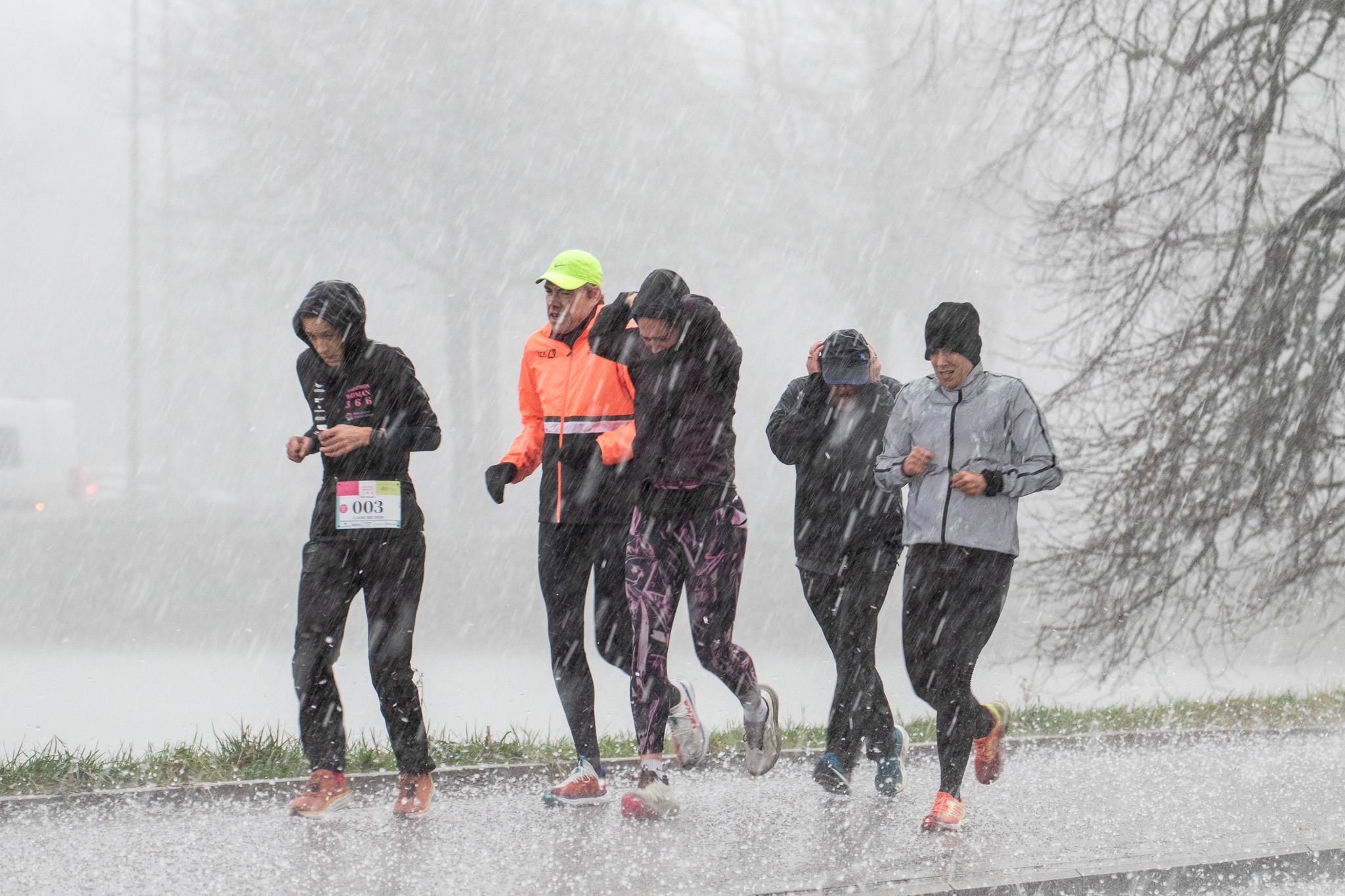
Running in a hailstorm
Undeterred, she continued training, eventually easing past her target and then setting new goals. She says she was spurred by an ambitious nature and “the need to prove that I’m strong.” Last year, she would complete each of her 366 marathons – mostly at the Watersportbaan lake in Ghent, but some closer to her hometown of Lochristi – in around four hours.
In fact, the target had simply been to beat the record, but the press (ahem, them) announced that she would keep going for the whole year. Twenty-four pairs of running shoes later – not to mention enduring bouts of flu and even Covid – she battled on to year-end, accompanied in the final stretch by 600 supportive runners, including Belgian Olympic medallist marathon runner Bashir Abdi. Why not continue to beat the men’s record? “Because I had been injured since Christmas, I really had to push myself to run until the 31st of December.”
Indeed, Dosogne does not shy away from describing the whole experience as an ordeal and would strongly advise anyone against attempting a similar feat, although she did raise €65,000 for BIG against breast cancer, a network of academic research groups. And moreover, she can now boast of being a Guiness World Record holder – the task of daily collecting GPS data and uploading the proof to be verified adding to her extraordinary achievement, and all while continuing to work part-time as a regulatory affairs manager for a chemical company.
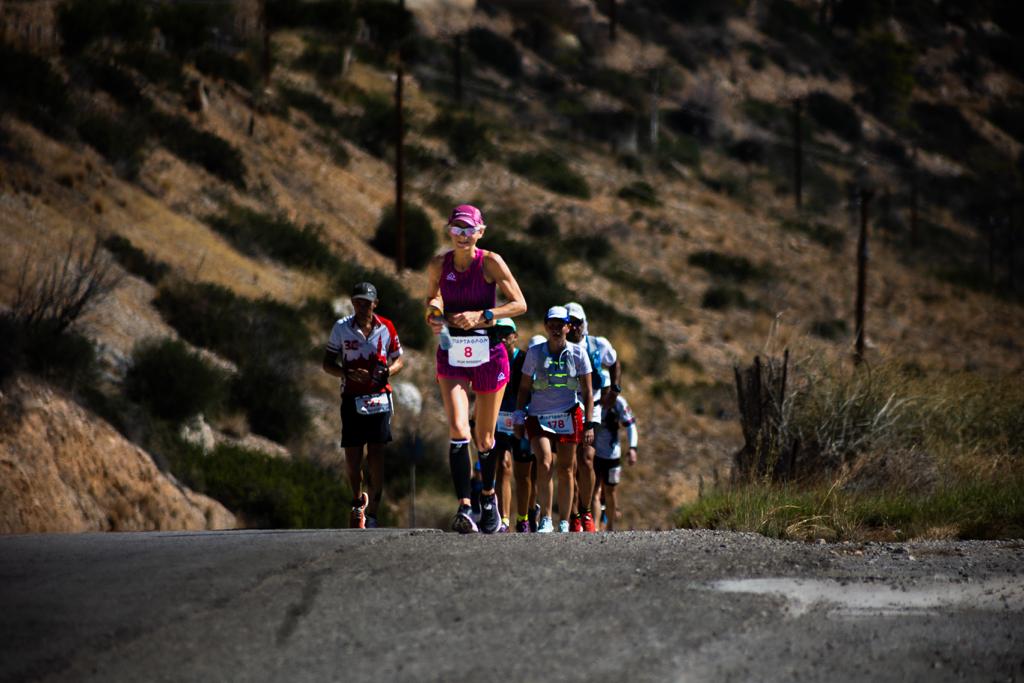
Hilde Dosogne in the 2022 Spartathlon
Her endurance athletic journey is not over quite yet, despite admitting that she has achieved her bucket-list goals: one of which was completing the Marathon des Sables across the sweltering Moroccan sands, after being inspired to take part by a documentary by filmmaker Tom Waes. In May, she became the national champion in a 24-hour race around the athletics track in Nekkerspoel, Mechelen, with a winning distance of 211.520km – running more than 15km farther than the second-place athlete despite being nearly 20 years older.
She also trained to compete again in September in Spartathlon, a 246km race from Athens to Sparta that traces the route that the messenger Pheidippides is said by Herodotus to have covered in 36 hours in 490 BC during the First Persian War. In Plutarch’s retelling of the legend, the messenger famously falls down dead on delivering the news of victory. While Dosogne acknowledges that injuries could one day put an end to her journey, for now it seems there’s no letting up.
Milestone maker
If Marathon Man to you is Dustin Hoffman in the classic 1970s thriller, then meet the Belgian extreme athlete known as ‘marathon man’ – and with good reason. In 2010, Stefaan Engels became the first man to run a marathon a day for a year.
“I doubted I would make it. Almost no one believed in me. There were dozens of moments when things could have gone wrong – and yet I overcame them all,” he says.
In fact, things did go wrong, namely an injury on day 18 in the high-altitude conditions of Mexico that he had chosen for the attempt. The injury, he says, was due to the snow and ice. “I continued in a wheelchair, and after 36 days, I started over with the count at zero.”

Ultra runner Stefaan Engels
His achievement is all the more remarkable given his age of 49 at the time and that he has suffered from asthma since he was a child. “My asthma was and always has been a limitation, but thanks to better medication, I manage. Without asthma, I might have built a professional sports career.”
Now, aged 64, Engels is currently preparing, “purely for fun and health”, to run his next marathon in March in Barcelona. It will be marathon number 1003.
So how did it all begin? “At 25, I started running 5km, which was considered unusual back then, just jogging in the street. But I got the hang of it, wanted more, and soon dreamed of a marathon. A year later, I realised that dream in Rotterdam with a time of three hours and 16 minutes.”
Running, sports and triathlons would shape his life. “I've been able to make a career of it: as an athlete, organiser of events like the Ghent Marathon and Ghent 10 Mile, and as a driving force behind countless sports initiatives. For 15 years, I've been coaching marathon runners and giving lectures to companies about the importance of pushing boundaries and investing in health to age gracefully.”
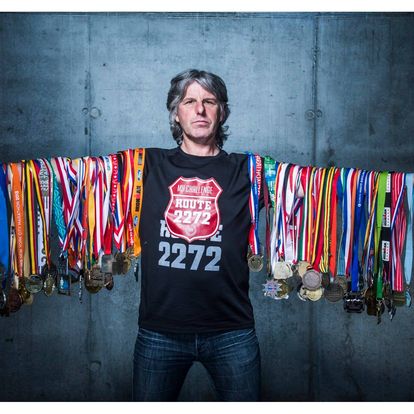
Ultra runner Stefaan Engels and his medal collection
Engels highlights his record 20 Ironman triathlons in one year, 2008 as a notable achievement (that’s a 3.9km swim followed by a 180.2km bicycle ride and a full 42km marathon). But he accepts that records are meant to be broken, and indeed his marathon-year milestone has been subsequently surpassed. “But I was always the first,” he says. “Like with the moon landing, everyone still remembers who that was.”
At the start of the new century, only a few courageous diehards were taking on extreme challenges, but Engels says, “more and more people are now being inspired to go further, harder and longer. I sincerely wish them the best of luck!”
As for Engels now, he just wants to encourage others. “I've dedicated myself wholeheartedly to inspiring others to push their boundaries, step outside their comfort zone and believe in themselves,” he says.
