
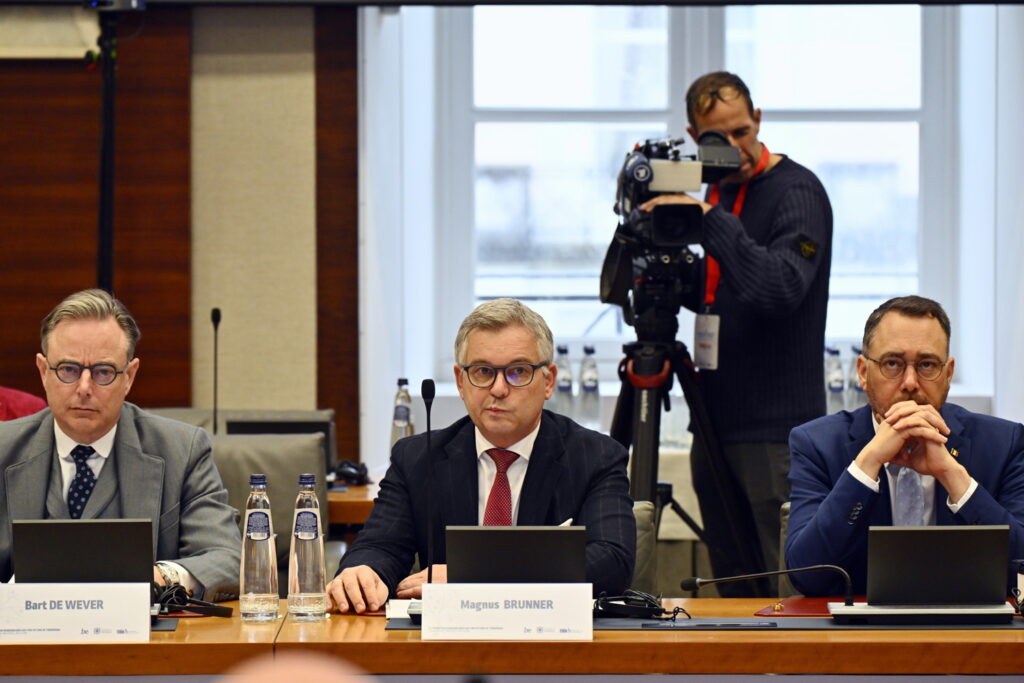
It is the government's responsibility not to repeat past mistakes regarding the follow-up of victims of terrorism. Prime Minister Bart De Wever said this on Wednesday during the European memorial ceremony for victims of terrorism in Brussels.
"Today, we commemorate people whose lives were taken or completely shattered," De Wever said at the start of his speech. He referred specifically to the 32 victims who were killed on 22 March 2016 in Maalbeek and at Brussels Airport and the 340 wounded. "A total of 700 victims were officially recognised. In a small country like Belgium, that means it hits close to home for everyone," he said.
He also admitted that governments often respond in a "highly predictable manner" after a terrorist attack. They provide medical care, take security measures and ensure that daily life can resume as quickly as possible. "For many victims, however, this is when the most difficult time begins," said De Wever.
An attack lasts only seconds, but its consequences can be felt for a lifetime. "Governments have not always taken this sufficiently into account. For a long time, they thought that after an attack, their main role was to be crisis managers and provide legal follow-up. And my country has had to learn this the hard way," said the prime minister.
In the years following the attacks, there was a great deal of anger among victims and their families about the lack of support and long-term care, according to De Wever. "The commission of inquiry set up after the attacks taught us important lessons about security and crisis management, but also about caring for the victims. And those lessons remain essential. Because an attack does not end when the news dies down or when commemorations are organised. For victims, it never really ends," he said.
"As prime minister, I cannot promise that there will never be terrorism again; no one can promise that. But I can say that we will do everything we can to avoid repeating the mistakes we made in the past. That is a responsibility I take very seriously," concluded De Wever, before giving the floor to victims of attacks in Zaventem, Nice, New York and Baghdad.
After the ceremony, De Wever took the time to speak with victims of the attacks, who told him what they expect from the state. The Prime Minister told Belga afterwards that he would be holding a meeting at his office on Friday to discuss what concrete measures could be taken. He hopes to present a concrete plan to the victims" associations within ten days, on the tenth anniversary of the attacks in Belgium, in order to offer better support.
The Prime Minister also indicated that Belgium is better prepared for terrorist attacks today, even though a new attack can never be ruled out. "Security policy has been strengthened and it is no coincidence that during this legislative period the security departments do not have to make savings and are even being strengthened in budgetary terms," he said.
Foreign Minister Maxime Prévot also attended the ceremony, as did European Commissioner for Home Affairs Magnus Brunner, on behalf of the European Commission. "The attacks in Brussels struck at the heart of the European Union (...) We were the target; they attacked our openness, our way of life, our diversity," he said. He also warned that terrorism still exists today, "low-tech, on a small scale, but fuelled by a radical narrative that is often spread online and feeds on the geopolitical tensions that are increasing today". He referred to Monday's explosion at a synagogue in Liège as proof that "such chains" still exist today.
The European commemoration ceremony takes place every year on 11 March, the anniversary of the attacks in Madrid that killed more than 190 people. Due to the tenth anniversary of the Belgian attacks, the federal government took on the organisation. This year also marks the tenth anniversary of the attack in Nice on the French national holiday and the attack on the Christmas market in Berlin.
