
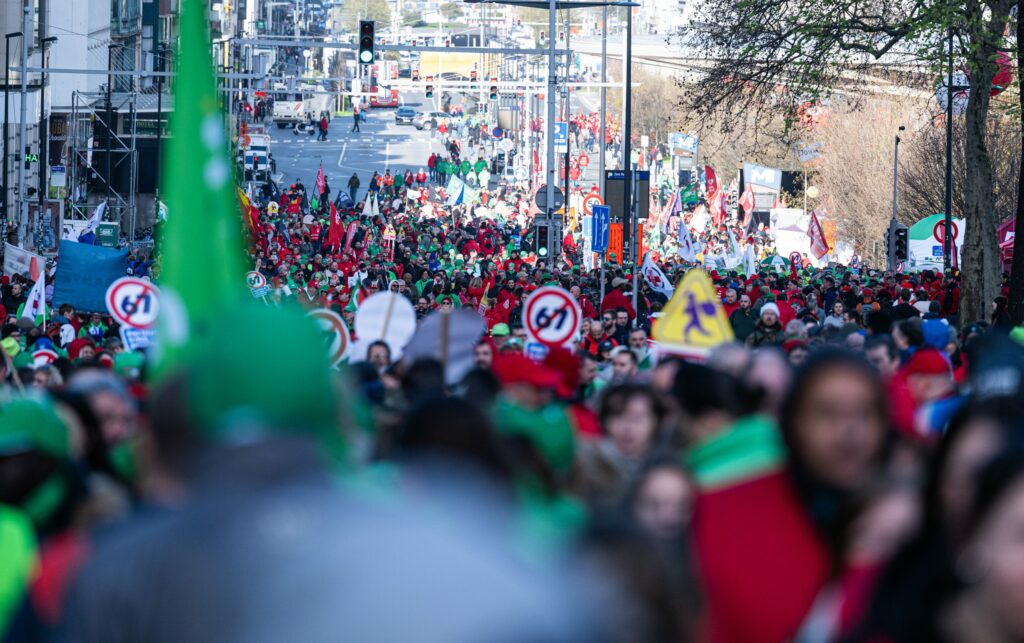
Between 80,000 and 100,000 people marched through the streets of Brussels on Thursday to protest against the Federal Government's austerity measures, such as the pension reform and the partial freeze on wage indexation.
The demonstrators set off from Brussels-North station around 11:00 in the morning to make their way towards Brussels-Midi, via the city's Small Ring Road. They arrived around 14:00, following what the police called a "generally peaceful" day.
"Whether you are sick or unemployed, or even just a citizen concerned about your freedoms of expression... everyone has their own very good reasons to be here," Myriam Delmee of the BBTK-SETCa trade union tells The Brussels Times.
"This Federal Government has provided us with more than enough reasons to make our voices heard. It is so important to speak up," she stresses.
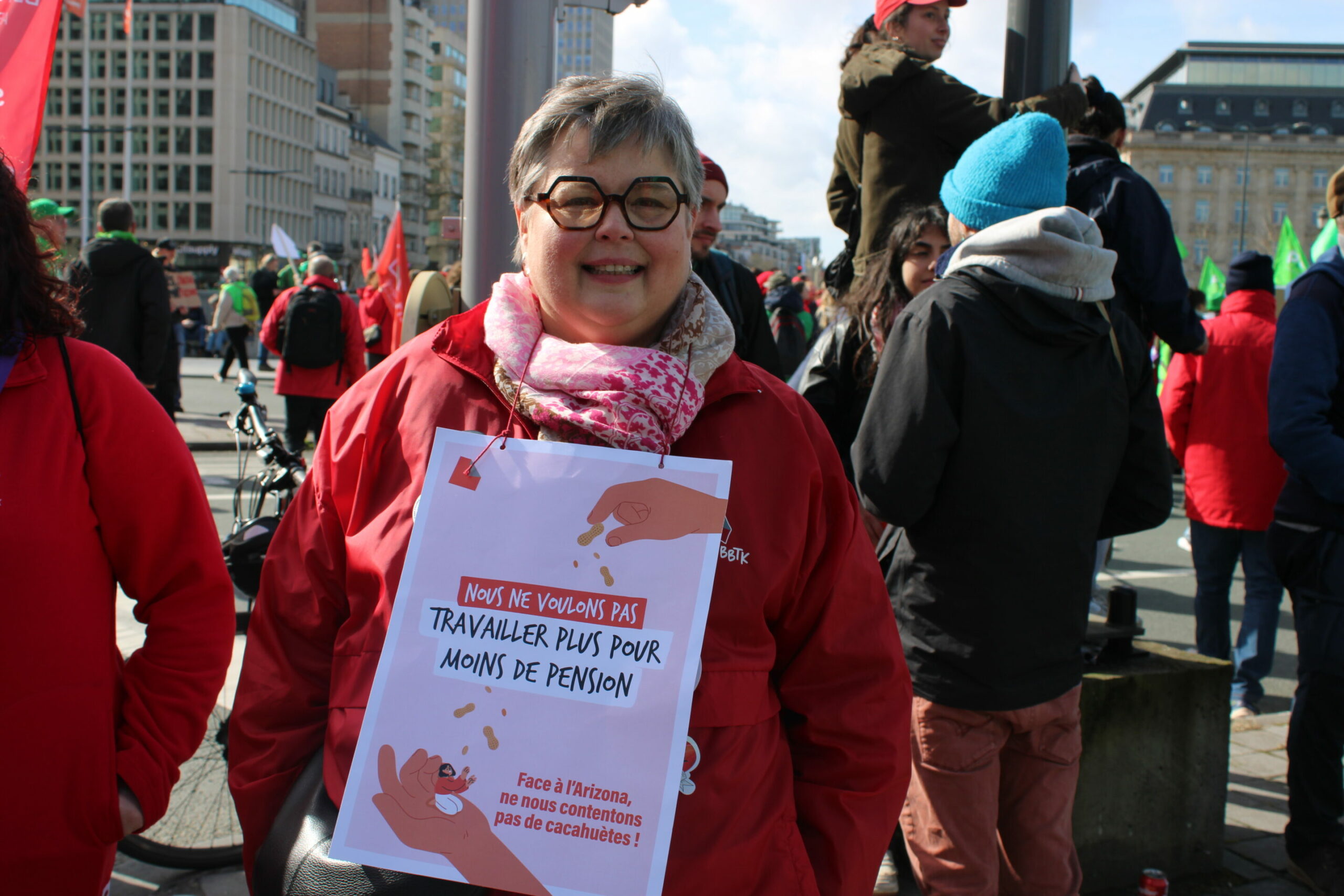
Myriam Delmee during the demonstration against the Federal Government's measures, in Brussels, Thursday, 12 March 2026. Credit: The Brussels Times/Maïthé Chini
The atmosphere during the march is jovial: union members chanting, waving banners and dancing.
Near the Porte de Namur crossing, the CSC/ACV union set up a tent with mirror walls. One member with a microphone is urging people to step inside, so they can see "who will be paying the bills for all the Federal Government's decisions."
One protester, Aida Khalilova, who works for an environmental NGO and just received her Belgian citizenship after having lived in Brussels for seven years, tells The Brussels Times that she is striking because she disagrees with the austerity measures of the Federal Government.
"We are now spending so much money on this race to arms, and at the same time, we are cutting social security and benefits and so on," she said. "This government is creating a very bare landscape. Being called Arizona, which calls to mind images of a desert, is very apt."
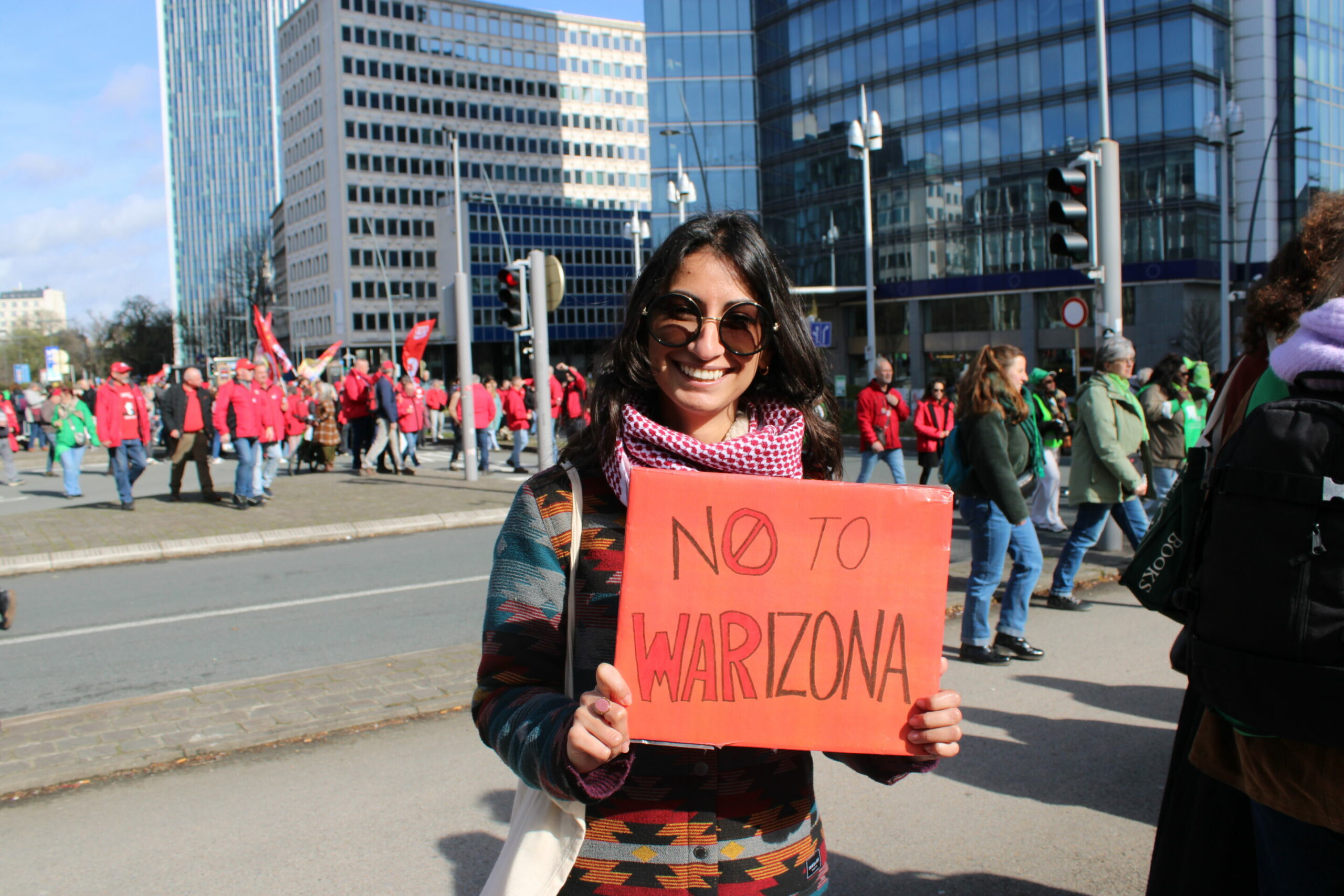
Aida Khalilova holding a 'No to Warizona' protest sign. Credit: The Brussels Times/Maïthé Chini
In a speech before the march began, FGTB-ABVV president Bert Engelaar denounced the Federal Government's decision to change Belgium's automatic wage indexation. "Prices are constantly rising, but wages are not keeping pace. Tampering with indexation is tampering with dignity."
He strongly criticised the government "for always attacking those who keep this country going: the workers."
Four women working in the healthcare sector, Dominic, Kirsten, Valerie and Anaïs, joined the strike to denounce the Federal Government’s austerity policy. "We will get less pension, they are taking away some of the premiums we should be getting. It really shows they do not value our work," they tell The Brussels Times.
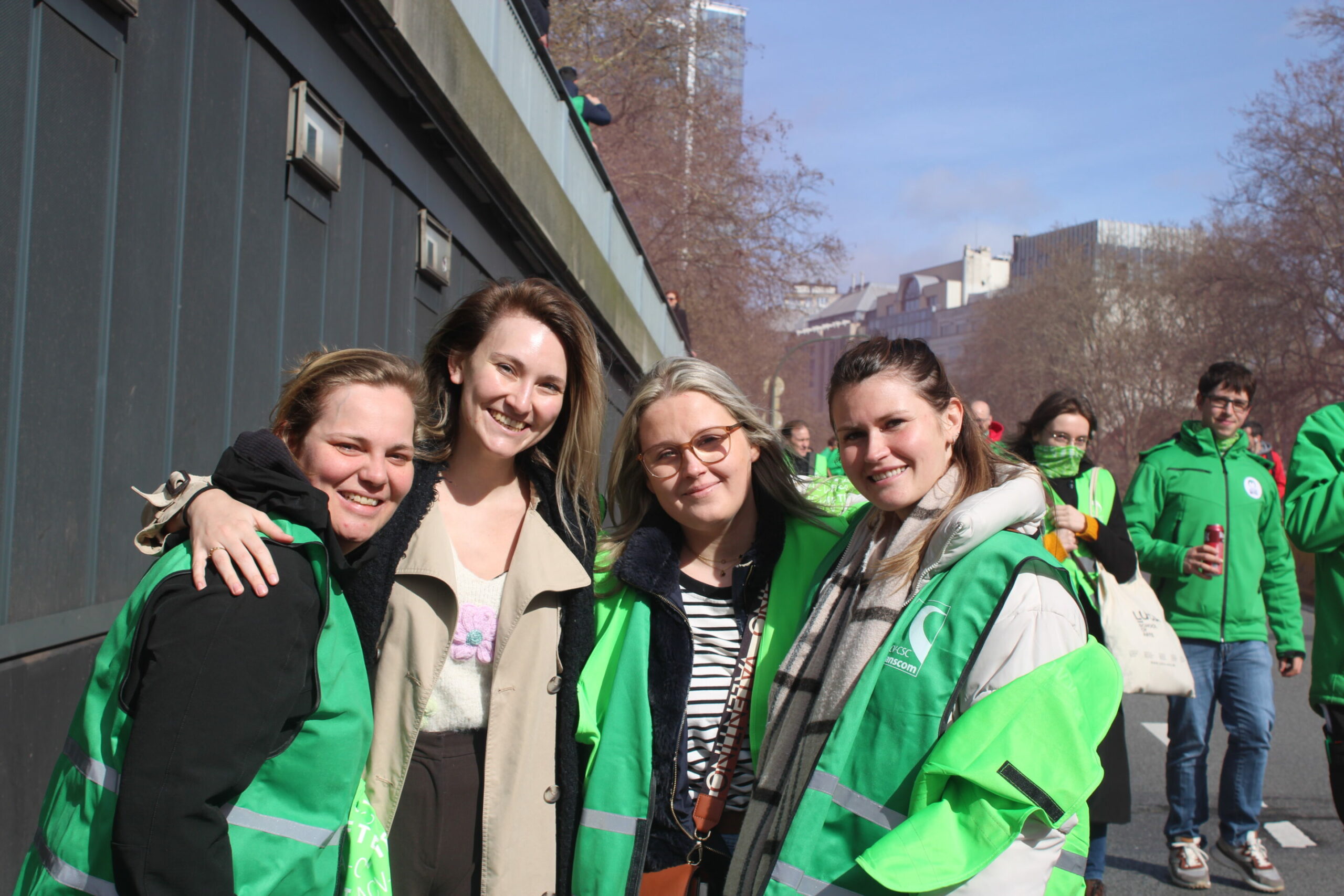
Dominic, Kirsten, Valerie and Anaïs, who all work in the healthcare sector, during the national demonstration. Credit: The Brussels Times/Maïthé Chini
While the police stressed that the march generally proceeded peacefully, they arrested some 50 people who were targeting the Beobank building on the Boulevard du Régent, near Madou.
"Our police services immediately intervened to prevent further damage and restore public order," the Brussels-Capital/Ixelles police zone said in a press release. Following a targeted intervention, the situation was quickly brought under control.
Meanwhile, Pierre has joined every strike to protest the Federal Government's measures so far.
"What they are doing is very dangerous. They are dividing everyone and pitting one group against another: the poor against the rich, unionised workers against non-unionised workers, the right against the left," he says. "It is very worrying."
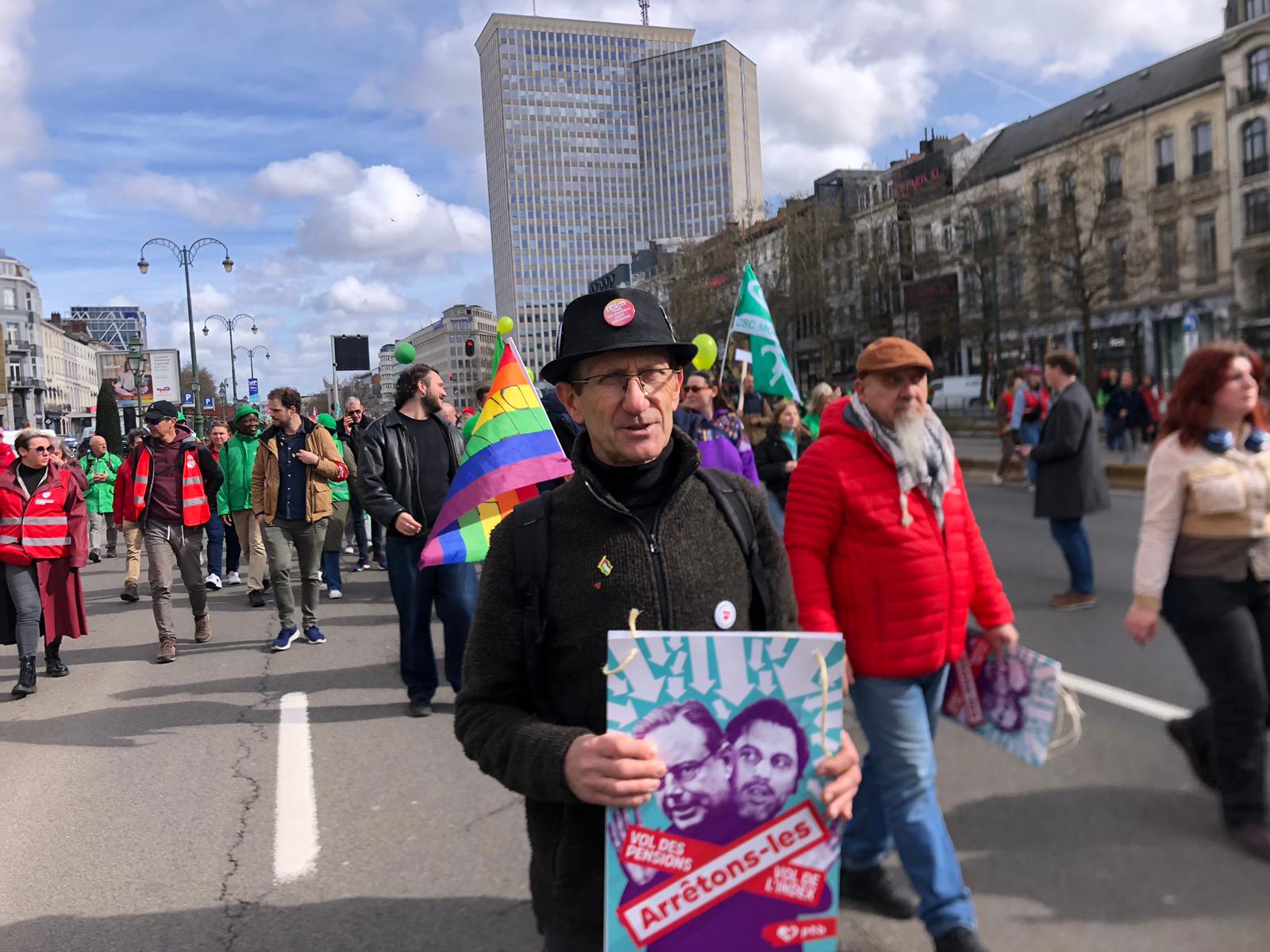
Pierre has been to every national demonstration against the Federal Government's measures. Credit: The Brussels Times/Maïthé Chini
A bit further, CSC's president, Ann Vermorgen, wondered about the pension reform. "Will we have to work until we drop?" she said, also criticising "the relaxation of night work and overtime," which will be "less well paid."
The CGSLB/ACLVB echoed this sentiment, with its president, Gert Truyens, stating that "a society that exhausts its workers jeopardises its own future" and that "it is women who will pay the highest price" for the pension reform.
Lieveke Norga from the trade union ACV Puls tells The Brussels Times that she completely agrees. "Women are working double shifts – one at work, one at home – their entire lives, and now the Federal Government wants to touch our pensions? Unacceptable."
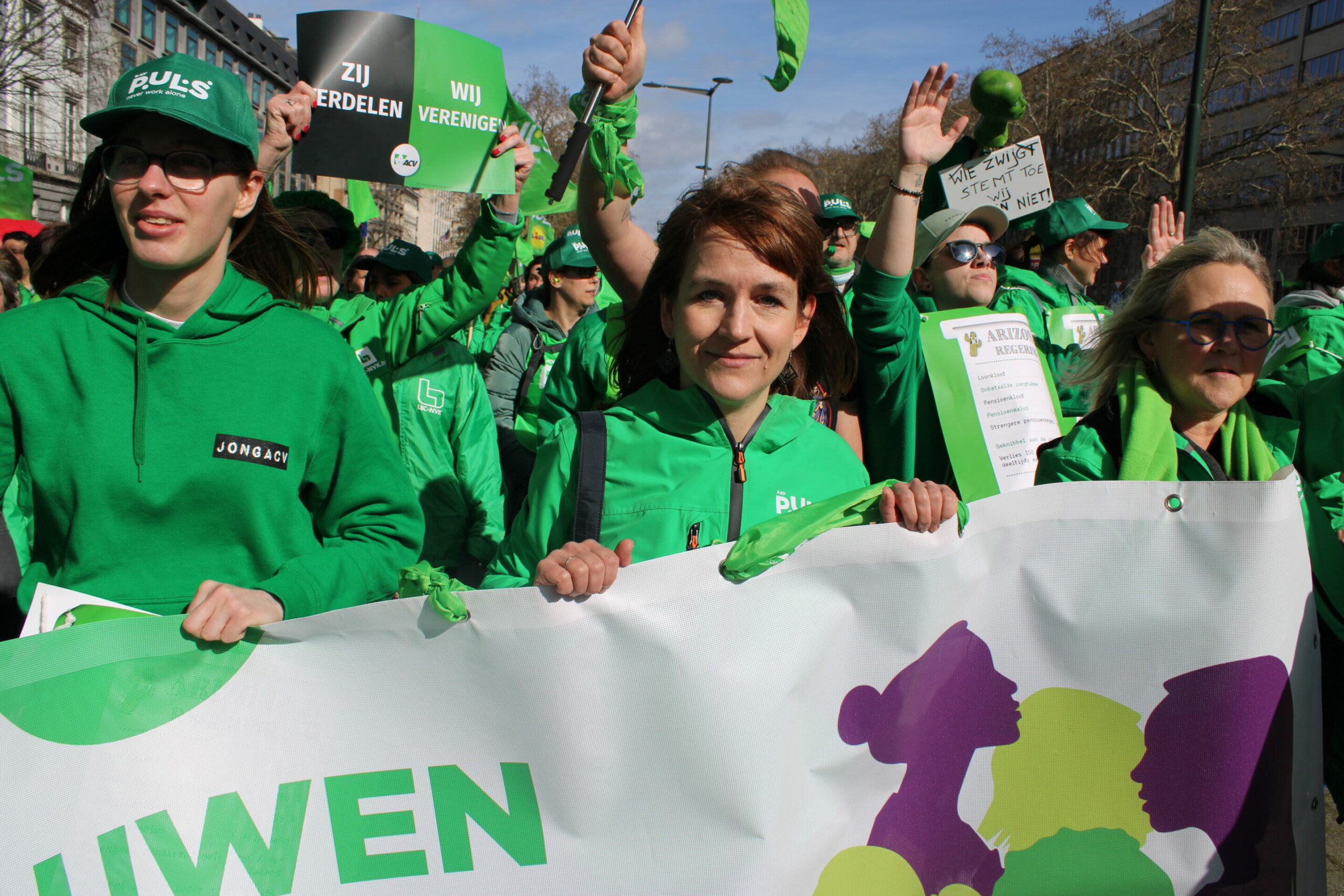
Lieveke Norga of ACV Puls. Credit: The Brussels Times/Maïthé Chini
The unions said they had reached out to the Federal Government by sending a letter to Prime Minister Bart De Wever (N-VA) and the five deputy PMs asking for a meeting.
At the other end of the spectrum, the employers' organisations FEB and Unizo expressed their "incomprehension" at this national action. They denounced a demonstration that "once again causes a drop in turnover" in a tense context for businesses, particularly due to the war in the Middle East.
"They are holding our businesses hostage, which are striving day after day to preserve as many jobs as possible," they added, regretting that the unions, in their view, are prioritising action over social dialogue.
'Bitter aftertaste'
On Thursday afternoon, Prime Minister Bart De Wever said in Federal Parliament that it is his government's "duty to stay on course" with its reform agenda.
Not for the first time, he stressed that there is "no other choice" but to implement substantial reforms, "because the budgetary problem we have inherited is enormous." De Wever emphasised that this is always done in consultation, adding that the trade unions can expect a new invitation for a meeting.
While De Wever said he understands that some reforms may leave a "bitter aftertaste" for some, he also said that there is "a lot of misinformation" circulating, with some people twisting a minister's words to cause tension.
"Above all, our government must stay on course, while remaining open to pertinent comments and willing to adjust things when justified. We have demonstrated this over the past year," De Wever said. "It is our duty to stay on course. Not doing so would be immensely selfish towards our children and grandchildren."
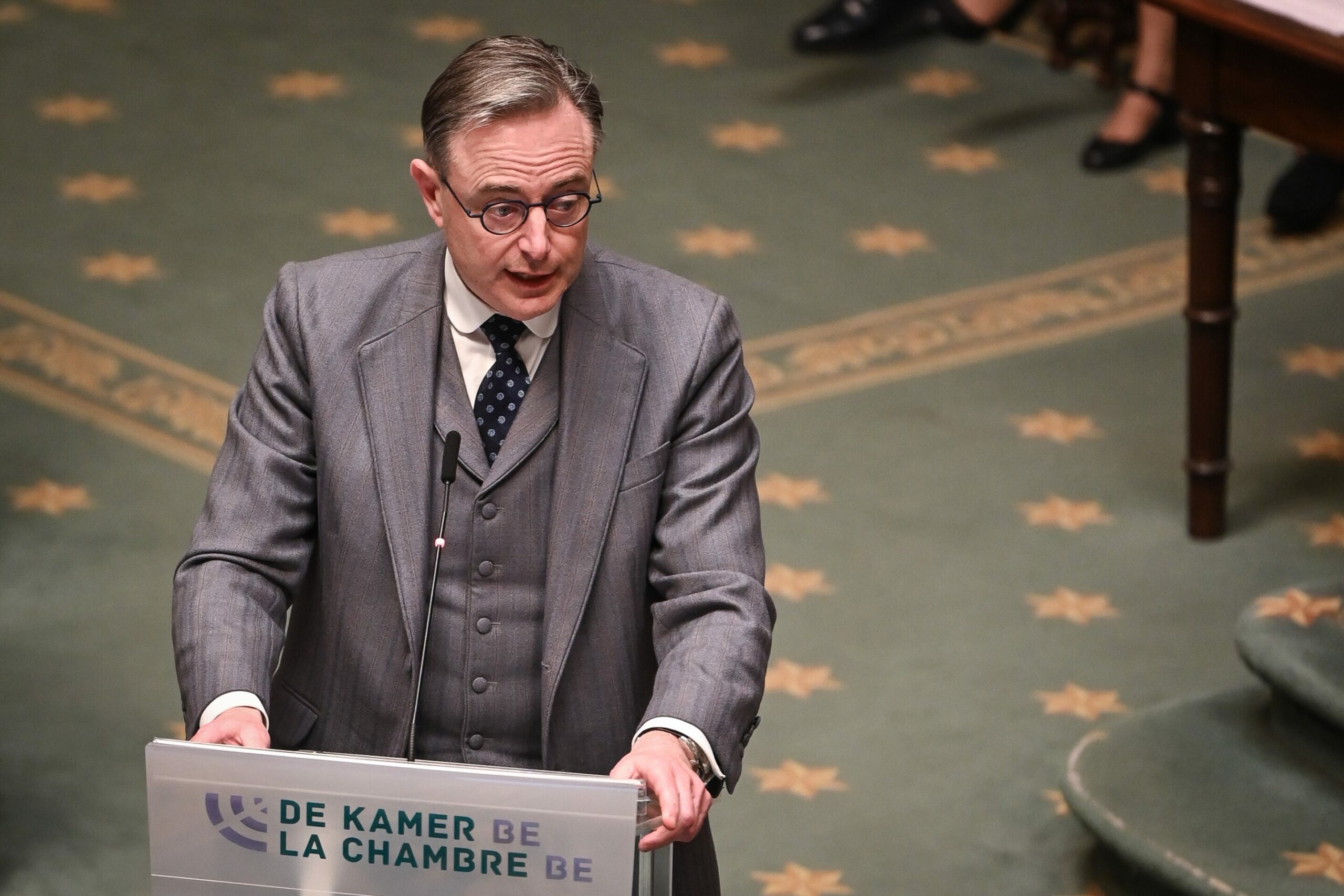
Prime Minister Bart De Wever pictured during a plenary session of the Chamber at the federal parliament, in Brussels, Thursday 12 March 2026. Credit: Belga/Elias Rom
The trade union action caused disruption across Belgium, particularly in the transport sector. The Letec, De Lijn and STIB/MIVB public transport networks were affected to varying degrees, while Brussels Airport and Charleroi Airport were at a standstill.
Prisons were also disrupted by the walkout of some staff members and were therefore operating at reduced capacity, with no visits or walks. Some postal workers also joined the protest, but Bpost reported a very minor disruption.
Rubbish collection in Brussels was also disrupted, but catch-up rounds will be organised from Friday onwards.
The previous protest on 14 October attracted around the same number of participants, according to the police.
