
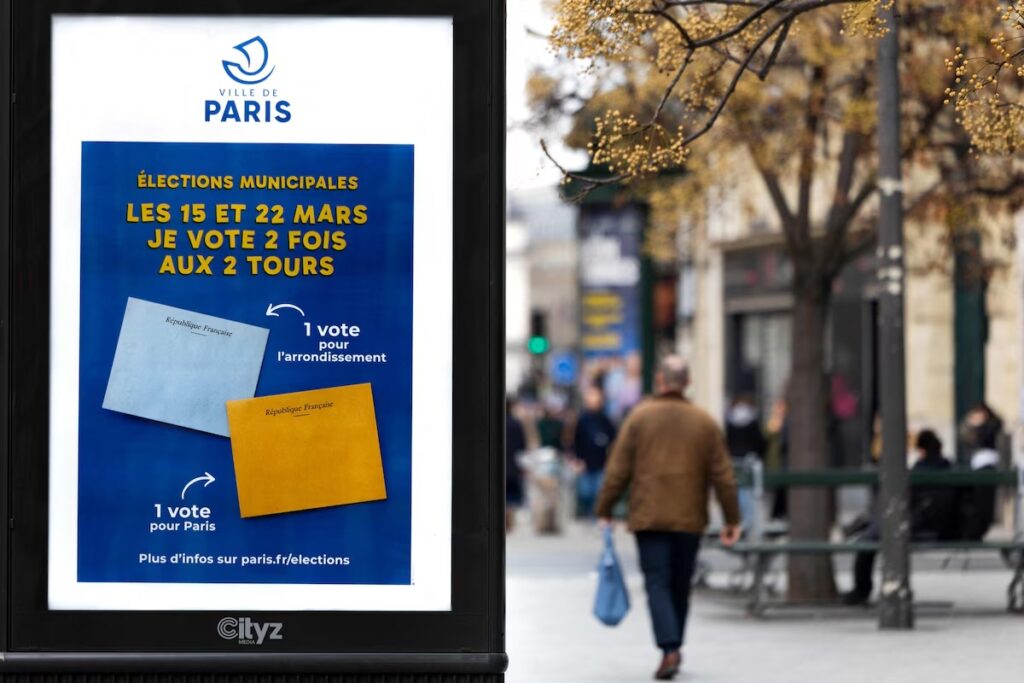
The far-right National Rally (RN) is gaining momentum, whilst radical left France Unbowed (LFI) made a surprise breakthrough in the first round of France's local elections on Sunday.
Both parties, which treated the local elections as a test run for the presidential race, emerged strengthened from Sunday’s first round, in a vote that saw the left hold its ground overall, particularly in Paris, Marseille and Lyon.
The period between the two rounds until next Sunday will be marked by the headache of potential alliances, which will also be scrutinised in the context of the race for the Élysée, currently dominated by the far right in the polls, within a highly fragmented political landscape.
In France’s three largest cities, the outgoing left is performing well: the Socialist Emmanuel Grégoire (37.98%) is well ahead of the former right-wing minister Rachida Dati (25.46%) in the capital.
Benoît Payan, the mayor with close ties to the Socialist Party, is leading in Marseille, though closely followed by National Rally MP Franck Allisio, and the Green candidate Grégory Doucet, also an incumbent, is neck and neck in Lyon with former OL boss Jean-Michel Aulas, backed by the centre and the right, following an impressive comeback.
Elsewhere, the National Rally is establishing itself on the local political scene, its objective a year ahead of the presidential election. Together with its allies, it is leading in more than 60 municipalities, compared with just eleven in the first round of 2020.
As of Sunday, the far-right party has retained its strongholds of Hénin-Beaumont (Pas-de-Calais) and Fréjus (Var), and has won a few new towns such as Cagnes-sur-Mer (Alpes-Maritimes). In Toulon, RN MP Laure Lavalette is well ahead but with a narrow margin.
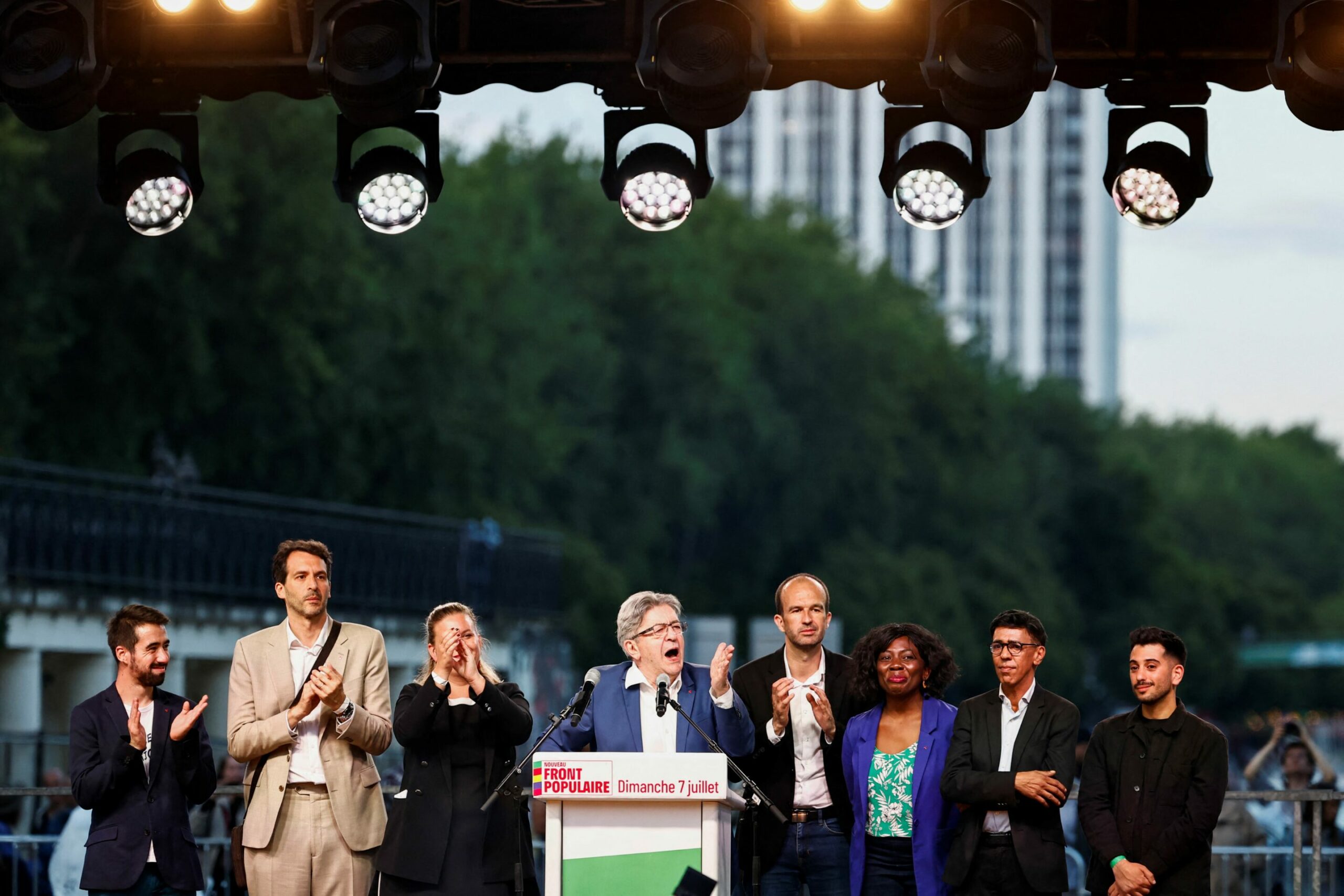
LFI's Jean-Luc Mélenchon addresses a rally after the 2024 elections. Credit: Belga / AFP
The party’s president, Jordan Bardella, has "reached out to the lists of the sincere right" to secure victory in the second round.
But beyond Le Pen’s party, it is La France Insoumise that is causing a sensation in several towns. "We were expecting the radical right and we got the radical left," sums up François Kraus, director of the politics at think tank Ifop.
FLI leader Jean-Luc Mélenchon hailed a "historic breakthrough". Already, Saint-Denis, the second-largest city in the Île-de-France region after Paris, has been won by LFI candidate Bally Bagayoko at the expense of the outgoing Socialist mayor, becoming the largest Mélenchonist municipality.
In Toulouse, LFI MP François Piquemal has managed to overtake his Socialist rival François Briançon, both of whom trail far behind the outgoing mayor Jean-Luc Moudenc. In Lille, the LFI candidate has caused a surprise, trailing the outgoing Socialist mayor Arnaud Deslandes – Martine Aubry’s successor – by less than three percentage points.
As for Roubaix, LFI MP David Guiraud has put himself in a strong position to win the mayoralty with over 46% of the vote.
Race for Paris
The radical left movement is in a kingmaker position in several other major cities, notably in Paris where Sophia Chikirou, on 11.72%, has promised to stand again if Emmanuel Grégoire does not offer her an “anti-fascist” merger.
The positioning of centrist Pierre-Yves Bournazel (11.34%) and far-right candidate from Reconquête Sarah Knafo, who qualified at the end of the count (10.40%), will also be decisive in this potential five-way contest.
The rise of the two radical movements, which have turned this campaign into a major test for 2027, suggests that tough negotiations lie ahead.
The lead candidates have until Tuesday at 6.00 pm to decide whether to stand, merge or withdraw ahead of the second round. A candidate must have secured more than 10% of the vote to proceed.
It is on the left that the question of alliances looks set to be the thorniest.
The Socialist Party, which is standing in many major cities and is also well ahead in Rennes, Strasbourg and Montpellier, wishes to break definitively with LFI. But the strong results of France Unbowed often complicates the equation.
