
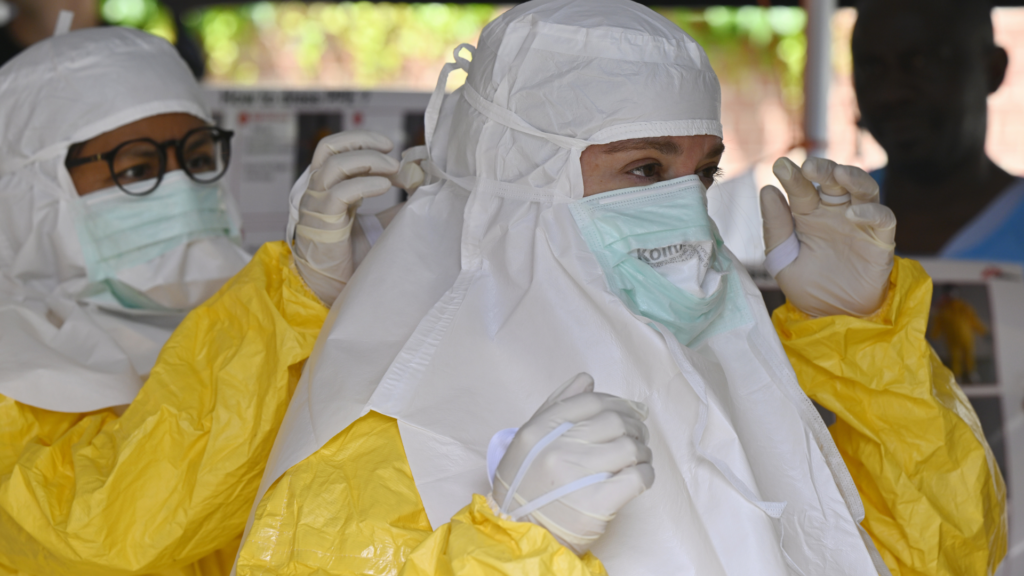
Ebola cases in the Democratic Republic of the Congo and Uganda continue to concern global health experts. What do you need to know, and how is Belgium responding to the situation?
Ebola is a relatively rare but severe illness that is often fatal in humans.
In May, an Ebola outbreak in the Democratic Republic of the Congo (DRC) and Uganda was declared a “public health emergency of international concern” by the World Health Organization (WHO).
A total of 534 confirmed cases have been reported in the affected countries, including 93 reported deaths, as of 6 June, according to WHO.
The outbreak has been particularly challenging for healthcare professionals, according to Doctors Without Borders, due to the lack of a specific treatment for the disease, the lack of access to testing equipment, and the fact that the outbreak is taking place in areas of the DRC which have been affected by decades of conflict.
The infection risk in Belgium remains "very low", with no confirmed Ebola cases ever recorded in the country, according to the Belgian Health Ministry.
What is Ebola?
Ebola disease is caused by a group of viruses referred to as orthoebolaviruses.
There are different types or strains of Ebola viruses. The known strains behind most outbreaks are the Sudan virus, the Bundibugyo virus, and the Zaire strain (more commonly known as the Ebola virus).
The current outbreak in the DRC was caused by the Bundibugyo virus, with the cases in Uganda linked to infected people who travelled from the DRC, according to WHO.
Ebola viruses spread naturally among animals, with fruit bats thought to be a natural host.
The Ebola disease was first identified in 1976 in what is now South Sudan and the DRC.
How does it spread?
Humans can be infected with viruses that cause Ebola through direct contact with blood or bodily fluids of infected animals, such as fruit bats or monkeys.
An infected person is considered contagious only after they develop symptoms. Even after death, an infected person remains contagious while the virus is still present in their body.
Transmission between humans occurs via direct contact with an infected person's blood or bodily fluids, including saliva, sweat, vomit or semen. Contact with objects or surfaces that have been contaminated with bodily fluids of an infected person can also transmit the disease.
Notably, the diseases can be transmitted through sexual contact with an infected person up to three months after their recovery, according to the Belgian Health Ministry.
What are the symptoms and treatments?
Symptoms of Ebola most commonly appear three to seven days after a person is infected, though they can usually appear anywhere between two and 21 days after an infection, according to the Health Ministry.
Initial Ebola disease symptoms usually include extreme fatigue, fever, nausea, muscle pain, headaches and sore throat.
As the disease develops, other symptoms include diarrhoea, vomiting, skin rashes and kidney and liver issues.
Internal and external bleeding, such as blood in vomit, may also be experienced, although this is not very common.
While there are two approved vaccines against Ebola, these are not effective against the disease caused by the Bundibugyo virus, according to the Belgian Health Ministry. There are also no specific approved treatments.
How is Belgium responding to the situation?
Passengers flying into Belgium from affected areas are being screened upon arrival by the Belgian health authority Saniport.
During the screenings, Saniport collects information regarding passengers’ health and possible symptoms, as well as contact details. Passengers are also informed about what symptoms to be on the lookout for, according to Annelies Wynant, spokesperson for the Belgian Health Ministry.
Depending on the evaluation of Saniport, passengers may be isolated to undergo further tests and receive medical assistance if necessary.
According to Wynant, all hospitals in the country have been informed of specific procedures and types of risks regarding possible Ebola cases. The Health Ministry further considers all Belgian hospitals to be capable of isolating any possible infected person safely.
Additionally, the health of crew members on ships travelling into Belgium is also being monitored by Saniport, with employees from the health authority present at the ports in Antwerp, Ghent, Ostend and Zeebrugge.
Related News
- US demands that Belgium impose entry ban on Congolese nationals in fight against Ebola
- EU ministers to discuss Ebola outbreak in DRC in special video conference
On Wednesday, De Morgen reported that Washington asked Belgium to impose an entry ban on people from the DRC, citing concerns of possible spread of the Ebola virus during the World Cup, which is taking place in the US this year.
Belgium's Federal Health Minister Frank Vandenbroucke (Vooruit) denied the request, explaining that the “scientific consensus is that action must be taken where the crisis is raging” and that the focus of the country is to screen passengers travelling from affected areas.
