
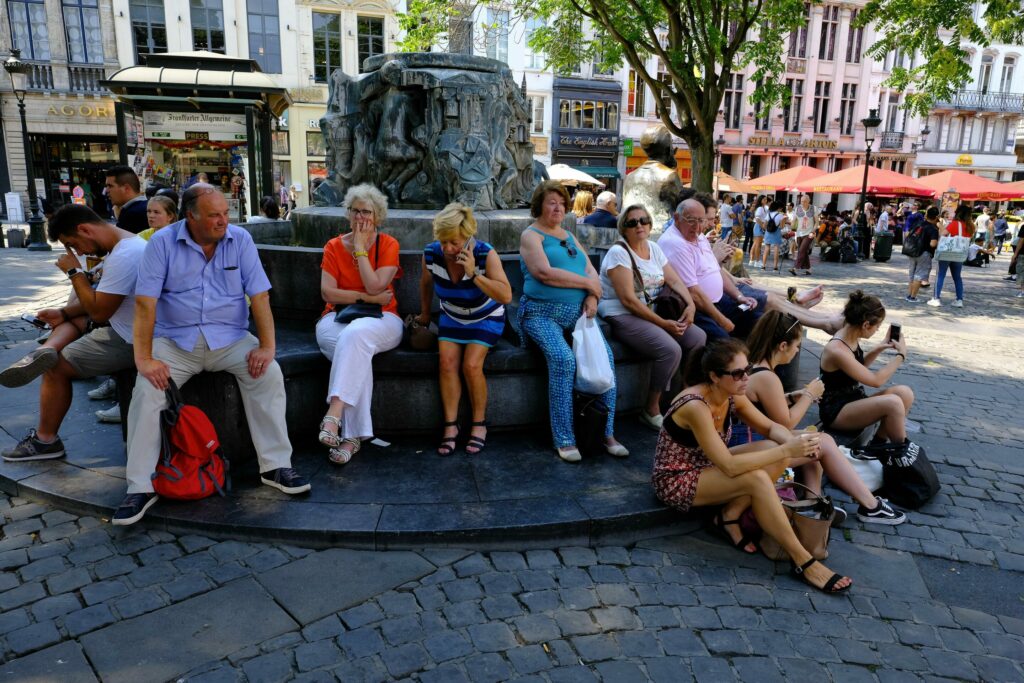
Just as we were starting to recover from this month's marathon heatwave, it seems another period of high temperatures might be on the horizon for Belgium.
Last week, multiple June temperature records were shattered during 12 consecutive days of extreme heat. Temperatures reached 35.3°C at Belgium's official measuring station in Uccle on Friday – the hottest day of the heatwave.
Highs of 40°C were recorded in eastern Belgium, while a red alert was in force in parts of the country.
Temperatures dropped significantly on Monday, but the mercury is expected to rise once again from Saturday.
On Monday, 6 July, temperatures are forecast to reach 31°C at time of writing. According to RTL Info, it is too soon to tell if this will mark the start of another heatwave because "the further we get into the forecast period the wider and less precise the margins become".
Meteorologist Pascal Mormal told the broadcaster: "Some models will indicate temperatures that could exceed 35 degrees, and others that could remain below 30. Here, the prevailing scenario today, in any case, is that temperatures could climb to 30-31 degrees Celsius during next week."
Chance of heatwaves five times greater than in the 1980s
The Royal Meteorological Institute (RMI) states that for an official heatwave to be declared, there must be five consecutive days with temperatures above 25°C, including three above 30°C.
The chance of a heatwave of at least 12 consecutive days, like the one that ended on Monday, has increased fivefold since the 1980s, climate scientists from the Flemish research centre VITO told Belga News Agency. Instead of once every 30 years, such a heatwave now occurs once every seven years.
Since 1975, half a century ago, only seven heatwaves of at least 12 consecutive days have been observed in Uccle, specifically in 1975 (12 days), 1976 (17 days), 1997 (17 days), 2003 (13 days), 2006 (16 days), 2020 (12 days), and 2026 (12 days).
Over time, the team of climate scientists at VITO calculated the annual probability of a single heatwave of at least 12 days occurring in Belgium.
In the 1980s, this was around 3 % – or once every 30 years. Today, the situation looks completely different, and the probability has increased fivefold, to an average of once every seven years.
"If we want to reduce the risks of increasing heatwaves, we must take action on two fronts," Hendrik Wouters of VITO told Belga.
"We must further reduce greenhouse gas emissions by continuing the transition to renewable energy, phasing out fossil fuel-powered vehicles, and making industry more sustainable. But we must also adapt to the already inevitable warming.
"So, more greenery and shaded areas in cities, formulating building regulations that take higher temperatures into account, and implementing effective heat plans to protect vulnerable citizens."
