
At the risk of stating the obvious, the world today is in turmoil. Smaller states like Belgium must navigate the storms with agility, restraint and a deft diplomatic touch. Much of that task falls to the diplomats stationed across Belgium’s global network of embassies, representing the country’s interests abroad and managing relations with host governments.
A glance at the map of Belgian embassies offers a revealing snapshot of the country’s foreign-policy priorities.
Foreign Minister Maxime Prévot recently outlined plans to restructure Belgium’s diplomatic footprint, and from this year, the government will close embassies in Sarajevo (Bosnia-Herzegovina), Conakry (Guinea), Bamako (Mali), Maputo (Mozambique), Havana (Cuba), Rio de Janeiro (Brazil), Kuwait City (Kuwait) and Guangzhou (China).
At the same time, new embassies are set to open in locations deemed strategically significant, including Tirana (Albania), Windhoek (Namibia), Muscat (Oman) and Tashkent (Uzbekistan), while several existing missions will be reinforced with additional staff.
Yet beyond staffing levels and geographic reach, Belgium has another, often overlooked, instrument of diplomatic visibility: the buildings that house its embassies.
Embassy architecture is perhaps the most tangible expression of a state’s presence abroad. By their very nature, these buildings serve as physical embodiments of the state they represent. Through their architecture, embassies project power, identity, values and political intent, offering an idealised vision of how a nation sees itself — and how it wishes to be seen.
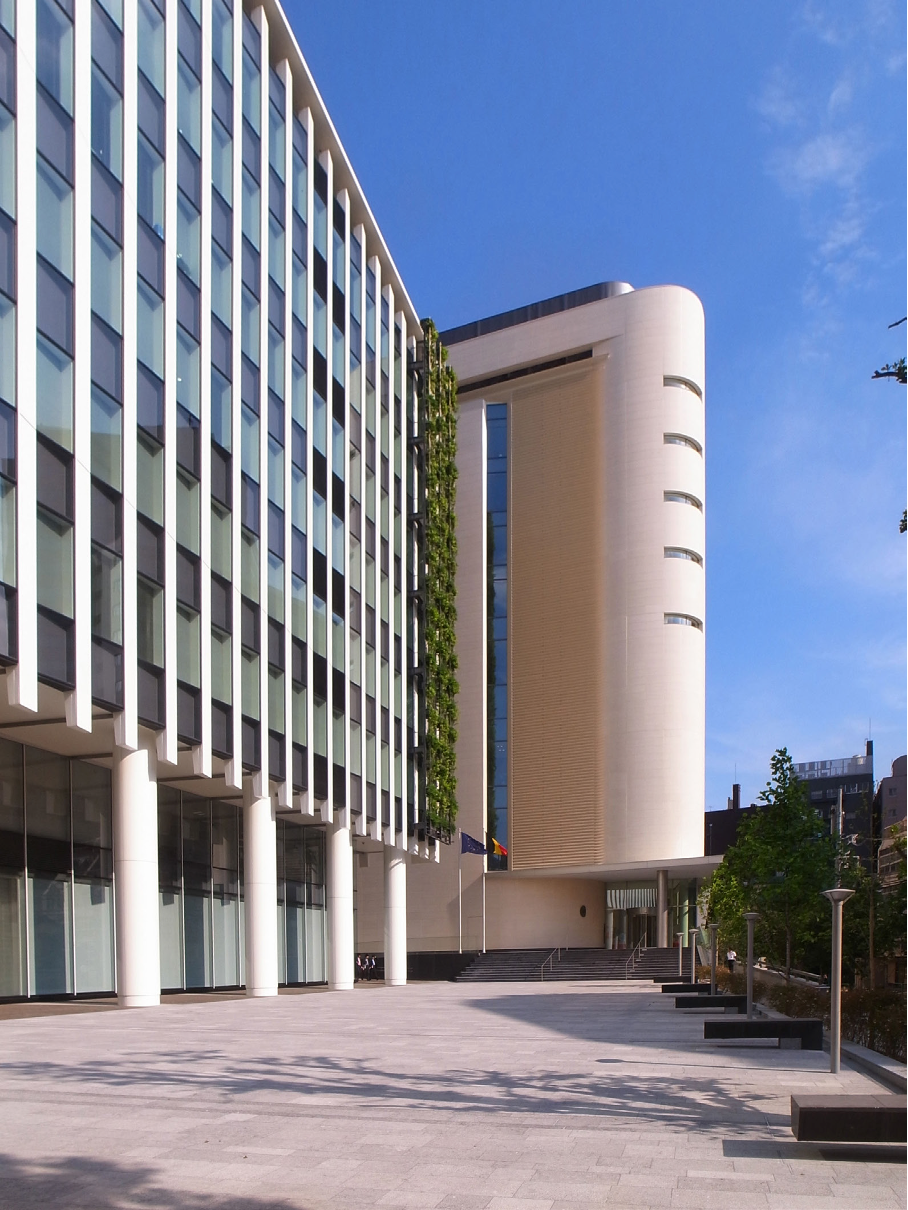
Belgian Embassy in Tokyo, Japan
This symbolic dimension is particularly pronounced in purpose-built embassies, where the sending state must define and shape a politically charged architectural commission from the ground up. Belgian politicians, diplomats, and civil servants are required to steer such projects through a series of decisions laden with representational, diplomatic, and political implications.
Design for diplomacy
Should an embassy occupy a prominent site in the urban core, asserting visibility and prestige, or retreat to a more discreet suburban location in the name of security? Should Belgium commission a national architect and explicitly showcase domestic craftsmanship, embedding a recognisable national character in the design? Or should it turn to local architects, producing a building that engages more directly with the architectural traditions of the host country?
Those questions lie at the heart of Building for Belgium: Belgian Embassies in a Globalising World (1945–2020), my recent study of Belgium’s embassy-building programme since the Second World War.
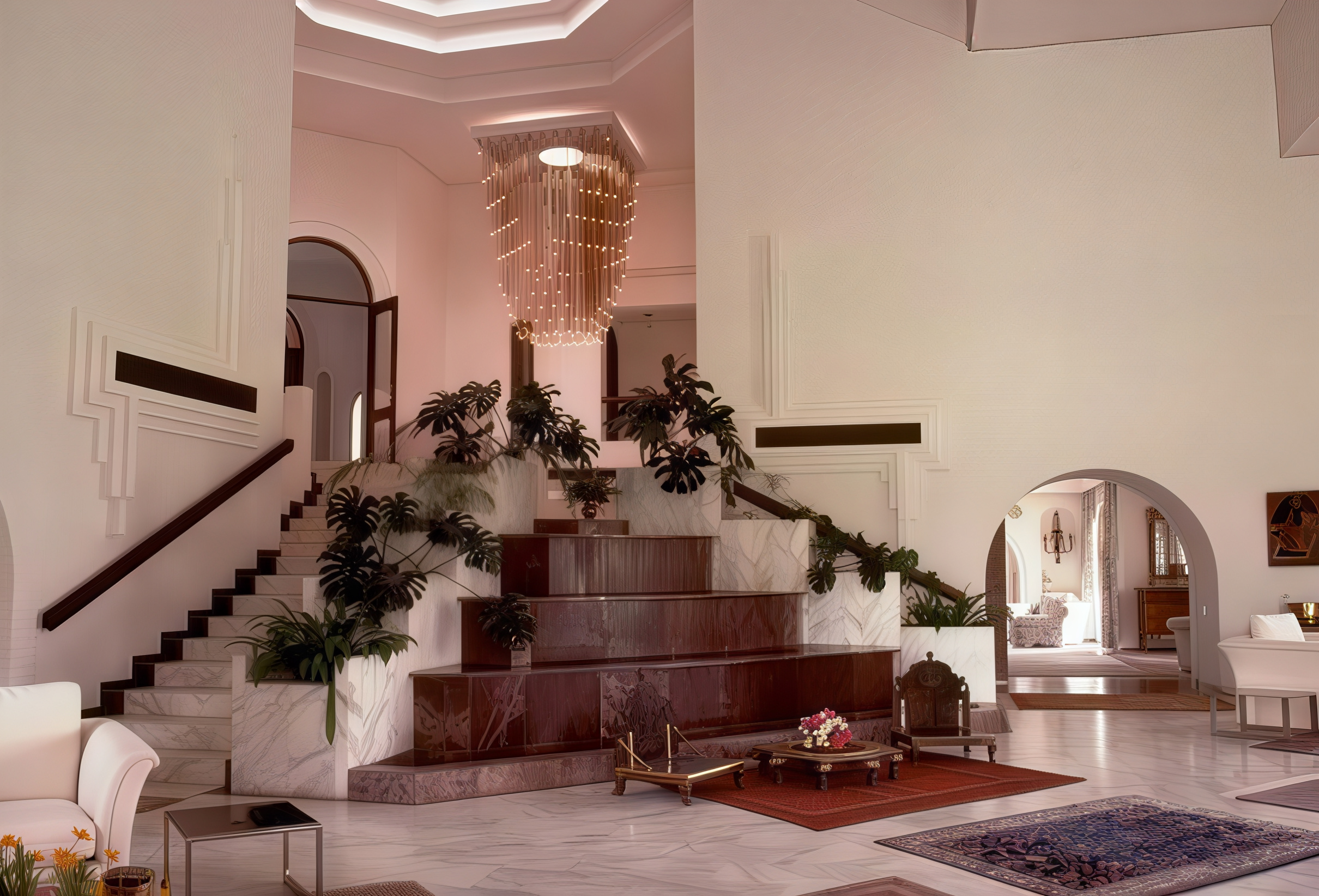
Belgium's embassy in New Delhi, India
Drawing inspiration from canonical studies of American, British and Soviet purpose-built embassies, I looked at the deliberate investment in embassy architecture as a means of conveying diplomatic and political messages abroad. At its core was a simple question: what architectural language was considered suitable to represent Belgium on the world stage?
Through detailed case studies, I looked at the trajectory of several high-profile embassy projects and Belgium’s evolving search for an architectural language capable of expressing national identity overseas. This was a global journey, with stops in Washington, Canberra, Warsaw, Brasília, New Delhi, Riyadh, Tokyo and Kinshasa.
Belgium has, at various moments, consciously deployed embassy architecture as a tool of international self-representation and a means of reinforcing bilateral relations.
Gravitas and granite
A classic illustration is the purpose-built Belgian chancery in Washington in the 1950s. The project was championed by Ambassador Robert Silvercruys (1893–1971), a fervent advocate of the emerging transatlantic alliance in the immediate post-war years.
Convinced that Belgian-American relations deserved a suitably dignified architectural expression, Silvercruys persuaded his superiors in Brussels to commission a new chancery. Throughout the project, every design and staffing decision was carefully calibrated to turn the building into a symbol of the alliance.
The commission was awarded to the eminent Belgian architect Hugo Van Kuyck (1902–1975), himself a living embodiment of Belgian-American ties. Van Kuyck had previously lectured at Yale University and served in the US army during the Second World War, where he played a role in planning the Normandy landings.
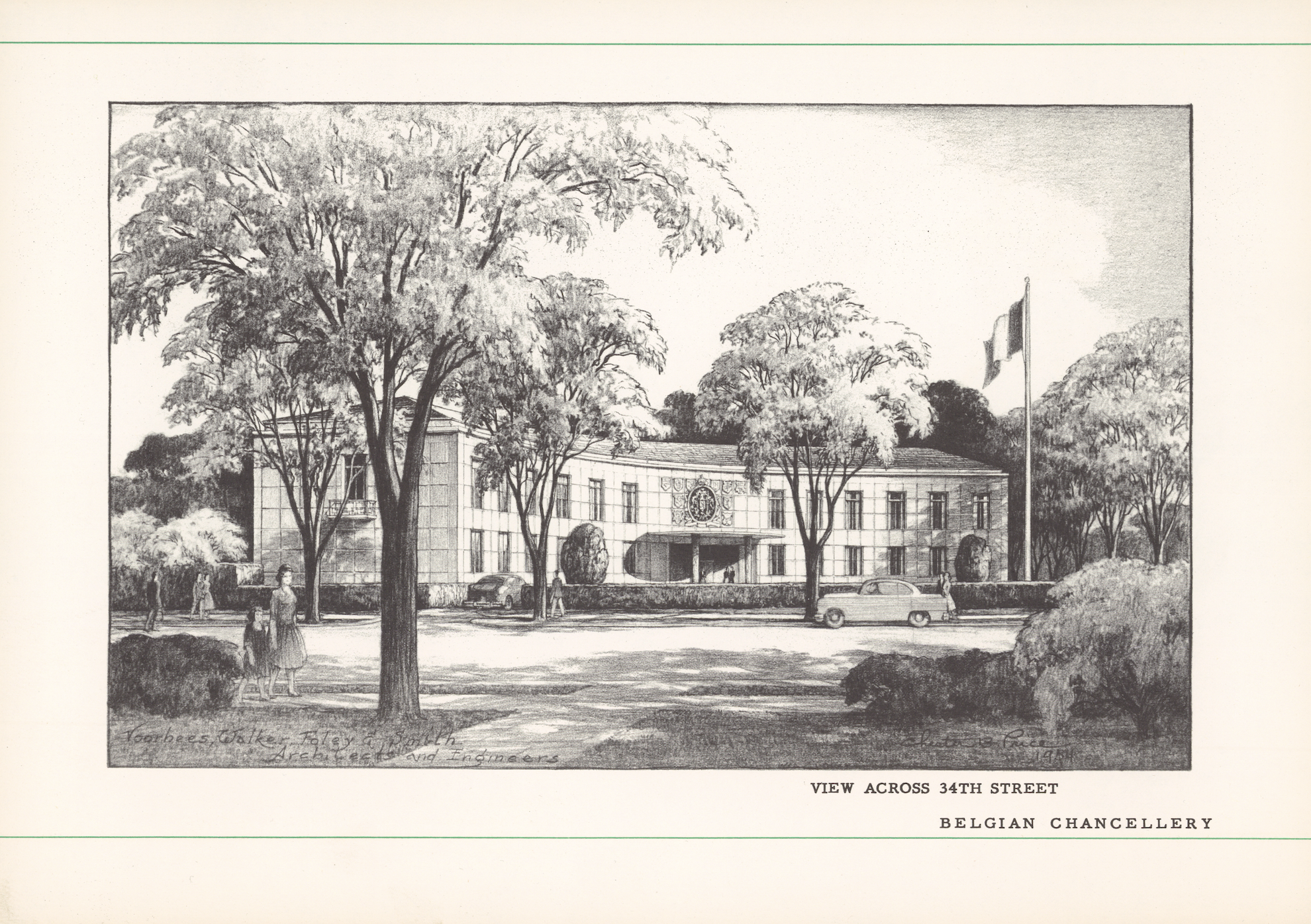
Belgium's US embassy in Washington DC
Working closely with American counterparts, Van Kuyck designed a building intended to honour both Belgium and its host nation. The chancery drew inspiration from the stripped classicism characteristic of Washington’s monumental public architecture – a modernised interpretation of Greco-Roman forms that retained essential proportions and elements while dispensing with ornament. In keeping with this aesthetic, the building was clad in Indiana limestone, lending it a sense of gravitas and permanence.
Yet while the exterior harmonised with its American surroundings, Van Kuyck ensured that unmistakably Belgian elements were woven into the design. Above the main entrance, the Belgian coat of arms – with its distinctive lion – was carved into the limestone façade. The entrance itself was articulated with columns faced in rouge belge, the deep red marble quarried in Wallonia.
Belgium’s presence was further reinforced inside. Conceived by Van Kuyck as a machine-à-représenter, the interiors spared little expense. Belgian black marble (noir belge) featured prominently throughout. At the same time, the inclusion of Congolese woodwork in the lobby sent a pointed political signal. At a time when Washington was pressing Brussels to prepare the Belgian Congo for self-rule, the prominent use of Congolese craftsmanship could be read as an assertion of Belgium’s continuing colonial authority.
The lobby also functioned as a space of cultural diplomacy. Among the artworks on display was a monumental tapestry placed near the spiral staircase. It depicts a transatlantic encounter set long before the emergence of either Belgium or the United States: the exploration of the Mississippi River in 1680 by the priest Louis Hennepin (1626–1704), a native of Hainaut, undertaken at the behest of the French crown.
By invoking a romanticised shared past, the tapestry sought to root Belgian-American ties in a deeper historical narrative. Silvercruys was particularly attached to the work, seeing in it a visual affirmation of Christianity as a common foundation of both the “old” and “new” worlds.
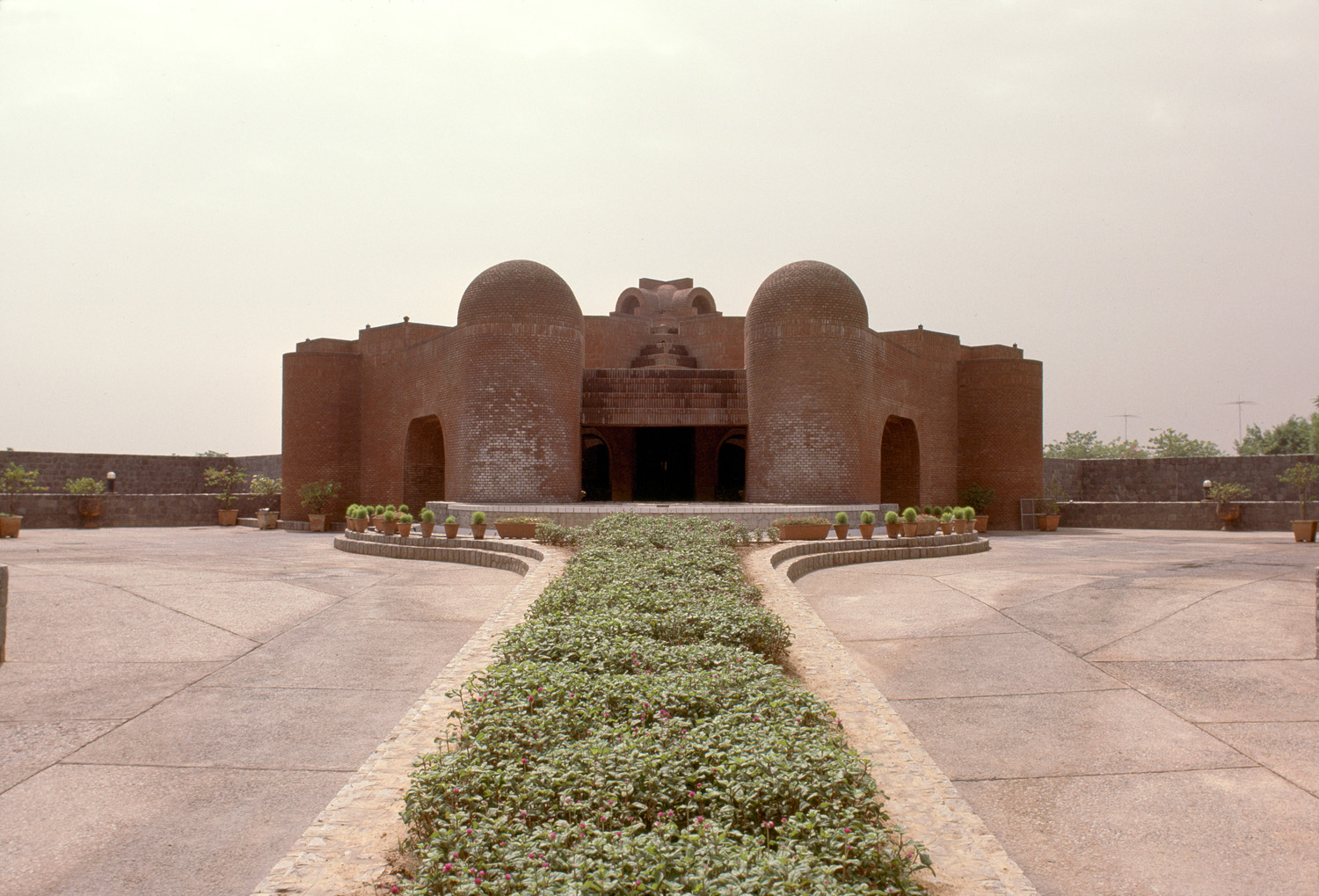
Belgium's embassy in New Delhi
To complete the ensemble, the Belgian furniture manufacturer De Coene was commissioned to furnish the chancery offices. Its neo-classical designs aligned perfectly with Silvercruys’s fondness for French decorative traditions.
Other embassies pushed the architectural language in different directions. In New Delhi, completed in 1983, Indian architect Satish Gujral’s design rejected European classicism altogether. Exposed brickwork, sculptural forms and references to local building traditions created an embassy that engaged directly with its Indian context. Its tactile materials and dramatic forms projected cultural openness and economic ambition at a time when security concerns remained comparatively restrained.
Functionality and adaptability
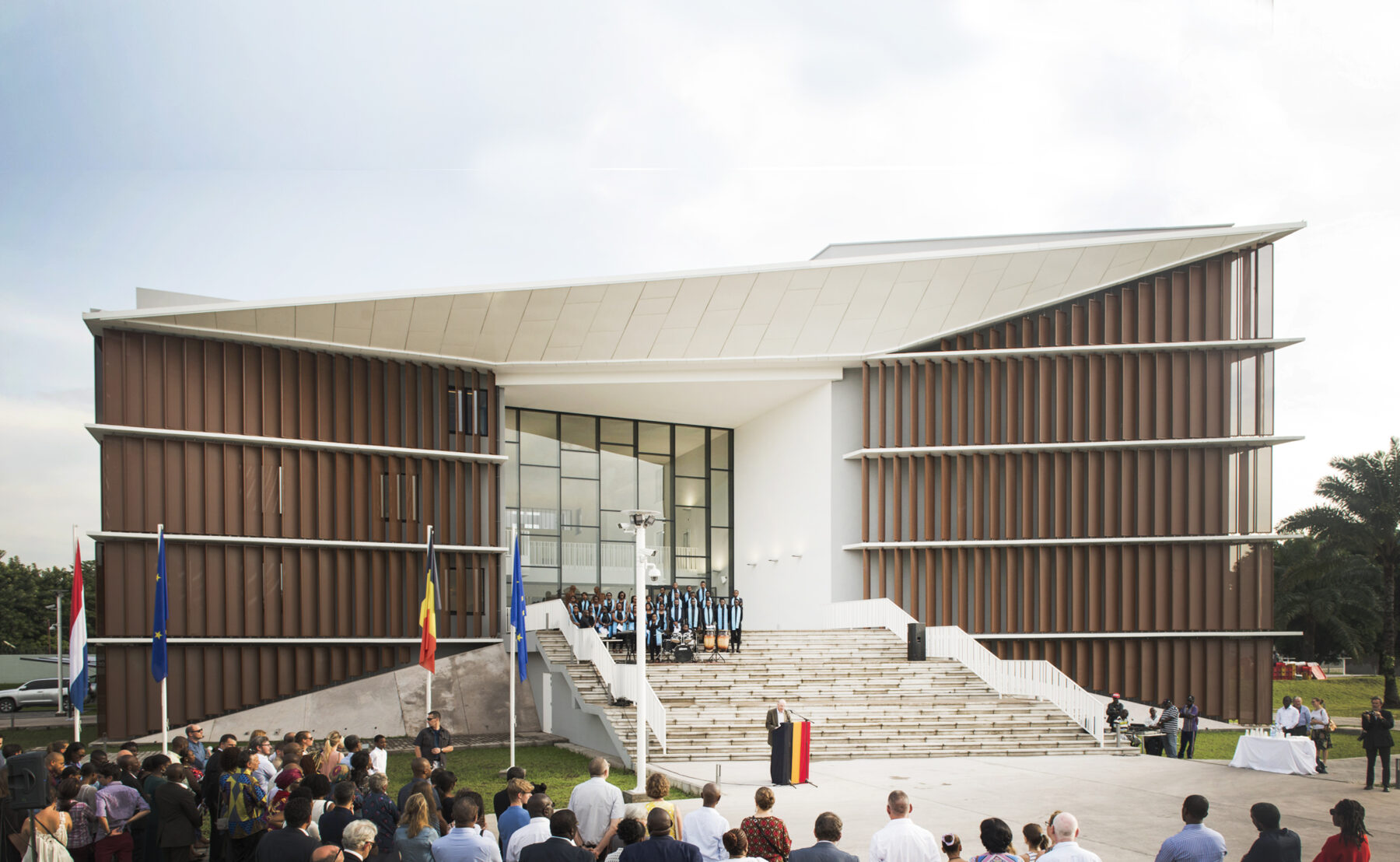
By the early 21st century, however, security, efficiency and sustainability had become dominant architectural drivers. This shift is particularly evident in the Belgian chancery in Kinshasa, completed in 2017. Designed by the Brussels‑based firm A2M, the five‑floor concrete building adopts a deliberately neutral, contemporary aesthetic. Its square footprint, sloping planes and dense brise‑soleil screens create a dynamic façade while responding to the tropical climate through passive design strategies such as insulation, shading and controlled daylight.
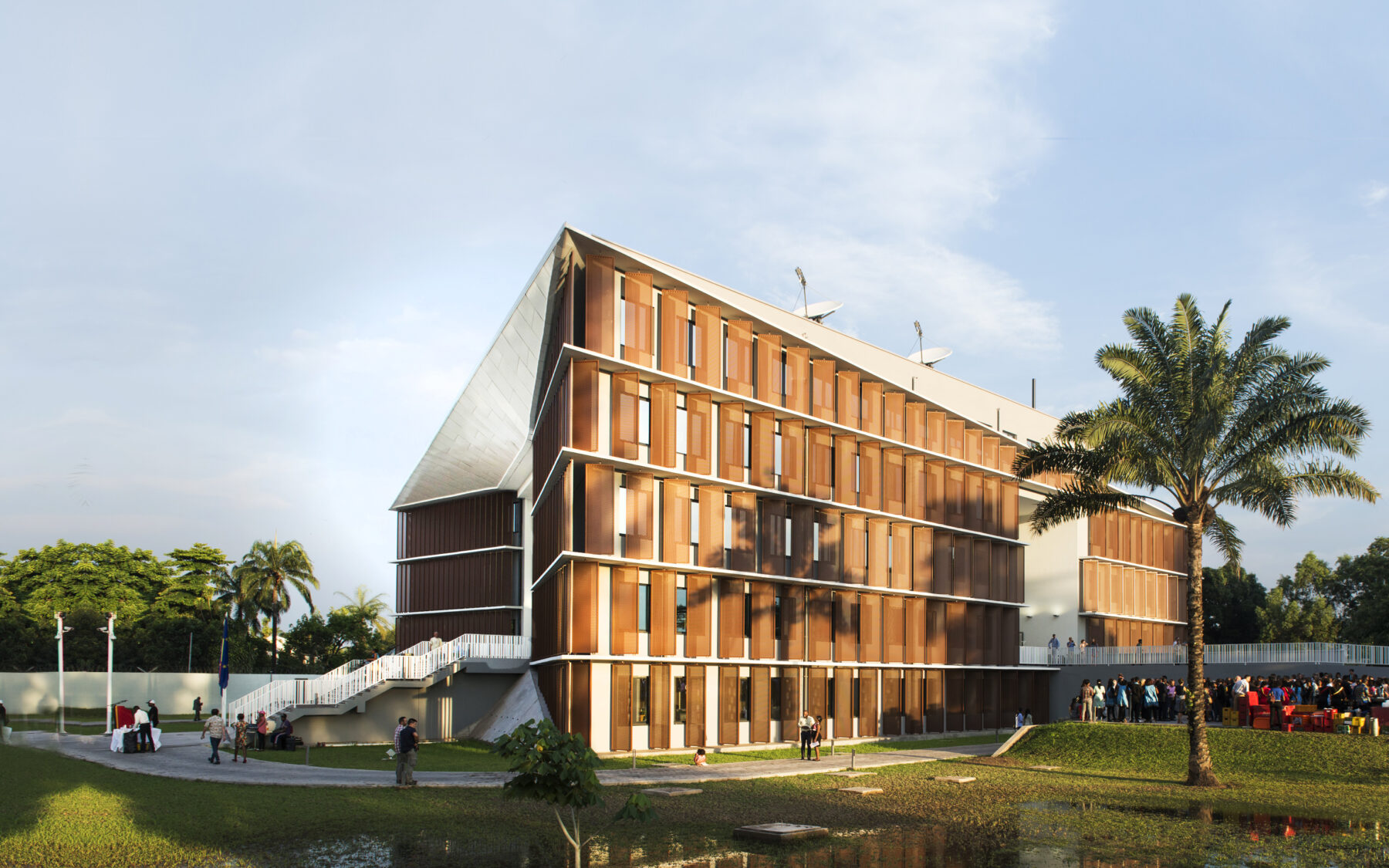
Belgian Embassy in Kinshasha, DR Congo
The Kinshasa chancery largely eschews overt national symbolism. Instead, its architecture emphasises clarity, functionality and adaptability, reflecting the complex, multi‑layered nature of Belgium’s presence in the Democratic Republic of Congo (DRC). Circulation is carefully choreographed: a monumental, glazed entrance and staircase for high‑level visitors contrasts with a separate, ground‑level access point for visa applicants.
Inside, a tall, light‑filled atrium acts as both organisational spine and representational space, binding together offices shared by Belgian, Dutch and regional entities. The result is an embassy that projects administrative competence and modernity rather than historical authority.
Taken together, these buildings show how Belgian embassy architecture has evolved from expressive statements of prestige towards more restrained, pragmatic forms. They also demonstrate how carefully conceived embassy projects can enhance a country's prestige and credibility abroad, functioning as diplomatic instruments in their own right. When executed with commitment and resources, an embassy can offer a precise snapshot of a particular political moment, place and geopolitical context.
Future embassy construction will inevitably take place under more constrained conditions. Strained public finances, the possibility of further state reforms, increasing pressure to share premises with European partners, shifts in the global order, transformations in diplomatic practice, and the ongoing challenge of articulating national identity all pose significant constraints. Yet one thing remains certain: Belgium will continue to be represented in capitals around the world through its embassy buildings – structures whose architectural and political histories are every bit as revealing as the diplomacy conducted within them.
Bram De Maeyer is the author of Building for Belgium, Belgian Embassies in a Globalising World (1945-2020), which reveals how the country has used design as a subtle but potent tool of diplomacy
