
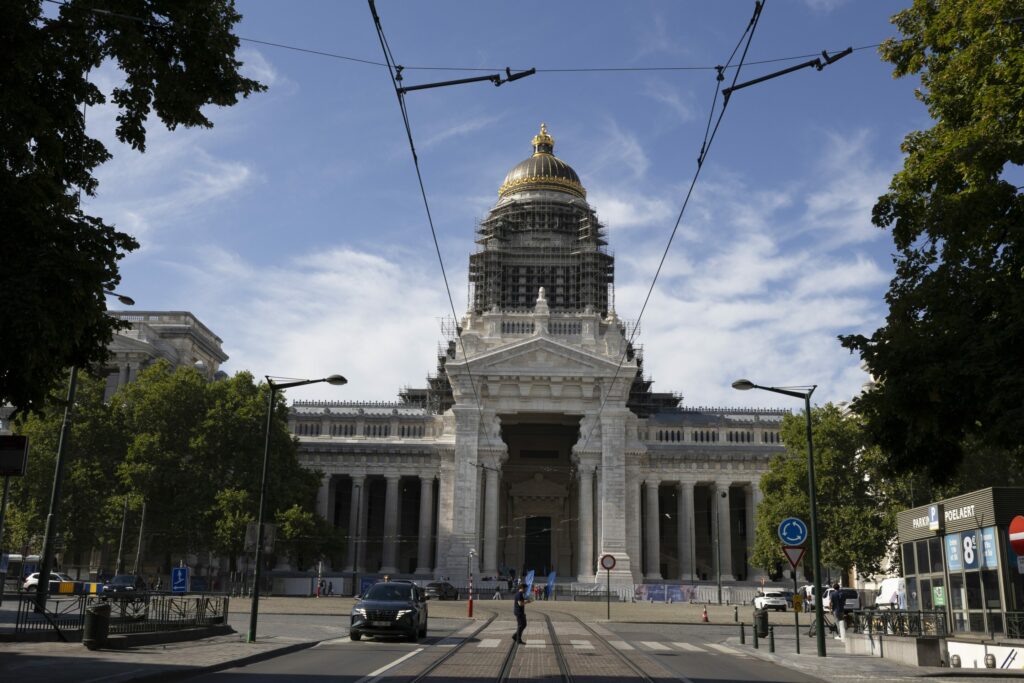
The scaffolding that has covered the main façade of Brussels’ iconic Palais de Justice for more than two decades has finally been removed, revealing the restored monument on Place Poelaert.
While the Palais de Justice has been surrounded by scaffolding for almost 40 years, the structures that have just been removed from the main façade are considerably younger.
According to the Buildings Agency, the scaffolding along the Place Poelaert façade was installed in the early 2000s as a preventive safety measure against falling stones. The first scaffolding around the Palais dates back to 1984 and remains in place around other parts of the building, including the base of the dome, which will be used for the next phase of restoration.
The Buildings Agency marked the completion of the first phase of the building’s long-awaited restoration on Thursday 27 August. The works, which began in August 2023, have restored around 22,750 square metres of the façade, equivalent to almost five football pitches.
The first phase of the restoration cost €31.7 million, including VAT, and lasted from August 2023 to August 2026.
Some finishing work remains to be completed in the coming weeks, with delays partly caused by several heatwaves this summer. The main entrance on Place Poelaert is nevertheless expected to reopen during September.
The Palais de Justice, designed by architect Joseph Poelaert and built between 1866 and 1883, has suffered from decades of weathering and water infiltration.
The restoration project aims to preserve the building’s historic appearance while improving its safety, energy efficiency and accessibility.
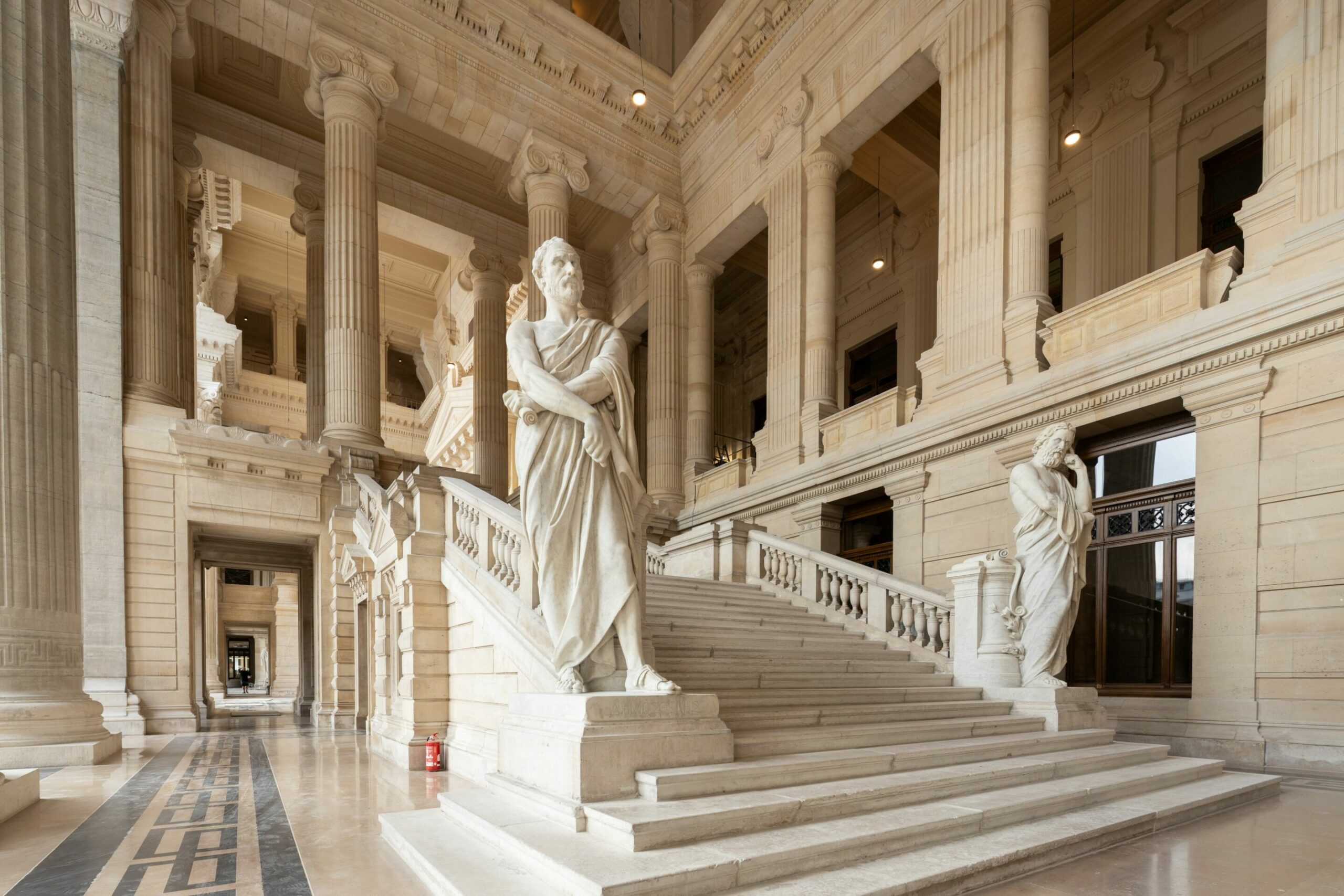
Credit: Régie des bâtiments
Four tons of stone replaced at 28 metres height
The restoration involved painstaking work on the building’s natural stone and decorative elements. Each section of the façade was cleaned, inspected and repaired where necessary, with the aim of retaining as much of the original material as possible.
Replacement stones were sourced from the original quarries, including Comblanchien limestone from Burgundy in France and blue limestone from Soignies in Wallonia.
Some of the most substantial interventions involved stabilising sections of the façade. Two corner stones, each weighing four tonnes, were replaced at a height of 28 metres.
The pointing between the stones was also renewed to prevent future water infiltration. However, the summer heat made the work particularly difficult, delaying some of the finishing operations.
The building’s 140 windows and 60 doors were also restored and repainted. Around 300 square metres of single glazing was replaced with vacuum glazing, which provides insulation comparable to triple glazing while being considerably thinner and lighter.
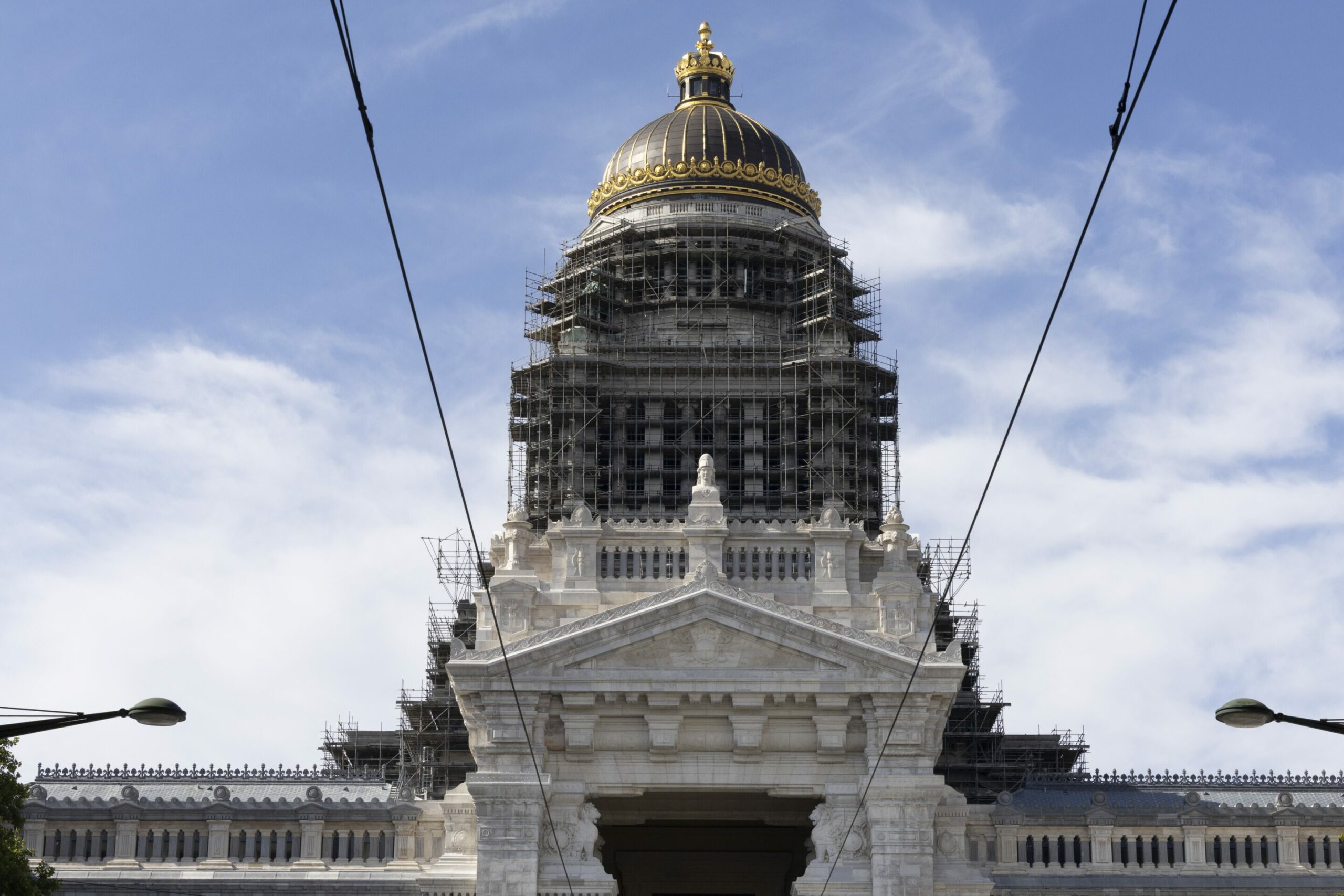
Illustration picture taken during Brussels Palais de Justice during a press moment to mark the completion of the restoration of the front facade of the Brussels Palais de Justice, on Thursday 27 August 2026. Credit: Belga / Nicolas Maeterlinck
A restored peristyle and forecourt
Inside the monumental entrance area, the restoration extended to the peristyle, where around 10,000 square metres of plasterwork were treated. Walls and ceilings were restored to their original colour.
The large bronze entrance door and four marble statues were also restored. The statues depict figures from Greek and Roman antiquity, including Lycurgus, Demosthenes, Cicero and Ulpian.
The peristyle’s zinc and slate roofs were renewed, while its 3,500 square metres of natural stone flooring were carefully restored.
The forecourt has also been redesigned and fitted with new railings inspired by the original ones installed before the Palais de Justice was inaugurated in 1883. The new configuration creates a wider blue-stone pavement, improving pedestrian comfort and safety.
New lighting has also been installed. However, following a request from the Royal Commission for Monuments and Sites, the façade will not have permanent decorative lighting. It may instead be illuminated using mobile installations during events.
Accessibility improved
The restoration has also brought changes aimed at making the building more accessible. A dedicated entrance for people with reduced mobility has been installed in the left portico. A platform lift allows visitors to reach the peristyle before proceeding to the security checkpoint, like other visitors.
"The major challenge for the Buildings Agency is to preserve our heritage without compromising its character, while adapting it to today's needs," Vanessa Matz (Les Engagés), minister responsible for the Buildings Agency, said.
"An entire generation of Brussels residents has never known the Palais de Justice without scaffolding," she added, describing the completion of the first phase as "a new page".
Justice Minister Annelies Verlinden (CD&V) said the restoration was about more than repairing the building’s stonework. "A good justice system needs good infrastructure," she said, arguing that the Palais de Justice should be accessible and adapted to current and future needs.
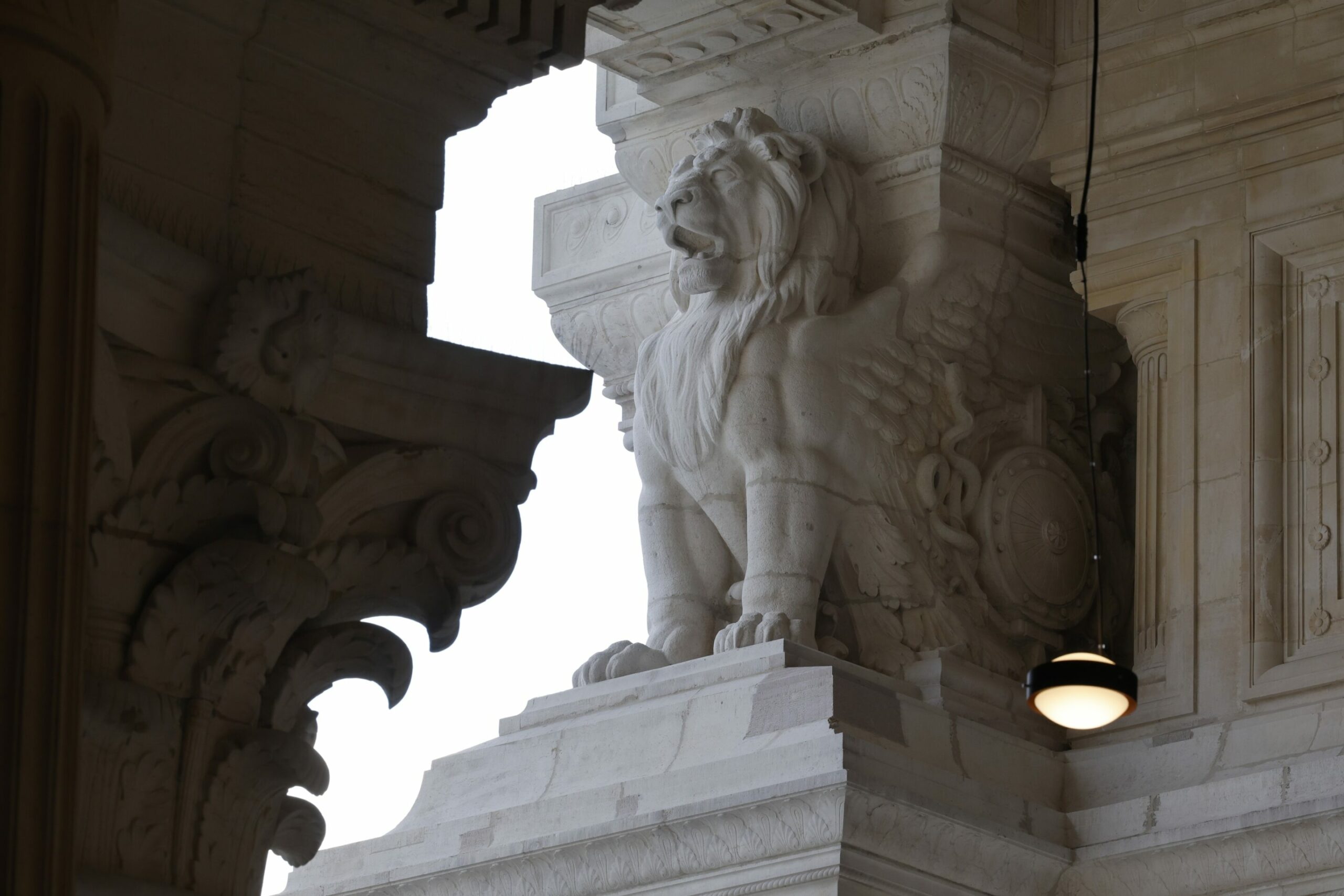
Lion statue on Brussels Palais de justice pictured after a press briefing to mark the completion of the restoration of the front facade of the Brussels Palais de Justice, on Thursday 27 August 2026. Credit: Belga / Nicolas Maeterlinck
The scaffolding is not disappearing completely yet
Although the main façade is now free of scaffolding, Brussels residents will have to wait several more years before the entire building is uncovered.
The scaffolding around the base of the dome will remain in place for the second phase of the restoration, scheduled to begin in 2027.
The Brussels-Capital Region granted the required permit for this phase on 31 March 2026. The public procurement procedure is expected to be launched this autumn.
The third phase will focus on the façades facing Rue de Wynants and Rue de la Régence, while the final phase will concern the façade facing Rue des Minimes.
The Buildings Agency expects all the Palais de Justice façades to be restored by 2035. Its stated objective is to remove all the existing scaffolding by 2030, in time for Belgium’s bicentenary.
