
Belgium's summer heatwave could cost the country €6 billion due to increased worker heat stress, according to new analysis by the Climate and Environment Risk Assessment Centre (CERAC).
The economic loss, equivalent to a 1% fall in GDP, stems from a decline in labour productivity. This decline results from heat affecting the ability to work, reducing efficiency and the number of working hours.
"Heatwaves are no longer just a challenge for public health," argued Luc Bas, director of CERAC. "They also represent a growing economic risk that must be taken into account in preparedness and adaptation policies."
Belgium's public finances would also be strained by any loss of productivity. A decline in GDP would also reduce tax receipts. As a ready reckoner, half of Belgium's GDP is captured in taxes.
Productivity drop
Analysis by the Federal Planning Bureau shows that Belgium already suffers from a labour productivity problem which affects the prospects for future wage growth.
In a paper on labour productivity, the Bureau explained that before 2008, labour productivity per hour averaged 1.3% annually. Between 2007 and 2012, it fell to 0.1% but has since been recovering. The current rate sits at 0.8% for the period between 2019 and 2024.
The added challenge of heat-stress-related productivity losses would spell bad news for Belgium's economic prospects.
In their report, CERAC notes that productivity losses from heat do not follow a linear path with each additional degree of temperature.
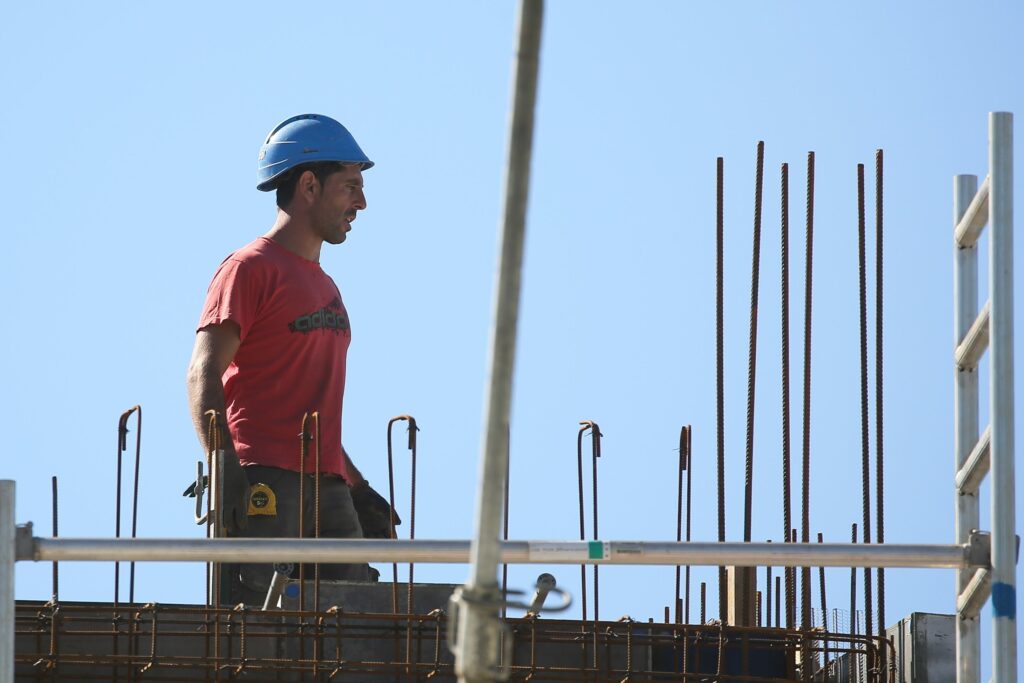
Instead, productivity drops off sharply above 30°C. Workers in sectors such as construction and agriculture are most affected and at risk of heat stress, as they are more likely to work outdoors.

A person using a hand fan pictured in Brussels. Credit: Belga/Emile Windal
However, other sectors are also exposed, such as those working in transport or logistics. CERAC's analysis shows that even office work is affected at the most extreme temperatures, slowing work.
The warning on lost productivity comes alongside a further finding that the number of days above 30 degrees could quadruple in Western Europe as climate change progresses, according to CERAC.
They argue for greater protection for workers who are most exposed, as well as adapting buildings and labour regulations for periods of extreme heat.
In June, a group of trade union federations called for binding EU rules on workplace heat to protect workers.
Not designed for heat
In research published by the European Trade Union Institute (ETUI), the federations highlighted that heat stress is not an issue only during heatwaves, being more likely to happen on "ordinary hot working days."
Regular extreme weather is no longer limited to southern Europe, with ETUI's research warning that "heat-related dangers are increasing in Central and Northern Europe, where workplaces and labour laws were not originally designed to handle prolonged periods of high temperatures."
Warning that unclear rules would affect both workers and the economy, they called for a new EU directive to set minimum standards for working temperatures, heat breaks or adjusted working hours, and specific protections for the most at-risk workers.
