
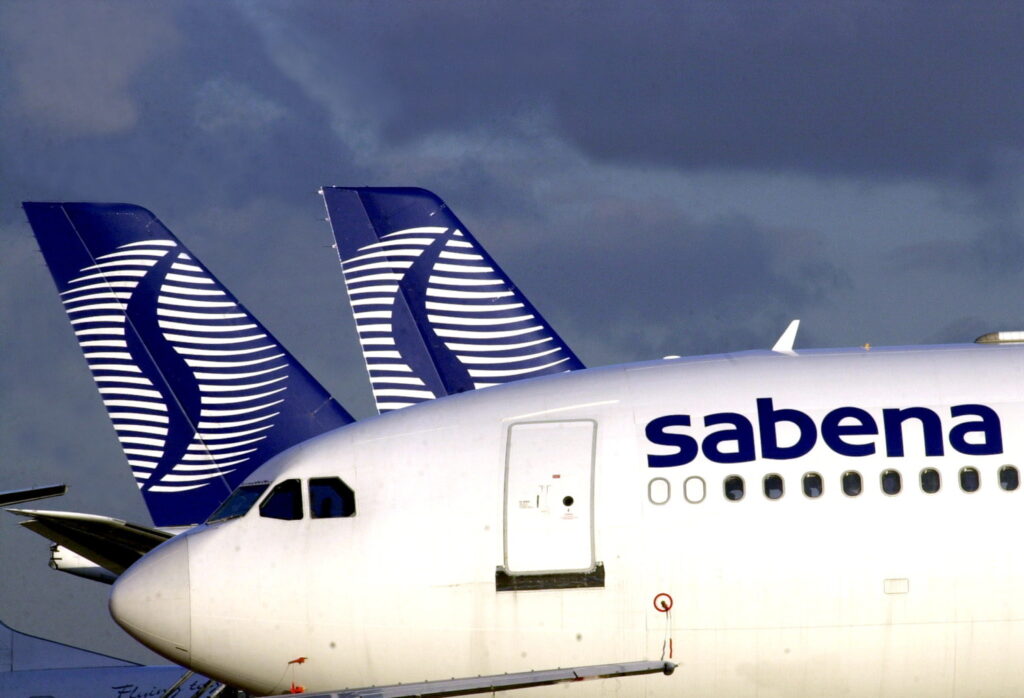
25 years after Sabena went bankrupt, an aviation economist says the collapse remains one of Belgium’s biggest industrial shocks, costing thousands of jobs and permanently reshaping Brussels Airport.
The Belgian national carrier employed 7,800 people, while the wider group accounted for about 12,000 jobs. Its failure had consequences far beyond the airline itself, said Wouter Dewulf, a professor at the University of Antwerp who specialises in the economics of air transport.
Sabena had been at the centre of activity at Brussels Airport. Its disappearance wiped out a large share of flights and transfer passengers, weakening the wider airport ecosystem.
Related News
- 'Uni is the best time to start a business': Record number of student entrepreneurs in Belgium
- Deal on EU air passenger rights: What changes for travellers?
- Once die-hard savers, can Belgians become natural-born investors?
Between 2000 and 2002, passenger traffic at Brussels Airport fell from 21.6 million to 14.4 million, a drop of about one third, Mr Dewulf said. He noted that the 11 September 2001 attacks also contributed to that decline.
The bankruptcy also forced major changes at the airport. According to Mr Dewulf, Brussels Airport became more efficient, more commercially focused and less dependent on a single customer, although he believes the airport’s 2004 privatisation played an even bigger role in that transformation.
Sabena’s collapse was also a serious blow to the Belgian government’s privatisation plans. Mr Dewulf said it would have been difficult to persuade international investors to buy into an airport that had just lost its main airline and nearly a third of its traffic.
In that context, the emergence of a new national carrier through SN Brussels Airlines was seen as almost essential to restore commercial credibility and protect the airport’s economic value.
The arrival of new shareholders accelerated Brussels Airport’s professionalisation and commercial development. Investment increased in terminals, retail, property, offices, car parks and logistics infrastructure.
Financially, the deal also proved highly attractive for investors, Mr Dewulf said. He estimated that the airport’s equity valuation rose from about €1 billion at the time of privatisation to around €7 billion in 2025.
That, he argued, raises a broader question: was privatisation really necessary to achieve such a transformation?
He points to Amsterdam Schiphol and Paris Charles de Gaulle as useful comparisons. Schiphol remains almost entirely in public hands, yet is one of Europe’s best-performing hubs, with nearly 69 million passengers in 2025, revenue of €2.76 billion and underlying net profit of €550 million.
In Paris, the French state still holds a 50.6% majority stake in Aéroports de Paris. Even so, the group has pursued an ambitious commercial strategy spanning aviation, property, retail and international investments, with revenue of €6.7 billion in 2025.
Mr Dewulf said those figures are not directly comparable with Brussels because of differences in scale, network and business scope. Even so, he said they show that majority public ownership is compatible with professional management, strong commercial ambition and high profitability.
He linked that argument to Flanders’ decision in 2025 to reinvest heavily in Brussels Airport by acquiring a 39% economic stake for €2.77 billion. Combined with the 25% still held by the federal state, Belgian public authorities now indirectly hold a majority economic interest in the airport, he said.
Brussels Airport posted record revenue of €828 million and net profit of €84 million in 2025, Mr Dewulf noted. He said that shows its commercial transformation is undeniable.
However, he added that the airport has also lost a significant part of its international connectivity since Sabena disappeared. Although passenger numbers have recovered in absolute terms, Brussels has dropped from about 10th place to 26th among European airports.
Mr Dewulf said four main lessons can be drawn from Sabena’s collapse. The first is that size does not guarantee profitability.
Sabena had a large network, an international fleet and strong brand recognition, but its business model was not financially sustainable, he said. Growth alone is not a strategy if it does not generate sufficient margins.
The second lesson is that a strategic partnership can be both a strength and a major risk. In Sabena’s case, the experience with Swissair showed that clearly.
Mr Dewulf said the Swiss group pursued an overly rapid expansion strategy that gradually weakened its own finances. At the same time, Swissair imposed an expensive fleet renewal programme on Sabena and aligned it with internal suppliers and services on terms that were often uncompetitive.
Today, Brussels Airlines benefits from a much stronger partner in Lufthansa Group, both financially and strategically, he said. Lufthansa’s full ownership of Brussels Airlines also ensures better integration and closer alignment of interests.
The downside, he added, is that Brussels Airlines now has far less strategic autonomy.
The third lesson is that an airline’s network must match the size of its home market. Brussels Airlines is unlikely ever to regain Sabena’s former scale, but Mr Dewulf questioned whether that is necessary.
He said its role should above all be to provide economically sustainable connectivity for Belgium, particularly to key European, African and US markets.
The fourth lesson concerns labour relations. Mr Dewulf said dialogue with trade unions is now generally more constructive and professional than it was in Sabena’s day, although tensions remain.
Asked whether the Belgian airport ecosystem is now structurally better equipped to withstand the failure of another major player, Mr Dewulf said it is, without hesitation.
But, he warned, that does not make it immune. Although Brussels Airlines benefits from the financial and commercial strength of Lufthansa Group, the German company must still divide investment and capacity across several European hubs, including Frankfurt, Munich, Zurich, Vienna, Rome, Brussels and now Lisbon as well.
The fundamental question, Mr Dewulf said, is what place Brussels will occupy in that strategy over the long term. He warned that it is far easier to cut an air route than to rebuild one, and that once transfer traffic has shifted to other hubs, it is especially difficult to win back.
