
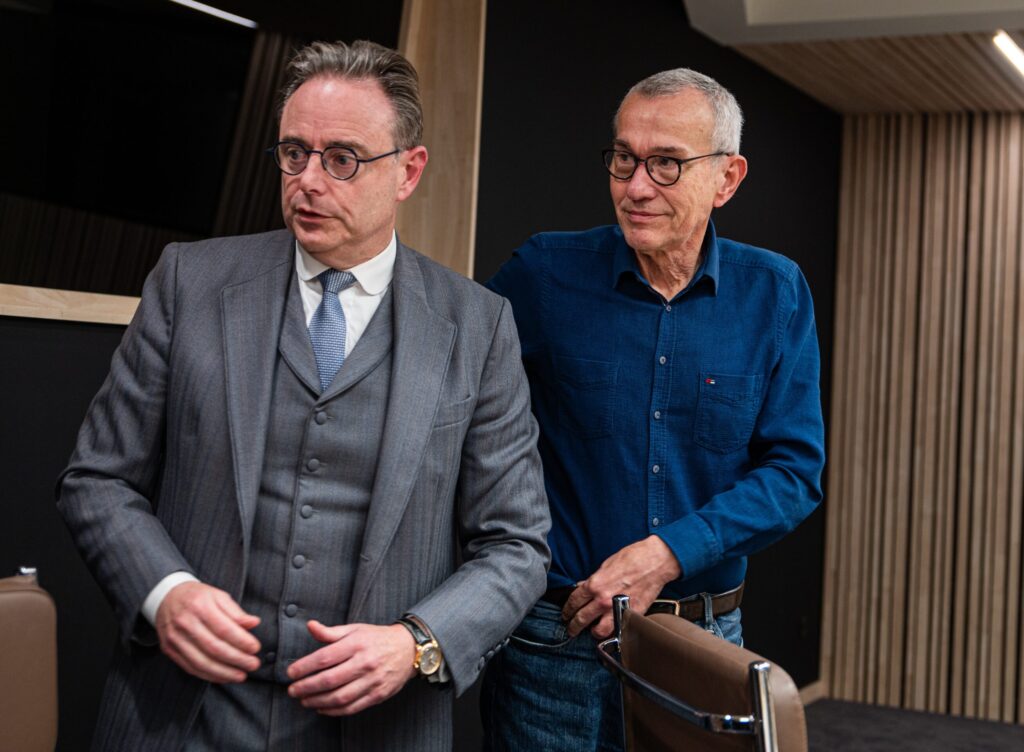
Belgium's Prime Minister Bart De Wever (N-VA) arrived at a meeting with King Philippe on Monday without an agreement on the 2027 federal budget, despite a deadline set by the monarch.
Over the weekend, limited progress was made as De Wever garnered support from four out of five coalition parties. As the negotiations collapsed late on Sunday, several parties pointed to Vooruit (Flemish social democrats) and its Minister of Welfare and Health, Frank Vandenbroucke, as the ones holding out.
"Vooruit’s refusal is detrimental to the process," Foreign Minister Maxime Prévot (Les Engagés) stated as he left the talks on Sunday. "The constant leaking of measures still under discussion undermines trust and makes negotiations extremely difficult. Particularly as incorrect information is also circulating and a distorted picture is being portrayed."
In recent weeks, the coalition had become split over increased taxes on wealth, as Vooruit and Les Engagés (Francophone centrists) wanted to shift the burden to the "strongest shoulders," while the MR (Francophone liberals) and De Wever's N-VA (Flemish nationalists) opposed the plans.
Related News
- On PM De Wever's chopping block to fix Belgium's budget: Non-profits, VAT and health care
- Belgium’s debt drift: Is the country's luck about to run out?
- Belgian King gives PM De Wever one more week to find budget agreement
De Wever managed to get Prévot to agree on a provisional budget in the final stretch.
By pivoting, Les Engagés isolated Vooruit in the negotiations, even going as far as publicly distancing themselves from their former allies.
"Vooruit’s refusal is detrimental to the process," Prévot stated as he left the talks on Sunday. "The constant leaking of measures still under discussion undermines trust and makes negotiations extremely difficult. Particularly as incorrect information is also circulating and a distorted picture is being portrayed."
A reporter for VTM Nieuws quoted directly from text messages they received from within Vooruit, criticising the PM as "stoïcally staring at a piece of paper."
According to Prévot, De Wever's ultimate proposal still included measures that were hard to stomach for his party, but made for a viable basis to find an agreement.
'Hopefully, the night will bring clarity'
The Belgian press agency Belga reported on Sunday that tension had been mounting between Vooruit and other parties in the coalition for several weeks.
Vooruit grew frustrated as it felt Vandenbroucke wasn't heard properly in the negotiations, saying that whenever the PM gave in on one of their demands, he would do so by compensating on another demand the party had made.
A source within the party points to the proposed indexation adjustment, a measure opposed by Vooruit, which was adjusted on Friday to include another €400 million in net earnings.
The other parties increasingly lost faith in Vooruit as a partner, Belga reports. The party's aggressive communication style directed at the Prime Minister and reported inconsistencies in their demands led to a breach of trust.
Vooruit's party leader Conner Rousseau responded to the criticism in a statement late on Sunday. "The other parties will point the finger at us. I’ll just have to accept that. But taking responsibility, my friends, also means protecting people from something that is unfair. Hopefully, the night will bring some clarity. Our country and its people deserve better."
The final hurdles
While Rousseau complains about the unwillingness of his "colleagues" to make the agreement "more fair," his coalition partners point toward several steps taken towards the demand by the social democrats.
The final agreement had been adjusted by over €1 billion in direct cuts to Public Health, with the ultimate disagreement amounting to "a couple of dozen million," VRT reports. De Wever initially proposed €3.6 billion in cuts to the sector.
Vandenbroucke has repeatedly pointed to the cuts and the adjustment in the indexing of pensions as unacceptable, as he proposed to instead eliminate the lowered social fees paid by athletes and professional football players.
MR leader Georges-Louis Bouchez, chairman of the football club Francs Borains, has directly opposed any changes to the reduction.
"Making further cuts to pensioners’ purchasing power, via the index, is a very sensitive issue for us," Vandenbroucke stated on Sunday.
