
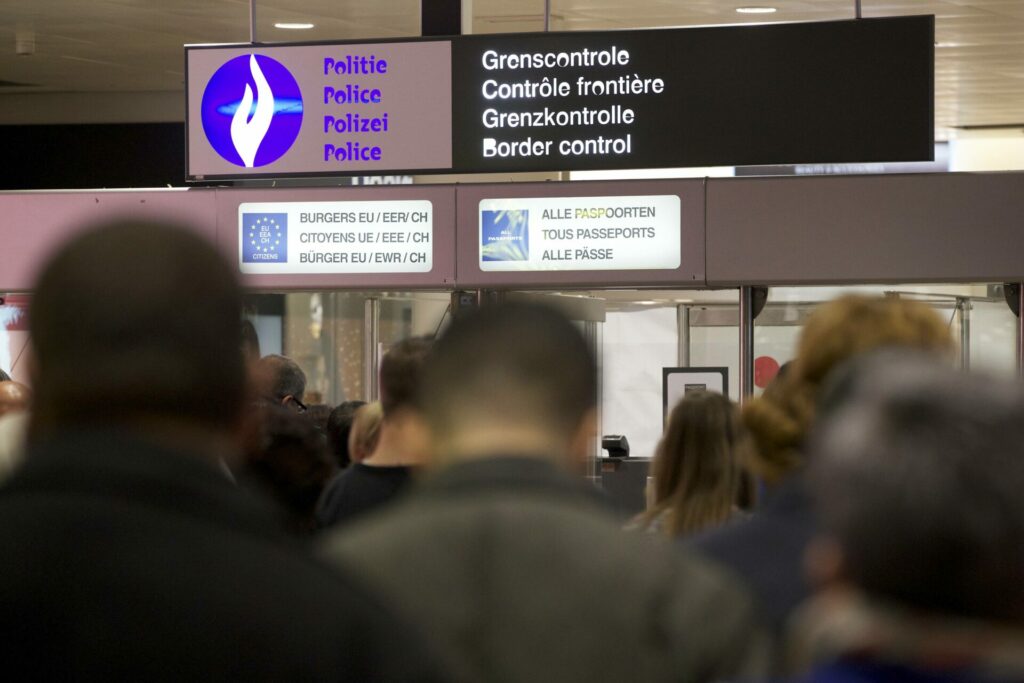
The EU implemented its new Entry-Exit system (EES) at its external borders on Sunday, allowing border control officials to dispense with passport stamps.
Under the new system, non-EU nationals travelling to 29 (mainly EU) countries must register their fingerprints and agree to be photographed. Participating countries must also log travellers' entry and exit dates. Although the roll-out is gradual, it already appears to be having a severe impact on travel, with some people reportedly left waiting for three hours at Brussels Airport this week.
One passenger, Rebecca Wells, flew from Chicago in the United States to Brussels Airport in Zaventem on Monday morning, landing just after 9am. She claims she was left waiting in a queue with her fellow passengers for almost three hours upon arrival.
Speaking to The Brussels Times, Wells, who was travelling with a US passport, said that the queue for EU passports was "considerably shorter" and went much faster than the one for arrivals from outside the EU.
When she got off the plane in Belgium, she entered a long hallway where her wait began. "There was nobody there to brief you or tell you what was going on," she said. "There was a restroom in the middle of the hallway and the end of the line wasn't very clearly marked. I was there for approximately three hours, and an hour in, there was a person who came with a cart full of water bottles."
The line at the Brussels Airport non EU customs would be far shorter if you actually had any staff !
Two out of 5 booths open at peak time! Belgium really is a joke @BrusselsAirport pic.twitter.com/xkVHRFGDv3 — Ezekiel 🇺🇸 (@Pontiac_Bandito) October 15, 2025
Despite the long wait, Wells said the new checks did not differ in any notable way from the traditional system: "The person at the end of the line in a booth just stamped my passport like normal. And there was a spot to put fingerprints, but he didn't ask for fingerprints and didn't ask me any questions, and I didn't have to fill out a form or anything."
Wells seemed reasonably unfazed by the process when explaining her situation, but noticed that for elderly passengers it wasn't as easy. "The whole time I was in line, I was well occupied. I was an individual traveller with a book, but there were some elderly people who had been on the flight with me and I imagined they must be in some kind of discomfort," she said.
First day of the new biometric screening for non EU nationals. The EU queue in Brussels airport virtually non existent in comparison pic.twitter.com/vfN2zDOA1s
— Joe Lynam (@JoeBLynam) October 13, 2025
A video of the queues taken by Estonian national Riina Lynam and shared on X by her husband Joe.
No issues for EU travellers
Riina Lynam, in contrast, had no issues travelling through the EU queue on an Estonian passport on Monday morning. "It's all digital in Brussels and [when I travel back to Ireland] I use my ID card, so I have no issues there," Lynam, who works for The European Parliament and travels to Belgium every week, told The Brussels Times. "But unfortunately, I saw a lot of Brits had to join the long queue when they arrived from Dublin. There was a lot of swearing!"
She first started noticing long queues over the summer and in September, but said the queue on Monday was much longer, stretching from passport control to the end of the terminal. "I couldn't even see the end of the line."
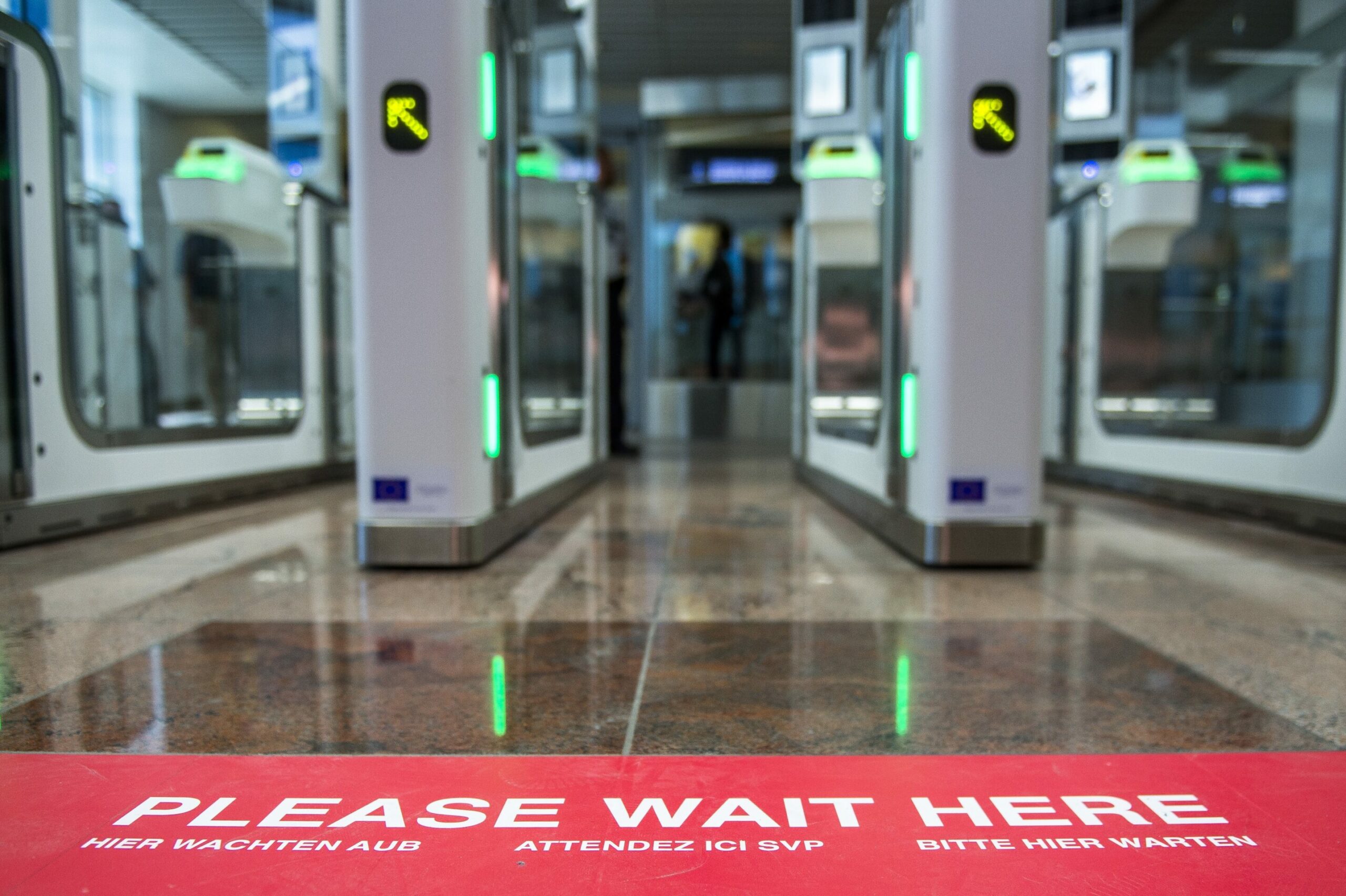
The inauguration of the e-gates, automated border control gates, at Brussels airport in Zaventem, Friday 10 July 2015. Credit: Laurie Dieffembacq / Belga
When approached by The Brussels Times, a press officer at Brussels Airport could not confirm whether the long waiting times were due to the Entry-Exit system, but said it was a "peak moment" with many passengers arriving at once.
Meanwhile, a spokesperson for the Federal Police, which is responsible for the airport's border control, attributed the long wait time to "a combination of factors".
"Although we are thus taking all possible measures to minimise waiting times, queues are of course possible, especially during peak hours when a lot of extra-Schengen arrivals are scheduled around the same time," the spokesperson said.
Changes to Eurostar
The new system also applies to Eurostar, and 49 Entry-Exit kiosks have already been installed in the St Pancras terminal in London. Just days after its launch, however, several controversial questions posed to non-EU nationals have been scrapped.
Passengers were initially set to answer questions on whether they had a return ticket, sufficient funds, booked accommodation and medical insurance, according to The Independent. France imposed the latter two, which are not new but have also not been used for years. Travellers who did not meet these conditions were then liable to be questioned further by border police.
Many expressed concerns that a lengthier process could lead to longer delays and passengers being turned away. However, French authorities have now allegedly agreed to drop the questions during the roll-out of the new system.
"We know those questions have caused significant confusion, particularly within the kiosk process," Eurostar's chief stations and safety officer, Simon Lejeune, told the UK House of Lords Justice and Home Affairs Committee. "We're very pleased that, through discussions with the French ministry and our colleagues, it's been agreed that those questions can be technically removed from the kiosks during the initial six-month introduction phase of the new system."
