
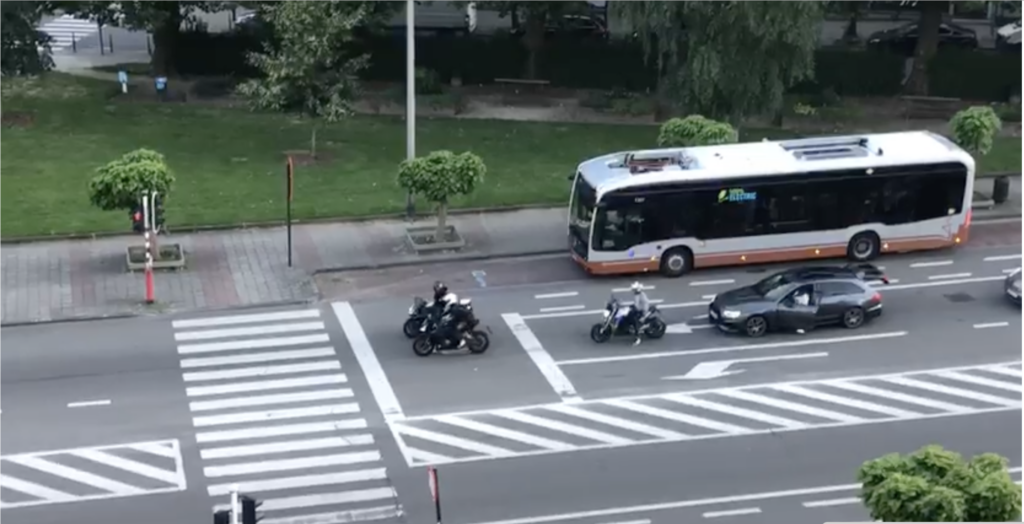
Young people riding screeching motorbikes and doing wheelies through Brussels streets day and night have become a serious disturbance to residents who feel powerless dealing with an adapting phenomenon.
Vincent Bourgeois represents Stop Rodeo Atomium, a committee of Brussels citizens who live near the Heysel plateau and are fed up with youths on motorbikes and scooters taking over streets and carrying out earsplitting high-speed stunts in what has become known as urban rodeos.
For more than a decade now, Bourgeois says they have been fighting tooth and nail to put a stop to the phenomenon, but are rather frustrated due to the cat-and-mouse game and without answers that address the issue structurally, once and for all.
Around the Heysel plateau, urban rodeos started with luxury cars in 2015, Bourgeois told The Brussels Times. The area beneath the Atomium became a meeting for urban rodeo enthusiasts driving at high speeds. "They were renting cars for €600 or €700 for a weekend just to come and drive around the Atomium."
Citizens living nearby saw rodeos becoming more frequent during the Covid-19 pandemic. Bourgeois thinks that there is a link to nightlife coming to a halt during lockdowns and curfews; some who previously gathered in clubs began renting these high-end cars to meet and race around the plateau instead.
"They would drive in circles around the roundabout below the Atomium, constantly."
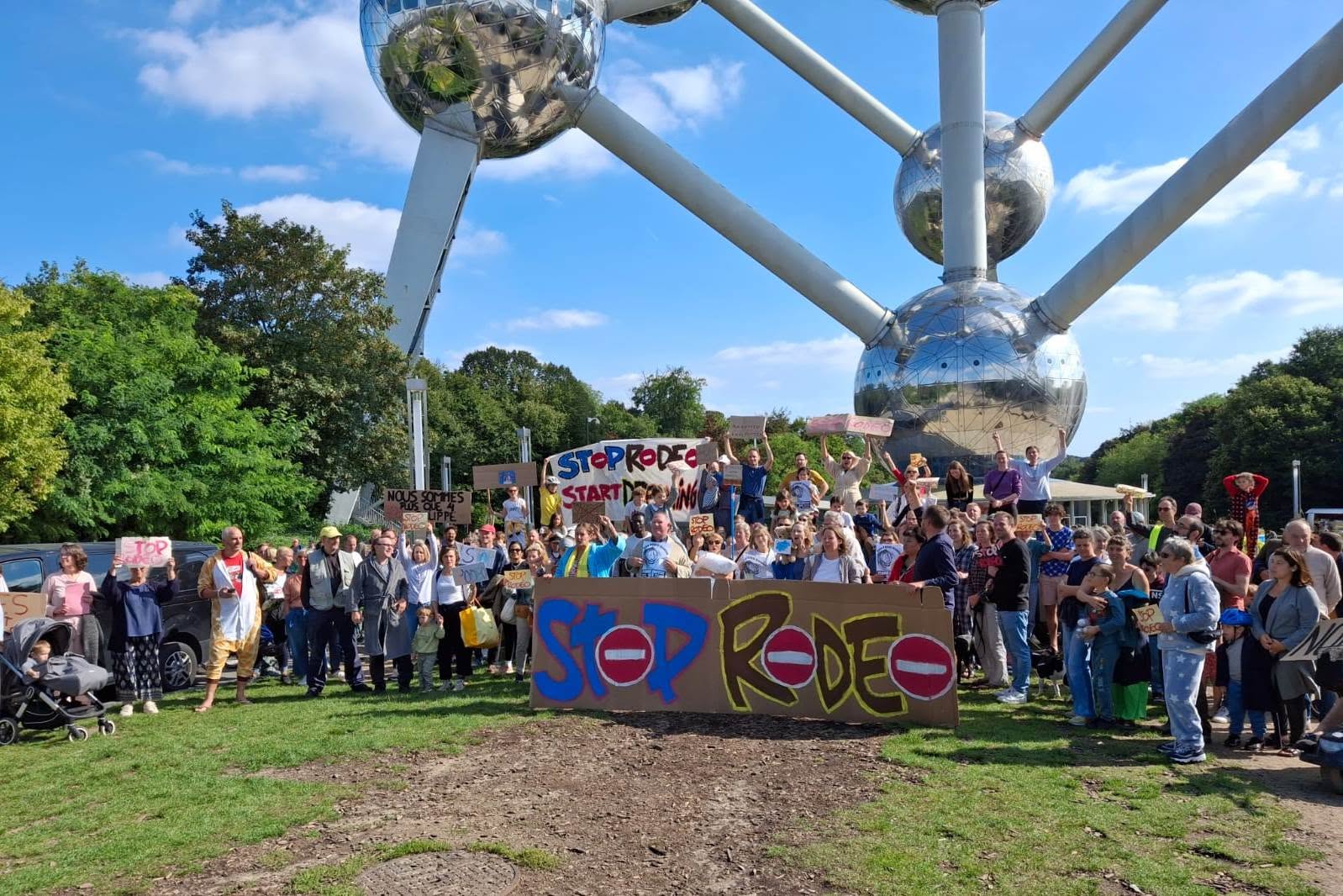
Stop Rodeo Atomium used an April Fool's joke to highlight the lack of structural action against illegal urban rodeos around the Heysel plateau, joking that rising fuel prices had succeeded where politics had failed. Credit: Stop Rodeo Atomium.
Unlike France, Belgium does not currently have a specific legal framework covering the matter, which makes it slightly more complicated to combat. Police can only arrest participants for violating existing traffic rules that prohibit speed contests and certain forms of dangerous driving.
Police spokesperson Ilse Van de Keere told The Brussels Times that in 2025, they had intercepted 53 cars and 15 motorcycles "in connection with the phenomenon". All 68 vehicles were towed away. Of these, 43 were dealt with through judicial procedures and 25 through administrative measures. Another 37 drivers had their driving licences withdrawn.
City of Brussels Mayor Philippe Close's (PS) cabinet told The Brussels Times the City has "significantly stepped up its response to urban rodeos", with more than 370 vehicles seized through administrative and judicial procedures and over 185 driving licences withdrawn since an administrative seizure system was introduced.
"More than 25 speed cushions and other safety measures have been installed across the Heysel plateau, while nearly 2 km of roads have been converted into pedestrian areas," the cabinet highlighted.
A proposal bill submitted to the Federal Parliament in May 2025 intends to define and fully cover urban rodeos in the country. In it, an urban rodeo is defined as "the intentional and repeated carrying out of manoeuvres with a motor vehicle that breach road-safety rules and either endanger other road users or disturb public peace."
If passed, offenders could face between 15 days and one year in prison, a fine of €200 to €2,000 and a driving ban ranging from eight days to five years, or even permanently. Penalties would be increased when offences are committed in groups or involve aggravating circumstances such as drink or drug-driving, or driving without a valid licence.
Another urban rodeo filmed by a resident in Avenue Miramar, Laeken Credit: Handout
Bourgeois said that residents demanded action from the City of Brussels, which Close responded to by installing concrete blocks and speed cushions in the area. These largely disrupted car rodeos, bringing their activities to a halt for a while. But riders then switched to motorbikes, which are far more difficult to stop through road design alone.
The shift is also acknowledged by City of Brussels councillor David Weytsman (MR), who said measures taken against car rodeos have produced results but that motorbikes have become the new challenge.
"Not everything has been resolved, but car rodeos and the nuisance linked to certain wedding processions have clearly decreased," he told The Brussels Times.
'Cross bitume'
Now, Bourgeois said, bikers gather near Place du Centenaire before dispersing across the Heysel plateau and neighbouring avenues. They now also perform the urban rodeos around Brussels Expo, the Roi Baudoin Stadium, and the Mutsaard neighbourhood in Laeken. Complaints from municipalities like Schaerbeek are also on the rise, since the issue is spreading and starting to take over other streets in the Capital.
Their activity, said Bourgeois, follows a predictable pattern: when temperatures are mild, "they are there every evening". "It starts quietly around 19:00 or 20:00, but after midnight it becomes much worse and can continue until three or four in the morning."
They sometimes remain stationary for five, ten, or 15 minutes while repeatedly revving their engines in broad daylight, which means the effects can be felt even when no race is underway.
Some residents who have approached riders themselves have been threatened. One resident sent The Brussels Times a video of bikers taking off at the intersection of Avenue Houba and Avenue Sobieski in Laeken right outside her window. The resident said they were hesitant to start filming, after having already been insulted by a biker.
Bourgeois said summer months are particularly difficult. The same warm, dry evenings that encourage people to leave their windows open are also when gatherings are most frequent. "There are nights when it's almost impossible to sleep," he explained. "You fall asleep, then you're woken up an hour later. You manage to fall asleep again, and then it starts all over."
Families with babies and the elderly suffer from sleep deprivation since repeated bursts of engines revving make it harder to have a good night's sleep.
Urban Rodeo taking place between Avenue Houba and Avenue Sobieski in Laeken Credit: Handout.
What to do?
Police told The Brussels Times that since Brussels Public Prosecutor Julien Moinil took office, there is now a preference for dealing with urban rodeos through judicial rather than administrative measures. This means that the consequences for those caught taking part are more severe, with responses beyond fines and local administrative sanctions moving towards prosecution.
Close said the city's approach is continually adapted as the phenomenon evolves, including targeted operations involving plainclothes officers on unmarked motorbikes, and changes aimed specifically at motorcycles that still partly evade existing measures. Drivers caught in the act can also face accelerated court proceedings, while Brussels Mobility carries out checks on illegally modified vehicles that generate excessive noise.
Following a new meeting with residents, the City executive is examining ways to close certain accesses to the Heysel plateau, according to Weytsman. The objective would be to prevent motorbikes from using parts of the plateau as a transit route and make it harder for the gatherings to take place.
Weystman said he would introduce "many more police checks and much tougher sanctions" immediately, if there were no constraints. He wants police operations concentrated at the places and times where riders regularly gather, accompanied by vehicle seizures.
Weytsman went even further, saying he would support the public destruction of vehicles used for urban rodeos if legislation allows it. "The message must be crystal clear: a vehicle used for a rodeo can be lost," he says.
He also supported introducing noise radars once they can be effectively used to sanction excessively loud vehicles. Such devices could identify vehicles exceeding permitted noise levels in a similar way to speed cameras.
Their deployment, however, illustrates another difficulty facing Brussels: responsibility for tackling the phenomenon is divided between different levels of government.
Noise radars
Weytsman said there are currently legal, technical, and budgetary obstacles to deploying some of the measures under discussion. At regional level, MR politician Anne-Charlotte d'Ursel has questioned the Brussels Government over the deployment of noise radars.
Their homologation is still ongoing, according to Weytsman, who wants the Brussels Region to prepare the necessary framework so they can be introduced quickly once enforcement becomes possible.
In the meantime, he argued they could potentially be deployed preventively and educationally, similarly to speed displays that inform drivers how fast they are travelling without automatically issuing a fine. "The problem is precisely that it depends on several levels of government. But that must not become an excuse for doing nothing."
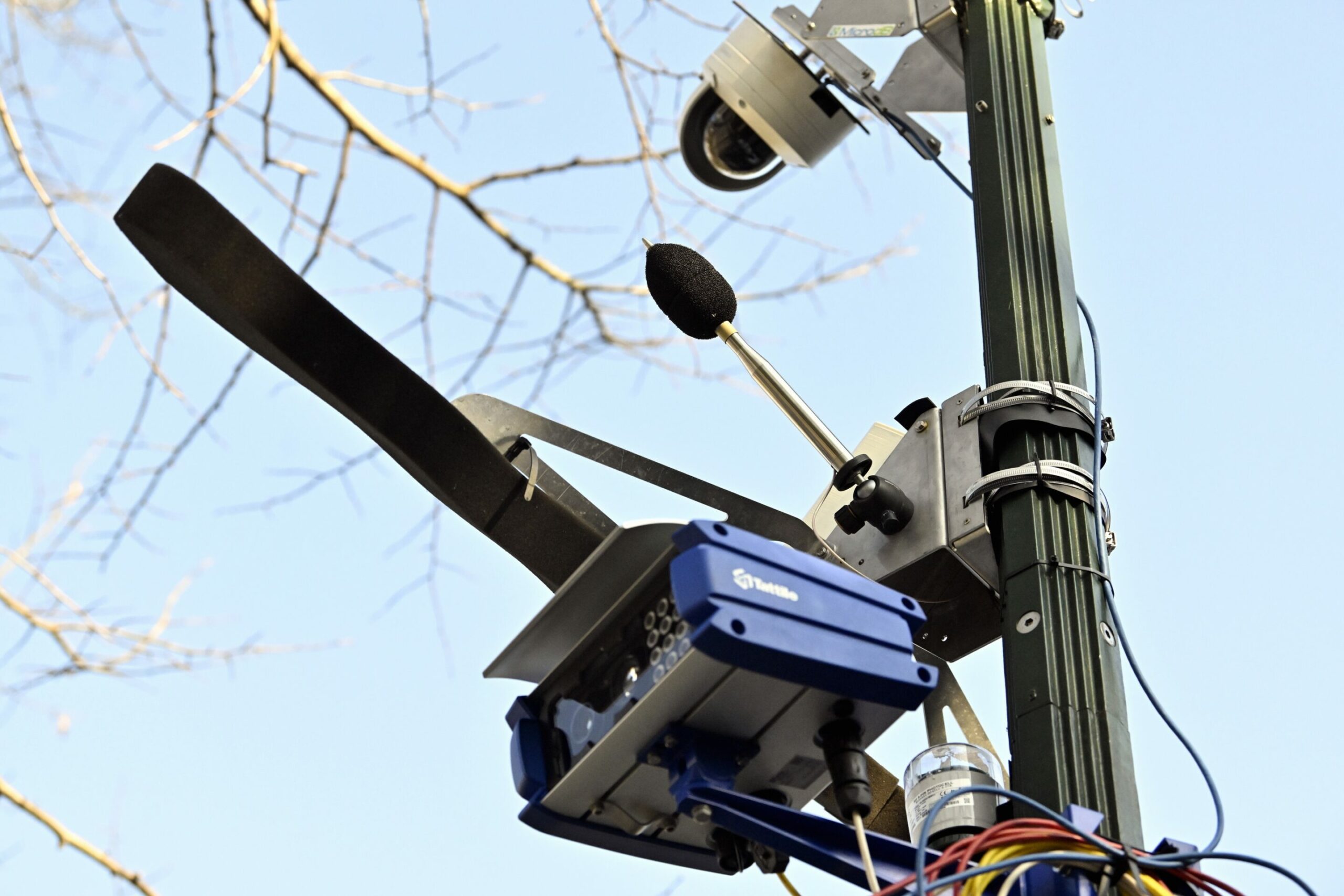
The first anti-noise radars in Brussels, 14 February 2023. Brussels Environment was testing two prototypes to measure vehicle noise. Credit: Belga / Eric Lalmand.
The Stop Rodeo Atomium group has raised the issue with the mayor and has also organised demonstrations, including a "pyjama protest" attended by around 100 people to highlight residents' disrupted sleep. They acknowledge that police patrols have become more visible at certain times, but argue that enforcement remains too inconsistent to prevent the gatherings from returning.
Residents have been encouraged to call the emergency services when a rodeo is taking place, but they say repeatedly calling 112 is not a sustainable answer to a phenomenon that has persisted for almost a decade.
The group has also called for more automated enforcement, including ANPR cameras capable of identifying vehicles entering or repeatedly circulating around the area. The association estimates that such cameras could cost between €30,000 and €40,000.
