
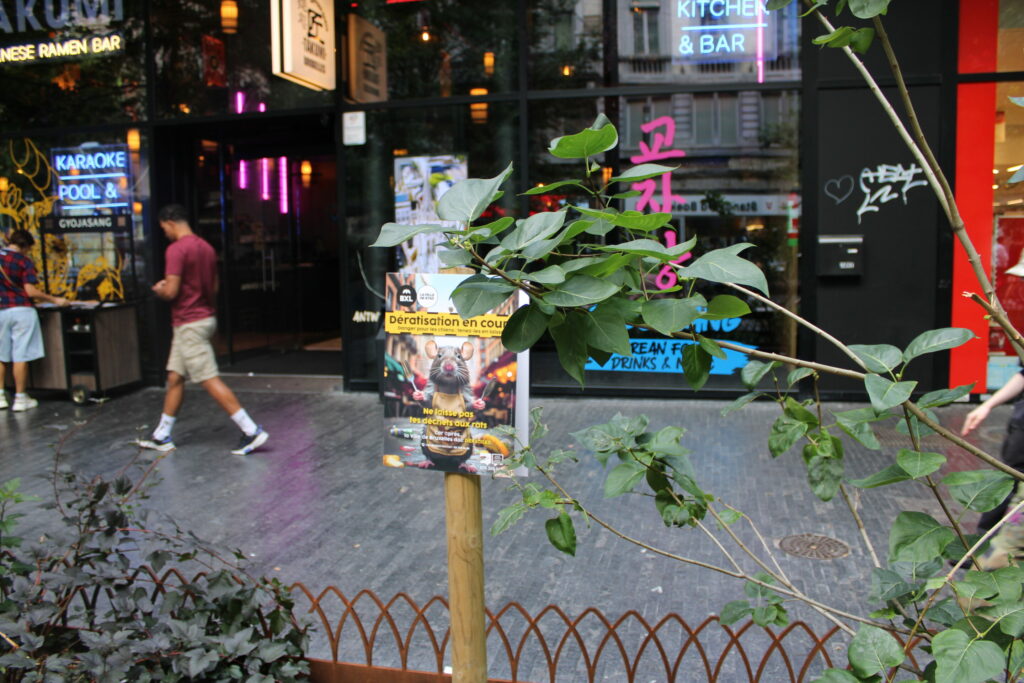
Rats have become more visible in Brussels' pedestrian zone on Boulevard Anspach and its surrounding streets, despite efforts to control their population.
If you happen to wander the streets of Brussels' centre around the pedestrian zone at night or early in the morning, you have probably been taken aback by the sight of rats going in and out of their lairs, or crossing the street to look for scraps of food.
On the night of 2 to 3 September, a scene was captured by passers-by at the Grand-Place, showing a mouse scurrying along a luxury chocolate shop display window; the rodent, visibly distressed, was looking for a way out.
"It was half past midnight. We were walking through the Grand-Place on our way home when we spotted a mouse in the shop window," one of them told Sudinfo, visibly surprised. "We thought, 'Wow, this can't be happening!'"
Related News
A few meters away, on Boulevard Anspach, a highly frequented fried chicken spot is all too familiar with the issue. The manager, who preferred to remain unnamed, told The Brussels Times that rats and mice are becoming part of the scenery in the city centre. Especially at night, "it's a rat party", he said.
He traces part of the problem back to the extensive works that transformed the central boulevards into the pedestrian zone. When the ground was opened, he believes rats living underneath were disturbed and pushed towards the surface.
"They multiplied after the major works, and now, we have become Paris," he said.
His observation is not entirely dismissed by the City of Brussels' councillor Public Cleaning, Anas Ben Abdelmoumen (PS); his cabinet told The Brussels Times that construction works can indeed temporarily make rats more visible. The cabinet is also working with the City of Brussels' green space department to adapt planted areas where rodents can find shelter.
But the City explains that what is happening beneath the pedestrian zone is only the tip of the iceberg; the rest is what lies above it.
All-you-can-eat buffet
With restaurants, fast-food chains and terraces stretching along much of the pedestrian zone, food is rarely far away. Neither are the leftovers. The City of Brussels says its cleaning teams intervene several times a day and empty bins regularly, with an additional round during hot days.
Yet whole pieces of bread, pizzas and other food scraps are still sometimes thrown in public spaces. And that eventually attracts rodents. "If rats don't find food, we are there to eradicate them," Andreas De Kerpel, Ben Abdelmoumen's spokesperson, told The Brussels Times.
People feeding pigeons (although without intentional harm) are another source. The seemingly harmless act can provide an easy meal for rats, which is why feeding animals in public spaces in prohibited around the capital and can result in a €200 fine.
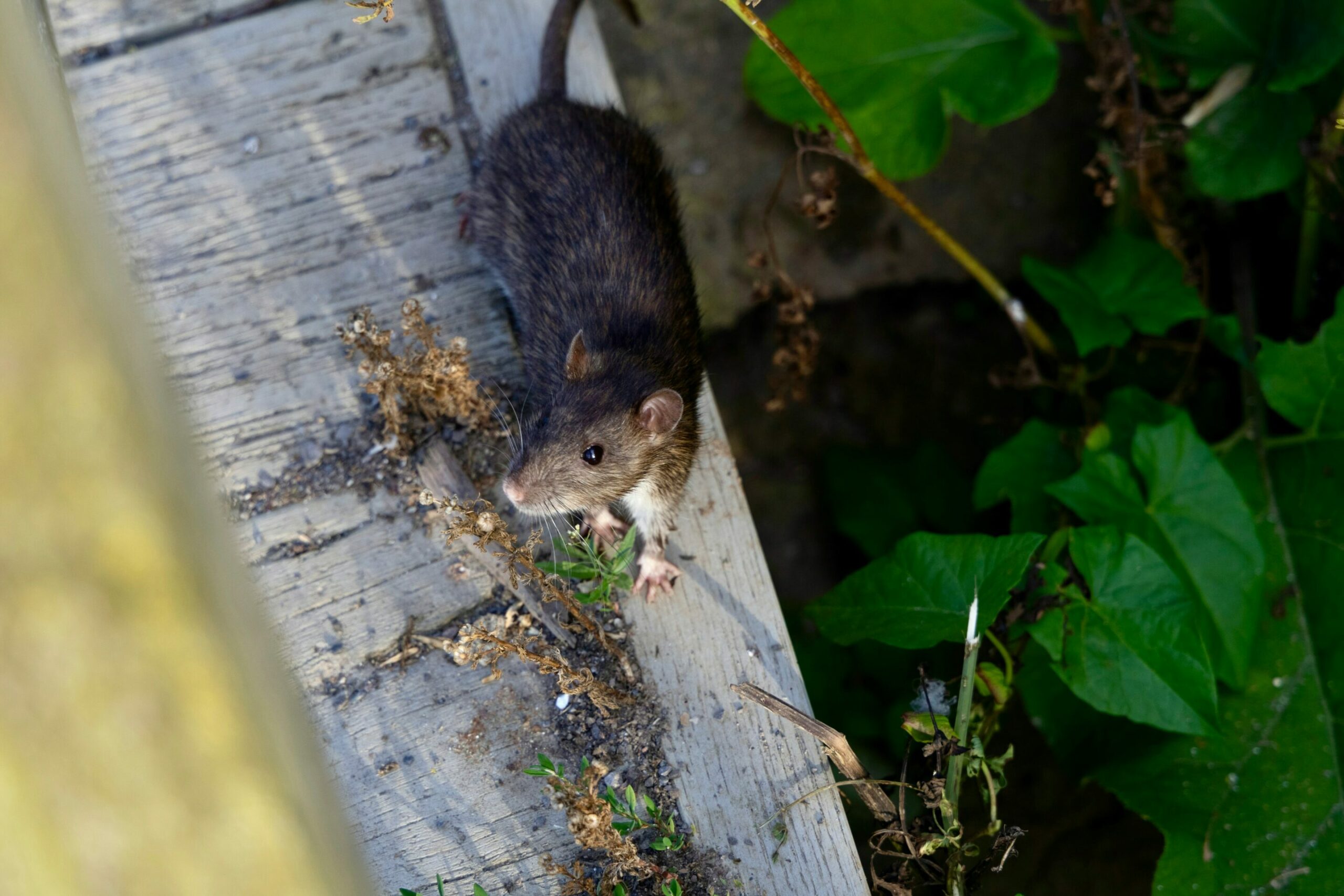
15 smart traps were installed this summer in the pedestrian zone as part of the City's intensified rat-control campaign. Credit: Unsplash.
The fried chicken restaurant faces the other side of the equation. The restaurant keeps food refrigerated and off the floor, and pays a private pest-control firm to regularly inspect and protect the premises.
"We pay for all of that ourselves," the manager said. "For us, as a business, it's important that we protect ourselves." There are also routine controls by the Federal Agency for the Safety of the Food Chain (FASFC).
The precautions do not stop at his restaurant door, however. Once rubbish reaches the street, keeping food away from rodents becomes a collective problem.
Brussels Cleanliness' spokesperson Adel Lassouli told The Brussels Times that its teams regularly encounter poorly closed or insufficiently protected bags, which can spill food onto the pavement.
Commercial waste (in pink bags) also follows a different system from household rubbish. Restaurants choose their waste collector and collection frequency based on their needs, as rubbish collection for restaurateurs is privatised.
Lassouli stressed that most comply with the rules, but it only takes a minority to put rubbish out at the wrong time, to exceed the volumes covered by their contracts or to attempt to dispose of commercial waste alongside household collections to attract rats. The longer food waste remains accessible, the longer rats have to find it.
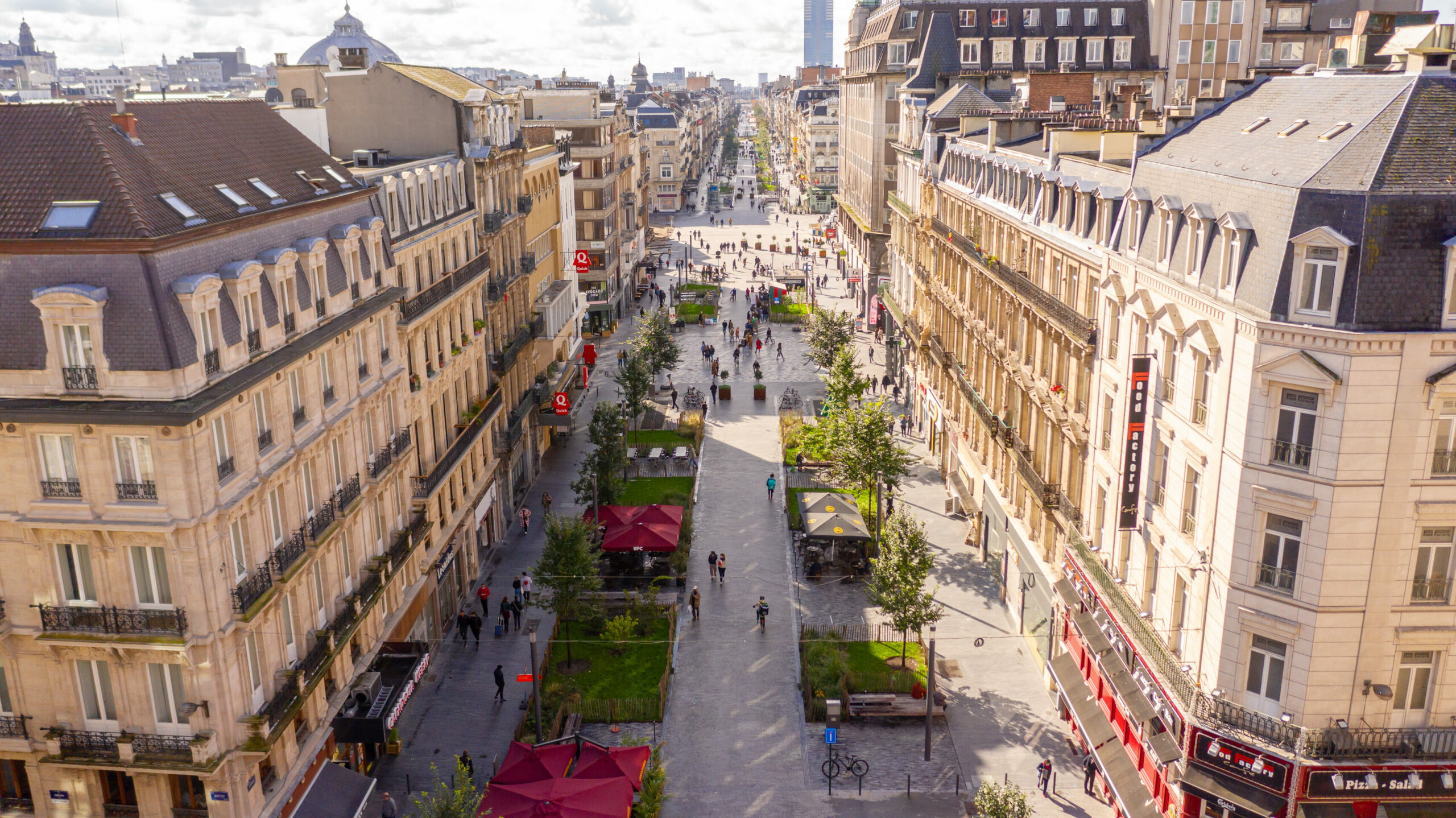
Boulevard Anspach. Credit: Beliris.
Brussels is hardly the first major city to discover how difficult that cycle is to break.
Paris, which the Anspach restaurateur jokingly invoked when describing Brussels' situation, has spent years combining conventional rat control with measures aimed at the environment sustaining the animals. Rather than relying solely on extermination, Paris' approach has included restricting access to food and water, protecting rubbish and reducing potential nesting sites.
Across the Atlantic, New York has pushed the same logic considerably further. The city has progressively moved rubbish away from loose bags left on pavements and towards sealed containers. Food-related businesses were among the first required to use containers, and collection rules were changed to shorten the amount of time rubbish could remain outside.
Around 70% of New York's rubbish must now be containerised, according to the city's sanitation department. The goal is to cut of one of the resources sustaining the rat proliferation.
And the principle is one that a Brussels rat catcher explained to The Brussels Times long before the latest sightings on Boulevard Anspach.
The Pied Piper of Brussels
Last year, The Brussels Times accompanied biologist and pest-control specialist Jean De Marcken through the Jean Glineur gardens in Etterbeek.
His equipment was somewhat less technological than New York's waste containers or Brussels' latest traps: a border terrier named Théo and a pair of ferrets trained to pursue rats through their underground burrows.
De Marcken's explanation for why rats flourish in cities was remarkably simple.
Three things are needed: food, shelter and the capacity to reproduce. Remove one of those conditions and the population becomes considerably harder to sustain.
Brown rats, he explained, are not simply wild animals that happen to enter cities. They have adapted extraordinarily well to living alongside humans, in sewers and basements, beneath parks, around rubbish and close to restaurants.
That makes Boulevard Anspach almost a case study of the conditions De Marcken described.
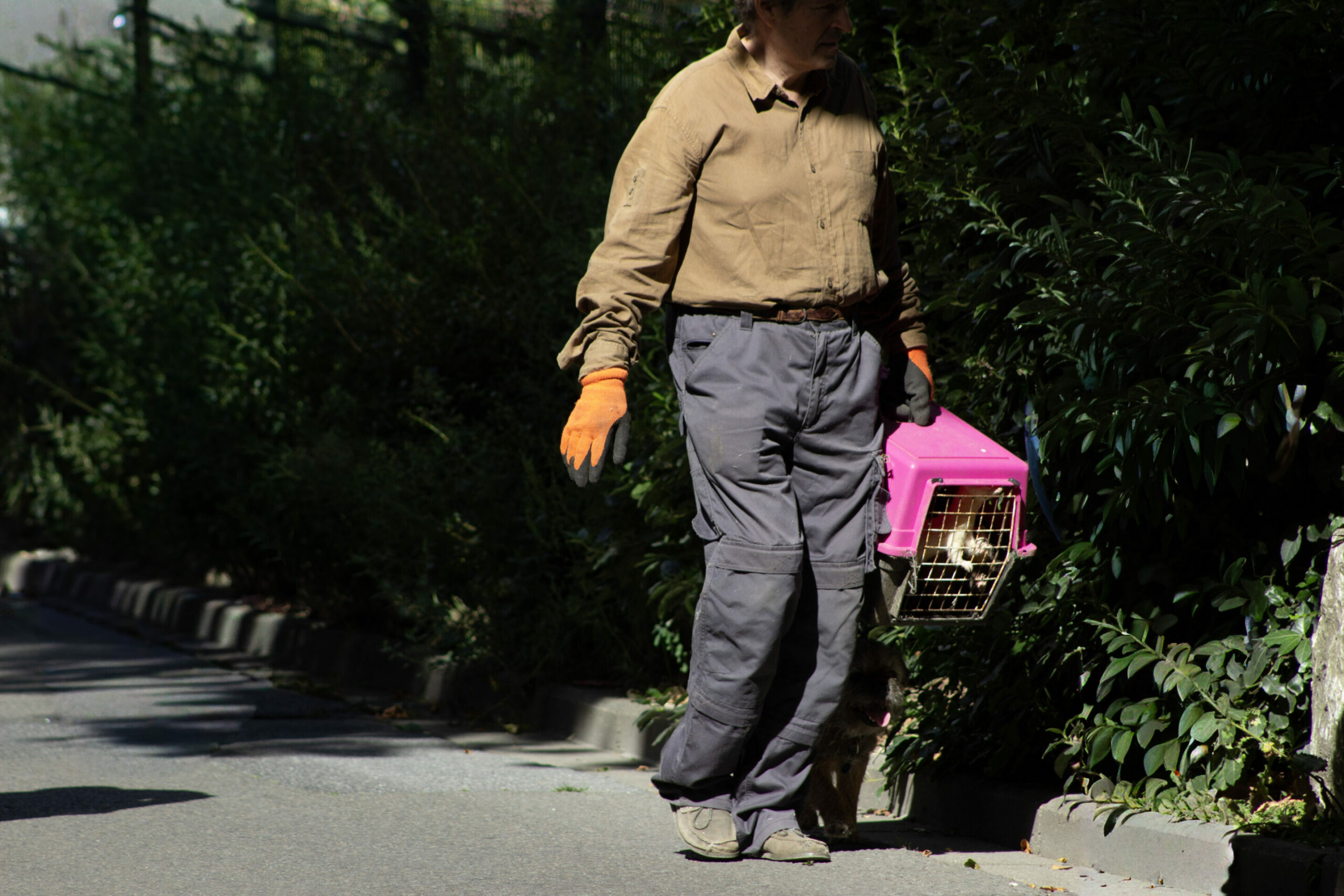
Armed with a leash, a dog, and a ferret, Brussels’ pied piper tackles the city’s most persistent residents. Credit: Ingrid Morales
Brussels counts its rats
What has changed since then is Brussels' ability to fight the rat, and count them. The City has increased its annual rat-control budget from €35,000 to €100,000 and purchased 25 digitally monitored smart traps, including 15 installed on the pedestrian zone this summer.
The devices lure rats, trap them inside, and immediately send information about each capture to municipal teams. This lets the City of Brussels' authorities see where and when rodents are caught. So far, the smart traps alone have caught 1,073 rats.
The figure does not include rats killed using conventional poison, which the City continues to deploy daily. Unlike the digital traps, however, poison makes it virtually impossible to know precisely how many animals have been killed.
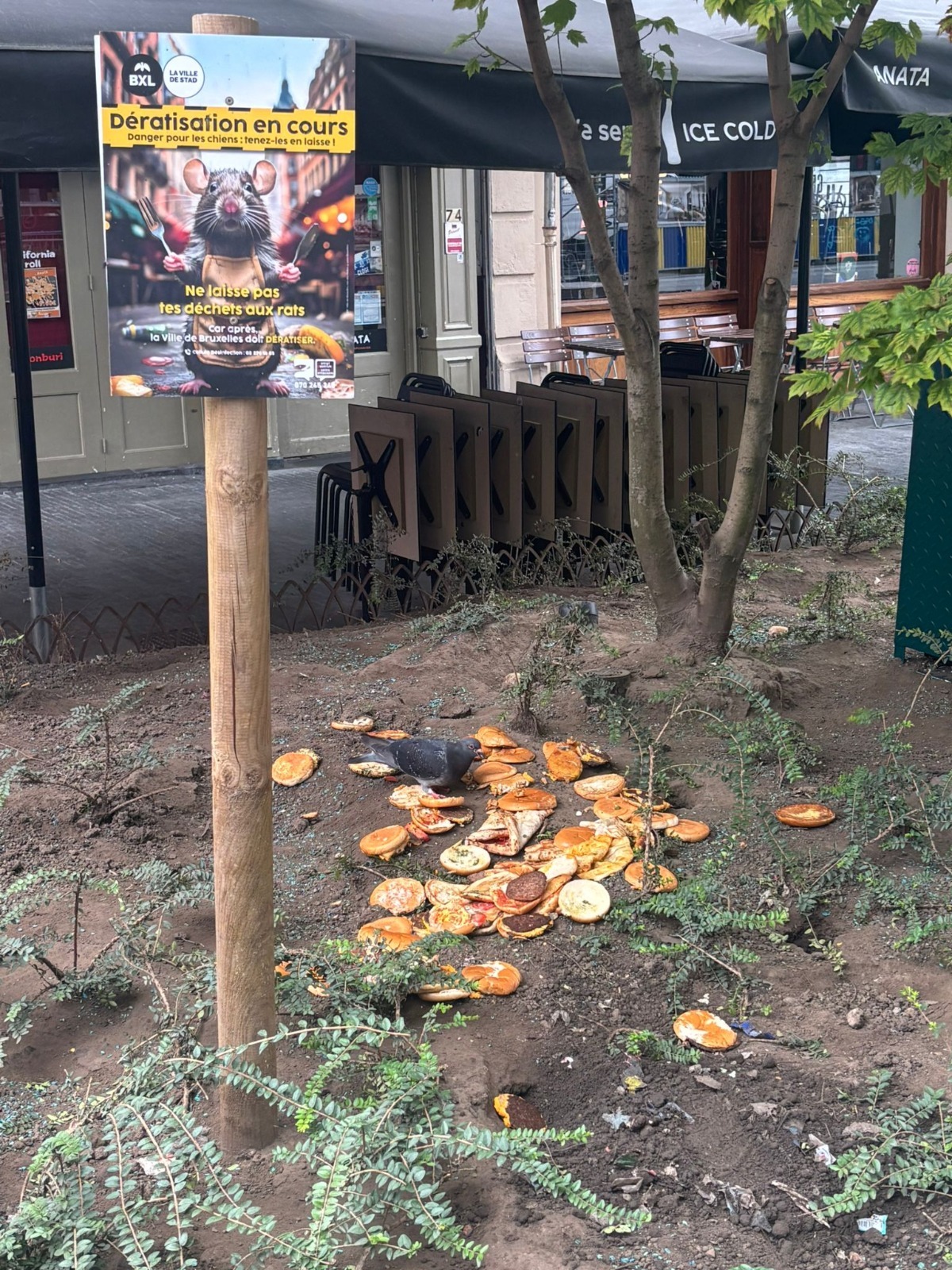
Despite signs urging people not to leave food in public spaces, loaves of bread can still be seen discarded on the ground around Brussels' pedestrian zone, providing an easy food source for rats. Credit: Anas Ben Abdelmoumen Cabinet.
That also means Brussels cannot reliably say whether there are more rats today than in previous years. Until the smart traps arrived, the City had no objective tool to produce comparable data on captures and activity. Now, the authorities are considering going further.
A public procurement procedure has been launched to find a specialist who can catch rats using ferrets, bringing the method De Marcken used in Etterbeek to the City of Brussels.
Around the Atomium, where the smart traps have already caught roughly 900 rats, the City says the situation is now "more or less under control". But Boulevard Anspach might prove harder.
It is one thing to remove rats from underneath a city. It is another to remove the conditions that keep bringing them back. For the restaurateur who watches them emerge around the pedestrian zone, complete eradication seems unlikely.
"They reproduce very quickly," he said. "There is no definitive solution."
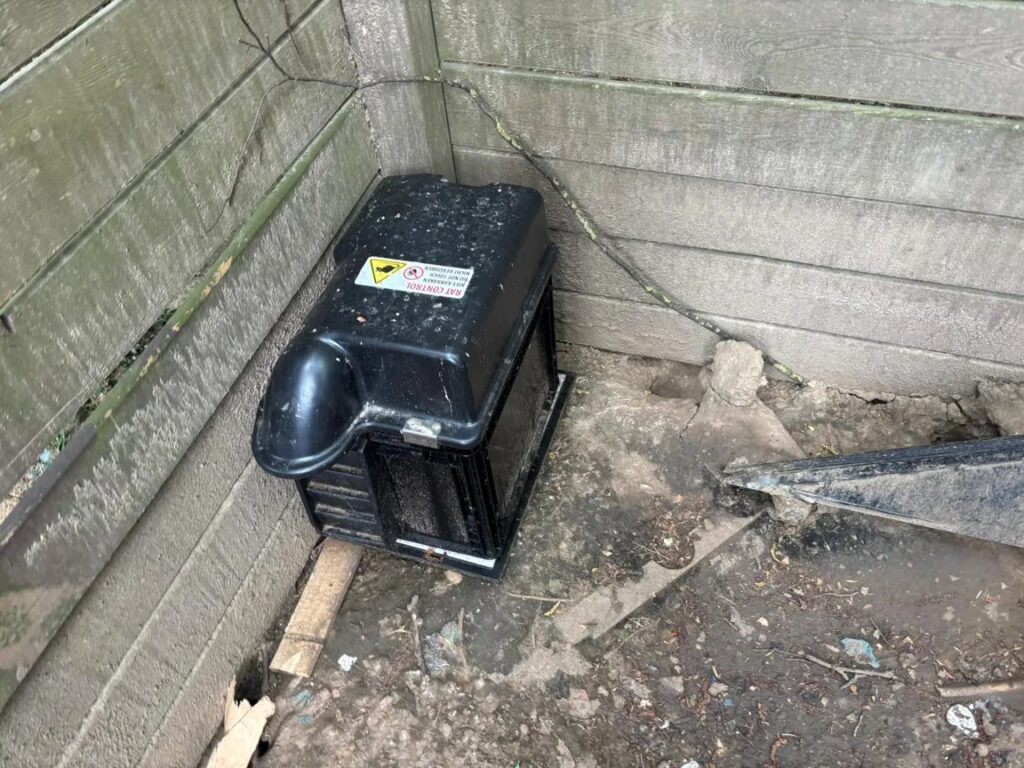
One of the digitally operated smart rat traps deployed by the City of Brussels to monitor and control the rodent population in real time. Credit: City of Brussels.
