

A Brussels Airlines passenger said she had to pay over €200 for a train ticket when her return flights were cancelled after she was wrongly labelled a no-show on a flight last year.
The widely used 'no-show’ clause typically means airlines can cancel return or subsequent flight tickets if a passenger is not present on an outbound trip.
Earlier this month, a Brussels Airlines passenger, Piret Mårtensson, told The Brussels Times she had to pay €355 for new return flights after she was incorrectly marked as a 'no-show’.
The story was very familiar to Nanna Bille Cornelsen, a 32-year-old Brussels-based NGO worker, who had her return flights cancelled by Brussels Airlines for the same reason in 2025.
Cornelsen said reading about Mårtensson's similar situation gave her a sense of "relief” after spending months trying to come to terms with an experience she compares to “fighting against Goliath.”
She was one of several people who came forward with similar experiences – though the only one whose story we have been able to investigate and independently verify.
Invisible passengers
Cornelsen said she flew with Brussels Airlines on 27 September 2025 from Brussels to Hamburg to visit her family.
Just like Mårtensson, she told The Brussels Times her outbound trip was "normal”: she said her ticket was scanned and she even received a security briefing before boarding as her seat was located near an emergency exit.
However, when she tried to check in for her return flight on 5 October, she was told her tickets had been cancelled because Brussels Airlines marked her as "no-show” on her outbound flight.
After a few hours of calls to customer service and conversations at Hamburg airport with staff from Brussels Airlines’ parent company, Lufthansa Group, Cornelsen “admitted defeat” and returned to her parents' home for the night.
She ultimately had to book a €225.89 train ticket to return to Brussels the next day. "There was no way I was going back to Hamburg Airport after all of that,” she told The Brussels Times.
Same story, same conclusion
Days after the incident, Cornelsen sent Brussels Airlines’ customer service documents and images to prove that she was on her outbound flight, including her digital boarding pass, text messages with her partner, and pictures inside the plane.
In an email from 2 March 2026 seen by The Brussels Times, a customer relations agent apologised for the experience but told Cornelsen that the flight was cancelled in line with their policy as she was labelled as "no-show".
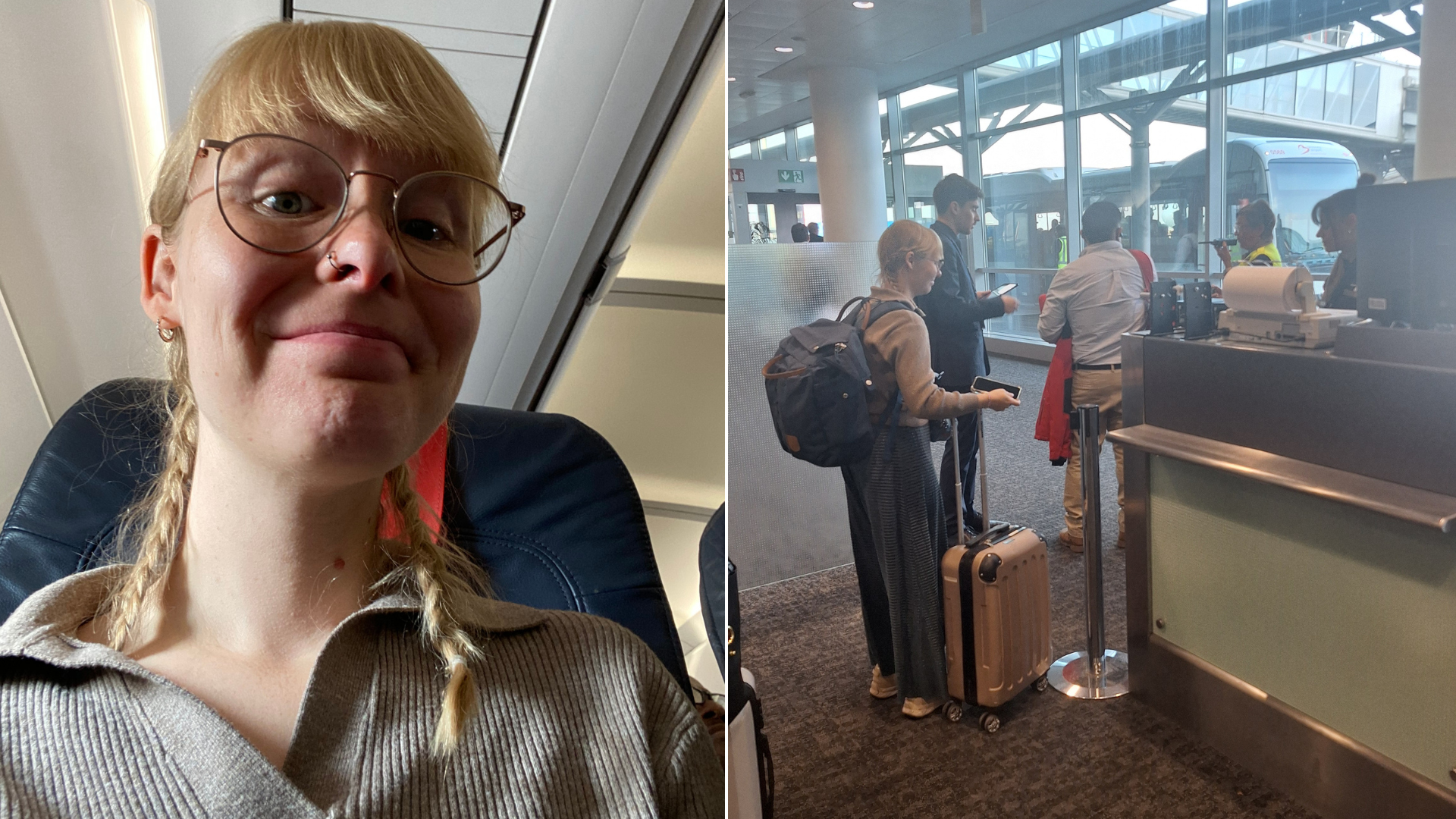
Pictures dated on 27 September 2025 that Cornelsen says were taken inside the outbound Brussels Airlines flight (seat colours match typical Brussels Airlines ones) and by the gate before boarding at Brussels Airport (logo seen on the background on a bus). Credit: Nanna Bille Cornelsen
Cornelsen said she had essentially given up on the situation being resolved by the time she received the email.“It's just so draining to keep talking to the same people again and again, or even different people, and explaining the same story with them ending up with the same conclusion,” she said.
Despite feeling "furious” at the situation, the NGO worker still considers herself lucky. “I was able to go back home, I was able to pay for a train ticket, I was able to take a day off without my boss being angry…but it might not be the case for everybody, right?” she said.
When approached for comment, a Brussels Airlines spokesperson said Cornelsen's situation will be shared with the airline’s Customer Service team.
Proof problems
It is unclear how frequent incorrect 'no-show’ cases are in Europe. In addition to Cornelsen's and Mårtensson's cases, at least two other similar ones were reported in Belgium last year, according to the consumer group, Euroconsumers.
However, Brussels Airlines’ spokesperson, Joëlle Neeb, says such incidents are ”not a common thing” at the airline.
“If this would be a common thing, then the policy, or the approach would definitely be adapted,” she told The Brussels Times, adding that "normally” passengers can be reimbursed or compensated if they can “indicate that they were on the flight.”
But what passengers need to do to prove this is not clear. “There is no predefined list of evidence to be shown by the passenger. Each file is being looked at individually and solved case by case,” said Neeb.
Cost vs Protection
For years, no-show policies have been considered problematic by consumer groups, with some national courts even ruling that the practice is “unfair” or “unlawful”.
Among the issues, consumer rights groups denounce the financial consequences of the policy, as it can cost passengers on average €770 to purchase new tickets, transport and accommodation, according to Steven Berge, Senior Legal Officer at the European Consumer Organisation (BEUC).
Brussels Airlines, however, says it uses the policy to protect itself from “misuse” and "fraud” by passengers who book cheaper non-direct tickets without intending to fly the full itinerary, according to Neeb.
Illustrative image showing passengers and suitcases at an airport. Credit: Belga
But Berge is sceptical about this type of reasoning without clear data to back it up.
Additionally, if the tickets are already paid for, he questions how much harm consumers “cheating the system” would actually cause, and points to the fact that no-show clauses often allow airlines to resell the previously booked seat, a practice he says could be seen as "double enrichment”.
The sentiment is echoed by Laura Clays, spokesperson for the Belgian consumer group Test Achats. Instead of no-show policies, Clays says airlines should have more logical prices and be more transparent.
“If it's cheaper for a consumer to book a flight and not take part of it, I don't see why you would blame a consumer for this,” she added.
EU talks passenger rights
A partial ban on no-show policies was suggested by the European Commission in a 2013 proposal to revise passenger rights. The institution argued that a full ban would "hurt competition” by impairing “airlines from offering indirect flights at lower prices than direct flights.”
After years of stalled development, the Council of the EU announced last year its position on the proposal. It stated that it wants to “disincentivise” the no-show policy and that affected passengers would be entitled to compensation.
Contrastingly, the European Parliament (EP) suggested in January 2026 that passengers “should not be denied boarding at the return journey on the grounds that the passenger did not take the outbound flight of a return ticket."
Members of the EP and Council met last week to address disagreements regarding a proposal. As it stands, the earliest an agreement could be found is during the second conciliation committee, scheduled for 2 June.
“The goal of both co-legislators nevertheless remains to aim at finding an agreement by the end of the Cyprus presidency,” an EU official told The Brussels Times.
The Brussels Times contacted the Lufthansa Group for comment but did not receive a response as of the time of publication.
