
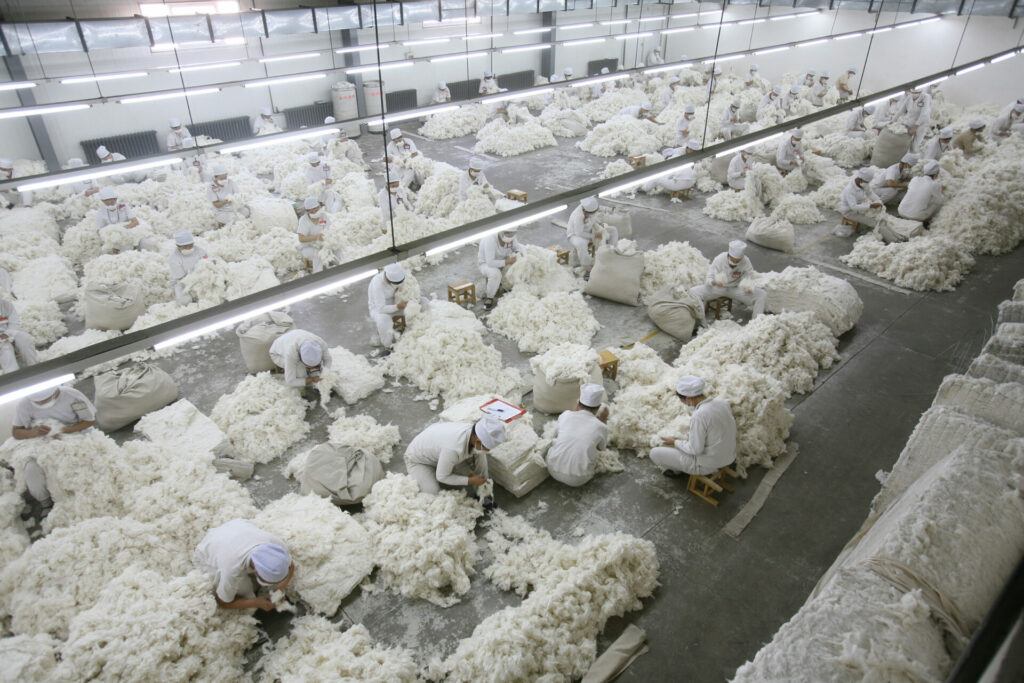
Sports equipment giant Decathlon allegedly sourced forced labour-tainted cotton from a Chinese subcontractor which sourced it from China’s Muslim-majority Xinjiang Province, a France 2 investigation has revealed.
According to the documentary, which airs on French TV on Thursday evening, the Mulliez Galaxy group, parent company to Decathlon, sourced cotton from the “Qingdao Jifa Group” which it alleges relies on a network of forced labour in China.
Chinese authorities have long forced its Muslim minority into “re-education” camps on accusations of extremism and sedition. In these centres, Chinese Uyghurs are often pressed into labour in China’s burgeoning cotton industry.
In response to these crimes, major manufacturers have been pressured to ensure that their supply chains do not include materials from Xinjiang, where the risk of forced labour in the production of goods is greatest.
The US bans the import of all goods from the Xinjiang region unless the importer can prove they are free of forced labour. The EU also bans all slave-labour derived goods, with harsh penalties for companies that do not ensure that its goods are free of inputs derived from modern-day slavery.
For its part, a representative of Mulliez Galaxy confirmed that Qingdao Jifa Group was its supplier but dismissed the investigation’s report as speculation. The company claims that 100% of Decathlon’s cotton is sourced from responsible practices.
Related News
- Activists demand release of jailed Uyghur scholar at Chinese embassy in Brussels
- 50 million people worldwide in modern slavery
- EU needs to 'get tough' on widespread slave labour goods, say experts
Some products alleged to contain slave-tainted cotton included official American basketball (NBA) merchandise sold in more than 1,700 Decathlon locations across the world.
Products tainted by slave labour are used everyday by Europeans. Around 17 global industries heavily invested in labour derived from slavery in Xinjiang, from agriculture to children's toys. Europe’s solar industry is said to be particularly reliant on imports from China’s Xinjiang region, according to research by Sheffield Hallam University.
