
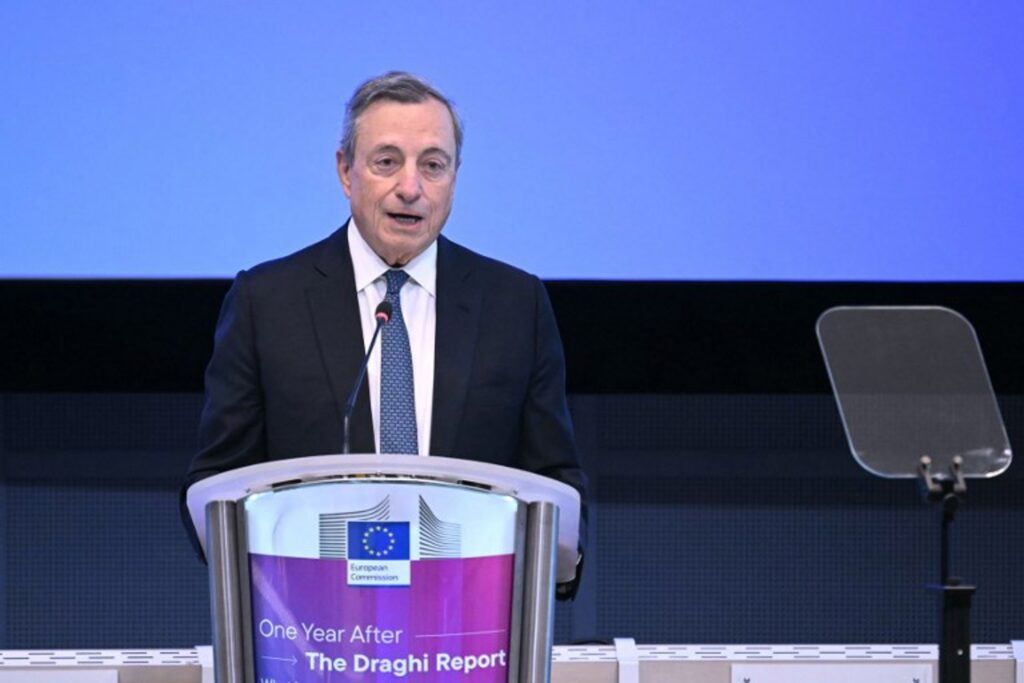
Former European Central Bank (ECB) President Mario Draghi criticised the EU for its slow progress in implementing recommendations from his competitiveness report issued a year ago.
Speaking in Brussels at a conference hosted by the European Commission, Draghi said Europe is now in a worse position, with a stagnating growth model, mounting vulnerabilities, and no clear plan to fund essential investments.
"Europe’s citizens and companies...express growing frustration. They are disappointed by how slowly the EU moves. They see us failing to match the speed of change elsewhere," he said.
Draghi added that "too often, excuses are made for this" slowness. "We say it is simply how the EU is built. That a complex process with many actors must be respected. Sometimes inertia is even presented as respect for the rule of law," he said.
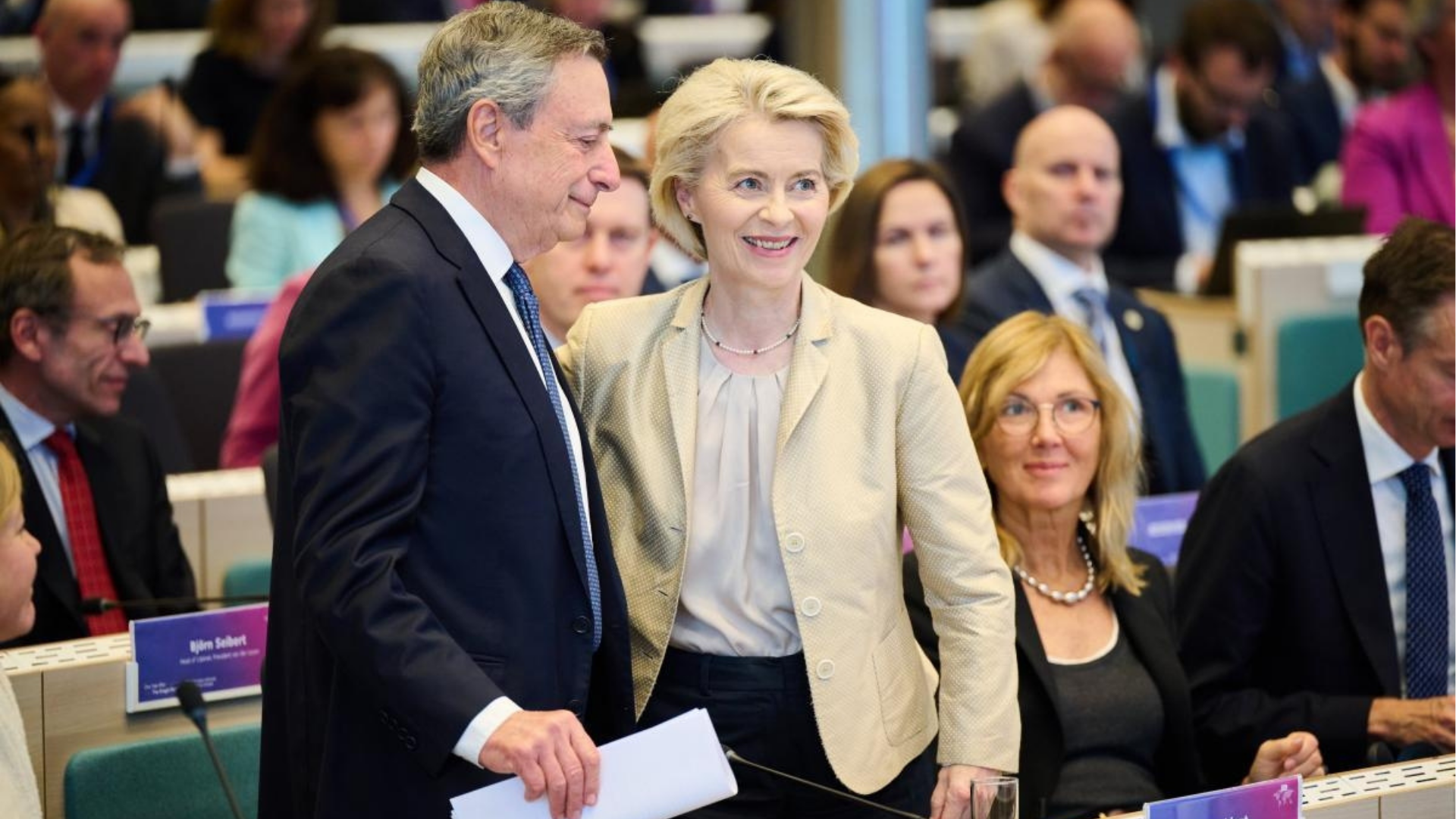
Mario Draghi and Ursula von der Leyen. Credit: Jennifer Jacquemart/Dati Bendo/European Union
The former ECB president sharply criticised barriers to adopting new technologies and called for a unified "28th regime” for business law, transcending national legal systems to facilitate innovation and cross-border financing within the bloc.
While he acknowledged that the Commission has made some progress, Draghi added that individual member states remain significant obstacles.
He further urged reforms to the GDPR, arguing that it has increased data costs for EU businesses by about 20% compared to their American counterparts.
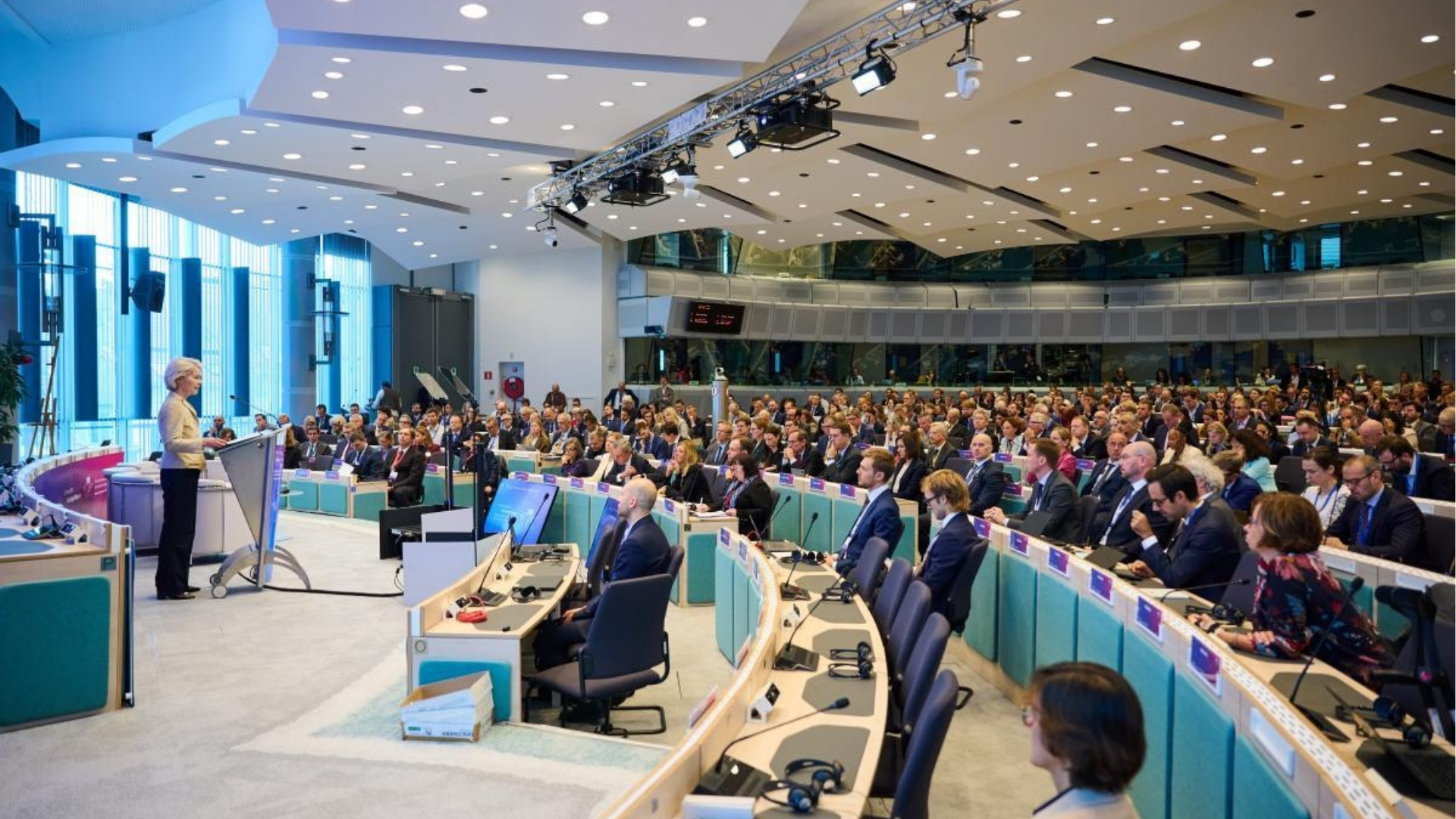
Ursula von der Leyen speaking at the conference. Credit: Jennifer Jacquemart/Dati Bendo/European Union
He proposed halting the next phase of the AI Act, covering high-risk AI systems, to allow for a better understanding of its drawbacks. Implementation, he argued, should be guided by hindsight, assessing models based on proven capabilities and risks.
"The next stage—covering high-risk AI systems in areas like critical infrastructure and health—must be proportionate and support innovation and development. In my view, implementation of this stage should be paused until we better understand the drawbacks," he said.
To address soaring energy costs, Draghi reiterated proposals to decouple renewable and nuclear power pricing from fossil fuels and to expand long-term contracts to cover all renewable and nuclear assets, both new and existing.
In the automotive sector, he questioned the validity of existing decarbonisation goals, particularly the 2035 deadline for zero-emission vehicles. What was intended to create a virtuous cycle has failed, he said, advocating instead for a "technologically neutral approach."
Credit: Jennifer Jacquemart/Dati Bendo/European Union
Draghi also championed public investment and joint borrowing, either across all 27 member states or through a coalition of willing participants. He explained that joint issuance would over time create space for the EU to pursue large-scale projects in areas like breakthrough innovation, defence or energy.
He further acknowledged Europe’s reliance on the United States for defence, which, he suggested, might explain concessions to U.S. interests in recent trade negotiations. However, he argued that the EU-Mercosur trade agreement could provide much-needed relief for European exporters.
Before Draghi’s remarks, European Commission President Ursula von der Leyen admitted the urgency of accelerating reforms. While listing key achievements over the past year, including advancements in artificial intelligence, defence industry revitalisation, and regulatory streamlining, she urged member states and the European Parliament to pick up the pace.
