
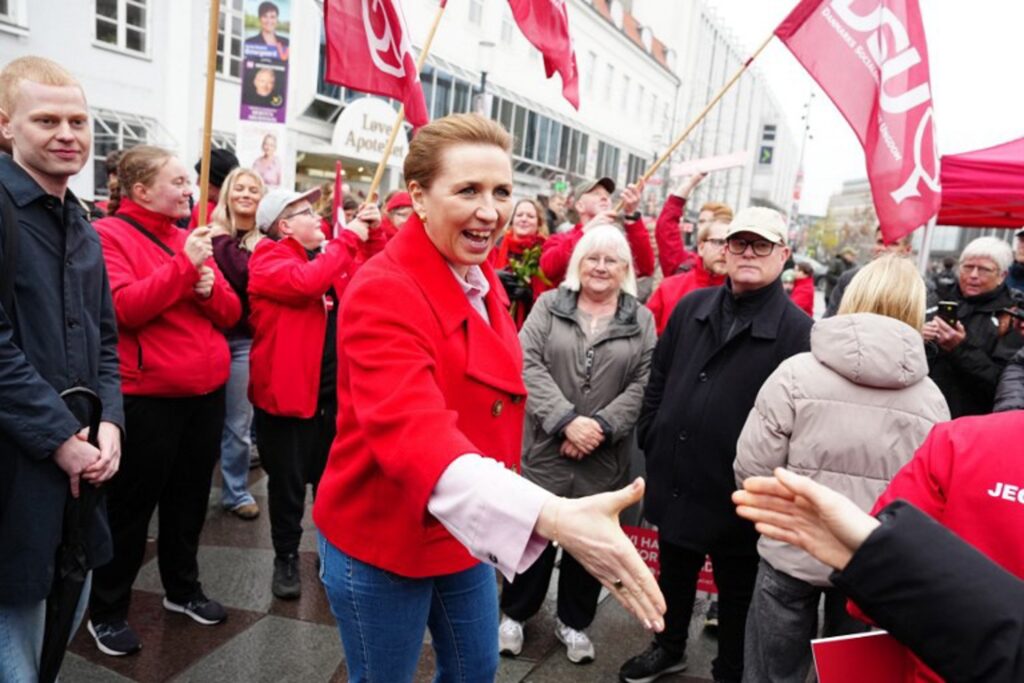
Denmark’s left-wing bloc has emerged ahead in the legislative elections, but without securing a majority, prompting Social Democrat leader Mette Frederiksen to declare herself ready to continue as prime minister.
"I am still prepared to take on the responsibilities of prime minister for the next four years," Frederiksen stated.
Frederiksen admitted her party had been expecting a drop in support, saying it is "normal when running for a third term." She added: "Of course, I regret that we didn’t win more votes."
The Social Democrats recorded their worst result in over a century at a general election. Despite this, Frederiksen is widely seen as the best candidate to lead a new coalition government.
A seasoned political operator at 48 years old, Frederiksen represents a brand of social democracy that advocates for strict migration policies to maintain the welfare state. Many traditionally centre-left parties have tried to emulate this model, including in Belgium and the UK.
In her manifesto, she describes Denmark as a "safe community built on trust and strong values," adding that the country "must distinguish between those who can and want to be part of Denmark, and those who do not."
Following a dismal performance in the November municipal elections, where her party lost control of nearly half the municipalities, including Copenhagen, Frederiksen regained popularity in early 2026 during a crisis involving Greenland.
She firmly upheld Denmark’s sovereignty over the autonomous territory and directly confronted former US President Donald Trump, who had expressed interest in purchasing Greenland, citing national security concerns.
Left-right coalition
The Social Democrats won 21.9% of the vote, its lowest result in over a century, significantly down from 27.5% in the previous election in 2022.
The left-wing bloc, comprising five parties, secured 84 seats in the 179-seat parliament—below the majority threshold. Meanwhile, the right-wing bloc, consisting of six parties, gained 77 seats.
The centrist Moderates, led by Foreign Minister Lars Løkke Rasmussen, claimed 14 seats and are set to play a key role in challenging coalition talks to form the next government.
Since 2022, Frederiksen has led a groundbreaking coalition of left- and right-wing parties, including the Moderates.
The outgoing coalition faces new hurdles as Liberal Party leader Troels Lund Poulsen ruled out further collaboration with the left. "There are now two clear options for the Liberal Party: either we form a centre-right government, or we move into opposition," he said.
On the left, the Socialist People’s Party (SF) secured 11.6% of the vote, becoming Denmark’s second-largest party for the first time in its history.
"We must strive to safeguard the welfare state and ensure an ecological transition," said SF leader Pia Olsen Dyhr. "If we fail in these goals, we won’t enter the government; we’ll remain in opposition."
Meanwhile, the far-right Danish People's Party, known for its anti-immigration stance, saw a dramatic resurgence, tripling its performance from the previous election to achieve 9.1% of the vote.
