
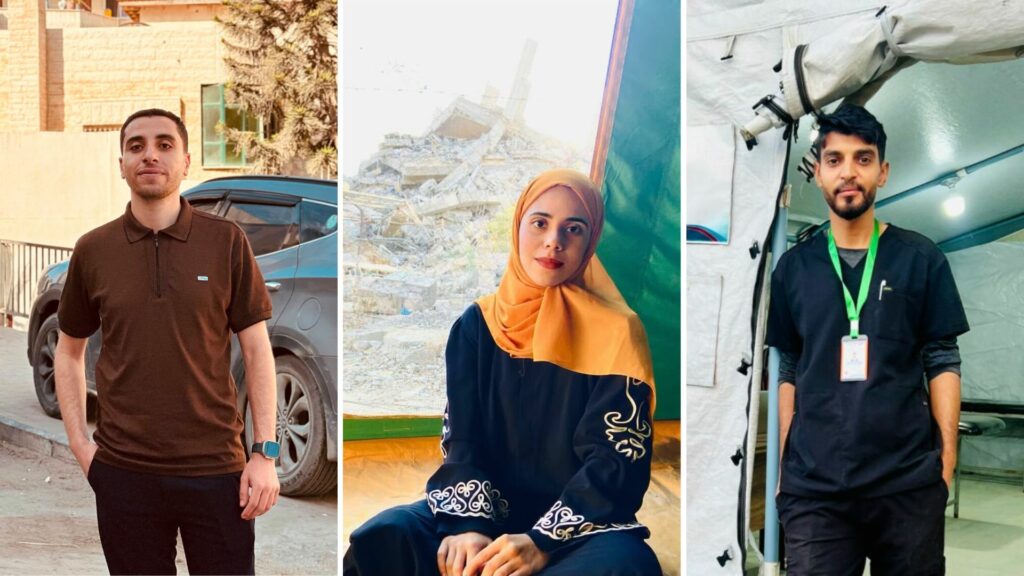
The new academic year in Belgium has already started but the 13 Palestinian students who received scholarships to study at Belgian universities are still stranded in the devastated Gaza Strip due to internal political divisions within the coalition government led by Prime Minister Bart De Wever despite its recognition of Palestine.
The students are desperate. "We are trapped inside a war zone with no safe way to leave," one of the students, Salwa Abu ElHaj, 23, told The Brussels Times.
“We are not asking for immigration or permanent residence,” she said on behalf of the 13 students and researchers. “We are students and researchers whose stay in Belgium would be temporary and directly connected to our studies and academic work.”
"What has become increasingly clear to us is that preventing us from coming to Belgium is a political decision, rather than something that is simply dictated by the security situation in Gaza," Ahmad Abu Jami,28, added.
He was right. They have not been denied exit from Gaza by the Israeli authorities because of alleged security reasons. In beginning of September, The Brussels Times reported about the stark left-right divide within the government.
The Prime Minister's N-VA (Flemish nationalists) and MR (Francophone liberals) are against the evacuations, while Vooruit (Flemish socialists) and Les Engagés (Francophone centrists) are in favour. The CD&V (Flemish Christian-Democrats) felt that the issue should at least be discussed.
A source close to the N-VA party commented on the condition of anonymity that those who oppose receiving the students believe that they, once they arrive in Belgium, will apply for asylum and then ask for their families to come. Belgium already receives more Palestinian refugees than most other EU Member States, the source claimed.
Belgum’s Asylum and Migration Minister, Anneleen Van Bossuyt (also N-VA), has made it clear that she fears a "domino effect", as the students could facilitate the arrival of other Gazans through family reunification.
A known hardliner on migration and a leading member of the N-VA, she supports "the strictest migration policy ever" in Belgium. Despite court rulings, Belgium refuses to restore material aid and shelter to asylum seekers. A recent decision allows police and immigration officials to enter the private homes of undocumented migrants if an investigating judge has issued a warrant.
From optimism to disappointment
A discussion did take place on 11 September by the kern, the Belgian government's restricted ministerial council. The feeling before the meeting was optimistic. Laurens Soenen, the spokesperson of Foreign Affairs Minister Maxime Prévot told The Brussels Times that the minister wanted to find a solution.
“He believes that it would reflect well on Belgium if it continued the evacuation of people from Gaza.”
However, no agreement was reached at the first 'core cabinet' meeting of the Federal Government after the summer break. Prime Minister De Wever (N-VA) and his five Deputy PMs discussed the issue but could not find a consensus.
"I put forward a memorandum with three parts," Prévot (Les Engagés) confirmed after the meeting.
The memorandum concerned the accommodation of the 13 scholarship students at the Belgian universities, a gradual and reasonable resumption of evacuations from Gaza "given the still dire humanitarian situation", and a financial contribution to a joint operation by the WHO and Jordan to enable sick children to receive treatment in Jordan.
According to Prévot, “the proposal was well received by two partners, met with a very lukewarm reception by another, and was completely rejected by the last – unless we were prepared to make concessions regarding return to Afghanistan and return hubs".
His cabinet did not reply to a request for the protocol from the meeting.
According to COGAT, the Israeli agency responsible for logistical and aid operations with the Gaza Strip, there is an established procedure for the departure of Gaza Strip residents to third countries, including for academic studies.
"The departure of residents from the Gaza Strip is facilitated upon the submission of a request by a third country willing to receive the individual, and following the completion of a security screening by the competent Israeli authorities," a spokesperson of COGAT told The Brussels Times in August. “There is no need for prior visa approval from the receiving country.”
Belgian universities protest
After the cabinet meeting, the rectors of 10 Belgian universities issued a statement where “they noted with dismay the continued failure to reach a decision that would allow their universities to welcome Gazan students and researchers who have been selected to receive study or research scholarships following particularly rigorous selection procedures”.
They condemned the “unacceptable political bargaining to which the individuals concerned are currently being subjected. They must not be treated either as bargaining chips or as adjustment variables in political debates on migration.”
“Their applications must be considered for what they are: those of students and researchers who have been awarded scholarships on the basis of their academic merit and who have all expressed their intention to return to their country afterwards in order to contribute to its reconstruction.”
“The claim that their evacuation is unfeasible does not withstand scrutiny of the facts, as several EU Member States have demonstrated that such an evacuation can in practice be organized,” they added.
The European Commission says that the travel of Gazans to EU is a Member State consular competency. It did not reply in time for this article to a question ahead of the Foreign Affairs Council (12 October) on what the EU can do to facilitate the travel of patients and students from Gaza to EU.
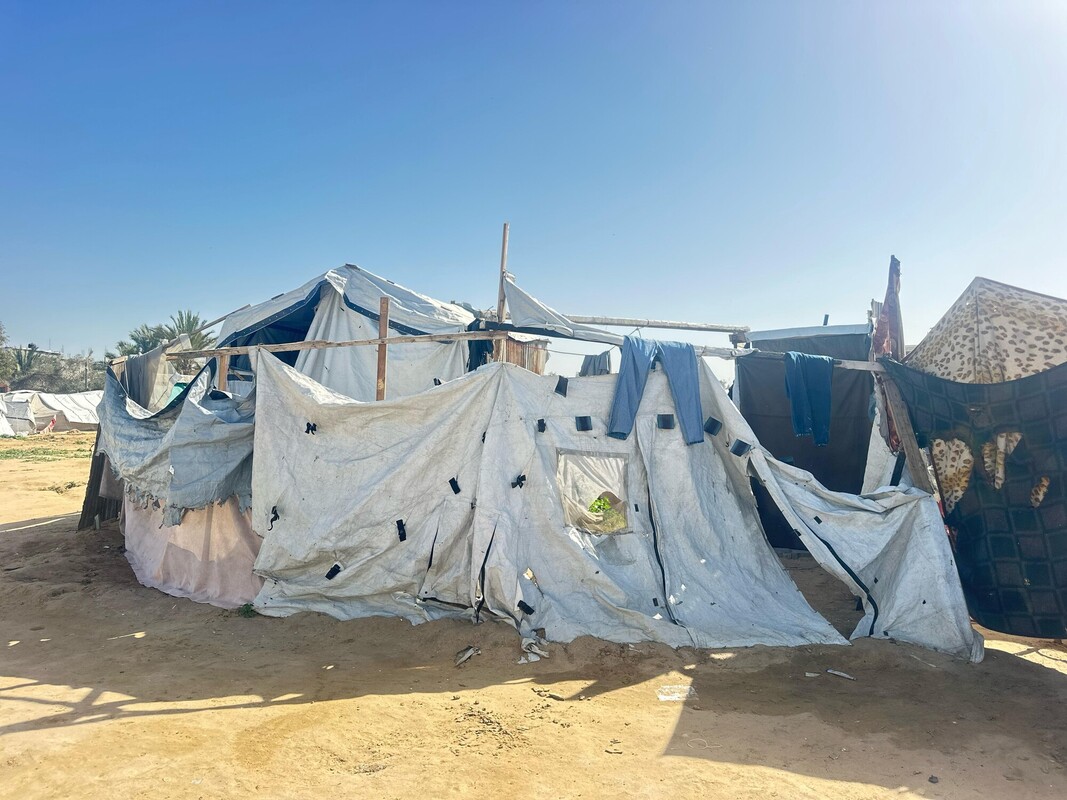
Tent camp in Gaza, Credit: Zyad Abu Mariam/NRC
Freedom of movement in the broader context
“Whether and how Belgium regulates admission to its territory is a matter of Belgian law and policy,” commented Shai Grunberg, spokesperson and director of public advocacy at Gisha, an Israeli NGO which advocates freedom of movement, specifically focusing on the Gaza Strip.
Giza offers legal assistance to Gazan who have been denied exit because of alleged security reasons but this is not the case with the students who have been granted scholarships in Belgium
“Exit decisions should be viewed in the broader context: Israel destroyed much of the Strip, including Gaza's universities, and it continues to maintain conditions that gravely undermine civilian life,” she said. “Young people in Gaza deserve a chance at a better future, including by gaining the skills that will allow them to rebuild the Strip.”
“Israel, as the occupying power and given its total control over movement of Palestinians to and from Gaza, has an obligation to enable Palestinians to exercise their right to leave Gaza and return to it. If Belgium isn't willing to engage in Israel's coordination process, the least it can do is demand that Israel facilitate the students' travel to Belgium independently.”
The war left Gaza devastated, destroyed most of the buildings there and displaced families several times. According to a report last June by the Norwegian Refugee Council (NCR), Israel’s destruction of homes in Gaza and restrictions on shelter materials trapped displaced families in dangerously hot tents and makeshift shelters during the summer heat waves.
In a joint statement issued on Friday (9 October), NCR warns that, as winter approaches, hundreds of thousands of families still live in tents, makeshift shelters or damaged homes and face a fourth winter exposed to cold, wind and flooding. More than 18,500 patients including at least 4,000 children, still need medical evacuation, and over 1,000 have died waiting.
For hundreds of thousands of families, tents have stopped being a temporary solution while waiting for their houses to be rebuilt, Haaretz, Israel’s leading opposition, wrote last week. “They have become home. Many of the tents are suitable for short stays, not for long durations. They have been worn down by prolonged use."
Health services have not started to recover either. According to a new report by Physicians for Human Rights Israel, there is not a single hospital in Gaza that is fully functional. The number of medical evacuations since the cease-fire began is still much lower than the numbers before the war, even though the need for treatment outside Gaza has grown.
