
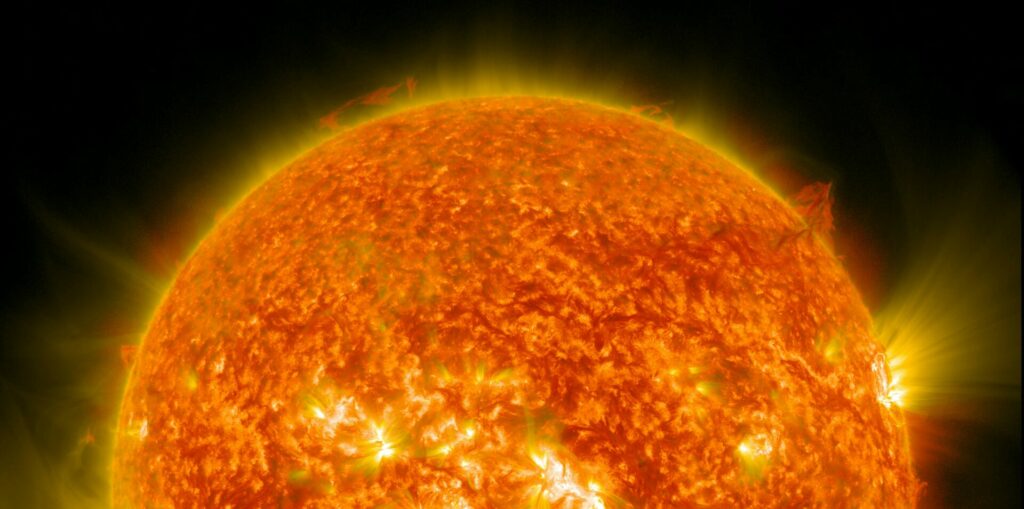
An international team of researchers has, for the first time, directly observed magnetic waves that could explain why the Sun's outer atmosphere, the corona, reaches temperatures of over one million degrees Celsius, far hotter than the Sun's 5,500-degree surface.
The discovery involves torsional Alfvén waves, first described in the 1940s by Swedish physicist Hannes Alfvén, who later won the 1970 Nobel Prize in Physics. Scientists have long suspected that these waves play a key role in heating the solar corona, but they had never been observed in large numbers until now.
Using spectroscopy, researchers were able to split the Sun's light and analyse the movement of the waves in coronal loops.
"These minuscule shifts allowed us to see that a torsional (rotating) movement was occurring simultaneously with the already known sideways motion," said Professor Tom Van Doorsselaere of KU Leuven's Plasma Astrophysics research group. "We've now observed this for the first time in several coronal loops, where previously we'd only encountered isolated cases. This is a major step forward."
The waves appear to be continuously present in the corona, potentially carrying enough energy to heat the Sun's outermost layer to a million degrees. "But we don't yet know the exact energy content of the waves," Professor Van Doorsselaere added. "We suspect this corresponds to the heating of the solar surface towards the corona, but further research is needed to truly confirm this."
Beyond fundamental science, the findings could improve predictions of space weather, which can disrupt satellites and communication systems on Earth.
"It's not easy to model the solar corona anyway," said Van Doorsselaere. "These observations will allow us to better model when solar storms occur and when they could cause damage."
The observations were made with the Daniel K. Inouye Solar Telescope (DKIST) in Hawaii, a 4-metre instrument that provides unprecedented detail of the Sun. The research, published in Nature Astronomy, involved KU Leuven, Northumbria University, Peking University, Queen Mary University of London, the Chinese Academy of Sciences and the US National Solar Observatory.
