
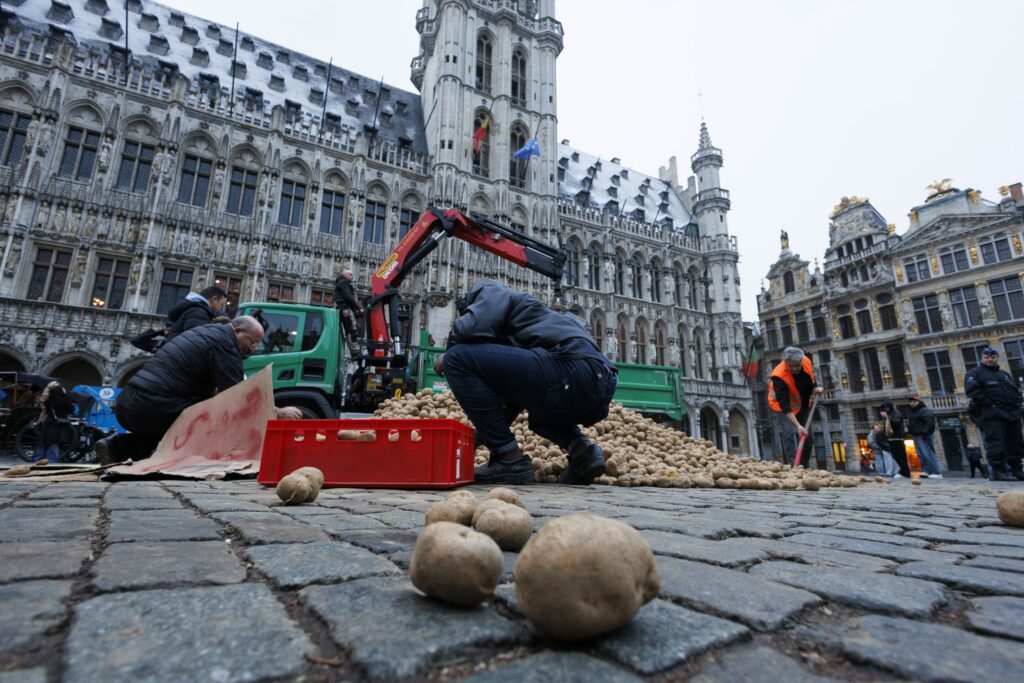
The area dedicated to potato farming in Belgium reached its highest level since 1980 in 2025, driven by favourable spring weather and strong demand from the food processing industry, according to new figures published by Statbel.
Potato farmland increased by 7.2% compared with the previous year, setting a new record over the past four decades.
The expansion comes as Belgium’s agricultural sector continues to undergo major changes. While crop areas increased in several categories, the overall number of farms fell by 2% to 33,307.
The total area used for cereals also rose by 5.3% in 2025, although it remained below 2023 levels. The increase was more pronounced in Flanders (+7.8%) than in Wallonia (+3.7%).
The rise was mainly fuelled by a sharp increase in winter wheat cultivation, up 19.5%, and spelt production, which surged by 71.8%.
By contrast, the area devoted to winter barley fell by 25.6%.
Overall, more than 71% of winter cereals were grown in Wallonia.
Belgium’s livestock sector, meanwhile, continued to shrink in several areas.
The national cattle herd declined by 1.2% in October 2025 compared with the previous year, with the sharpest drop recorded in Wallonia (-2.5%). The number of cattle farms also fell by 3.4%.
Pig farming saw an even steeper decline. The pig population dropped by 2.7%, while the number of pig farms decreased by 6.7%, including an 11.6% fall in Wallonia.
Poultry farming, however, continued to grow.
The number of poultry animals increased by 1.7% in 2025, with Wallonia recording the strongest rise at 3.6%.
Both laying hens and broiler chickens posted gains, increasing by 3.7% and 1.8%, respectively.
