
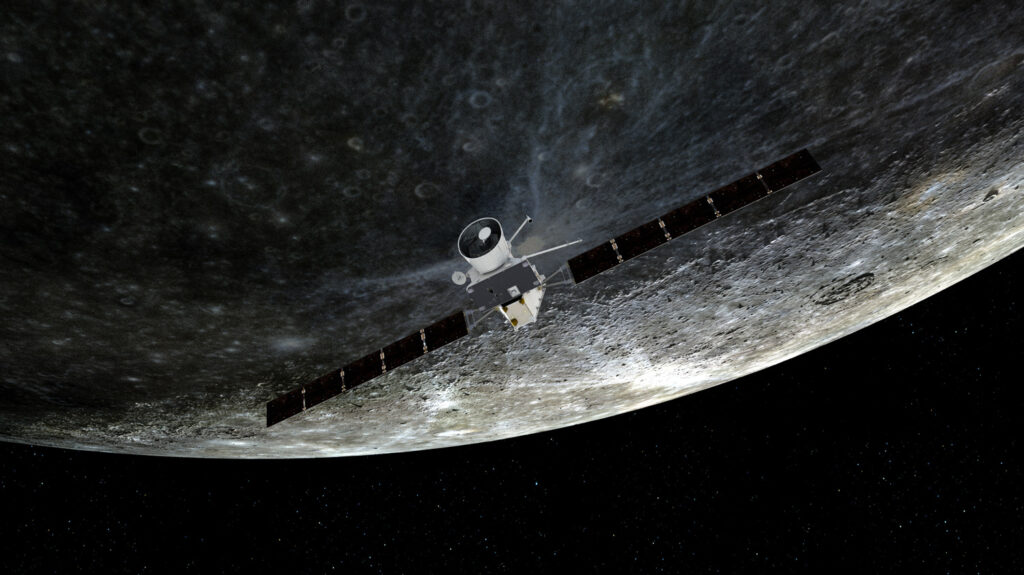
After an eight-year journey, the European-Japanese spacecraft BepiColombo has entered orbit around Mercury, the European Space Agency said.
Mercury is the smallest planet in the Solar System and remains less well understood than the other planets. It endures temperatures ranging from -180°C to 450°C and is exposed to intense solar radiation.
The first spacecraft to fly close to the planet nearest the Sun was the US probe Mariner 10 in 1974.
Related News
- 30 reasons not to say goodbye to Belgium
- Anderlecht’s meticulously-kept city of the dead
- 10,000 steps? Or 100 kilometres? How much walking do we actually need?
BepiColombo, an uncrewed mission launched in 2018, is one of ESA’s most ambitious projects. The four-tonne spacecraft carries 16 instruments designed to help scientists learn more about Mercury’s structure and composition.
During its voyage, BepiColombo travelled more than ten billion kilometres and made nine fly-bys of planets to adjust its speed and trajectory towards Mercury.
The mission is in fact made up of two orbiters, which are scheduled to separate on 9 and 10 December.
From April 2027, ESA’s Mercury Planet Orbiter is expected to study the planet in detail from an altitude of about 480 kilometres above the surface.
Japan’s Mercury Magnetospheric Orbiter will focus on gathering data about Mercury’s magnetic field. It will operate in an elliptical orbit reaching an altitude of 11,000 kilometres.
