
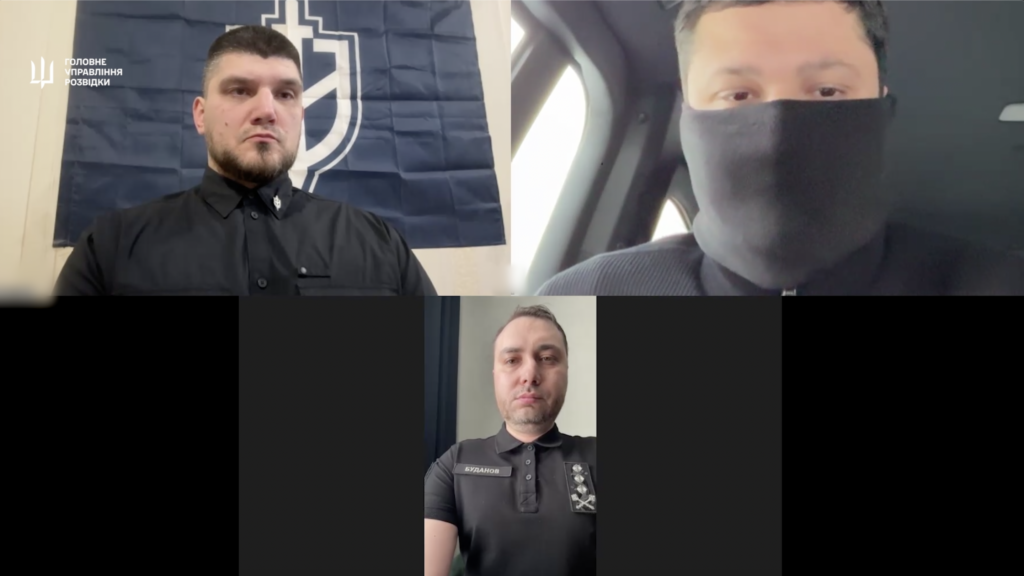
Ukraine's military intelligence agency claims it faked the reported death of an anti-Kremlin commander in order to stop an assassination plot by Moscow.
Denis Kapustin, the leader of the Russian Volunteer Corps (RVC), a military unit of anti-Kremlin Russian volunteers, was reported to have been killed in action on 27 December, after being supposedly hit with a drone.
But in a video released this week on Telegram by Ukraine's Main Directorate of Intelligence (HUR), Kapustin appeared alive alongside Ukrainian intelligence chief Kyrylo Budanov.
Ukraine says Kapustin's death was faked as part of a special operation designed to save his life, and to trick Russia into paying the $500,000 bounty on his head.
View this post on Instagram
"RVC commander Denis Kapustin is alive, and the half a million dollars received for his 'killing' will strengthen HUR special units," the statement said. HUR also reportedly identified officials involved in the assassination attempt, but did not publish their names.
Budanov congratulated Kapustin on his "return to life" and welcomed his return. Kapustin himself said that his "temporary absence had no impact on the work of the units".
A controversial figure
Many RVC members have been fighting on the side of Ukraine since 2014, and continued to fight for Ukraine at the onset of Russia's invasion in February 2022.
Their main goal is to restore Ukraine's territorial integrity within its borders as in 1991, including the Crimea, and to overthrow the current regime in the Russian Federation. But RCV and Kapustin are also known for their far-right rhetoric.
Before founding RVC, Kapustin was a well-known far-right activist in Europe, involved in the football hooligan scene in Russia and in Germany.
In 2019, Germany issued him an entry ban into the Schengen Area for "efforts against the liberal democratic constitution" and organising neo-Nazi martial arts events. Kapustin describes himself as a nationalist who believes that Russia belongs to ethnic Russians, but always rejected the neo-Nazi label.
He moved to Ukraine in 2017 and was involved with local far-right groups, such as the Azov Battalion, which was founded in 2014 to fight Russian Forces in the Donetsk region, and whose members were allegedly associated with the neo-Nazi movement. Azov limited its far-right rhetoric after integrating into the National Guard under Ukrainian government control.
Russian authorities added Kapustin to their federal registry of terrorists and extremists in March 2023 following a RVC attack on the Bryansk region.
At the time of publication, Russian authorities have not made any statements on Kapustin.
