
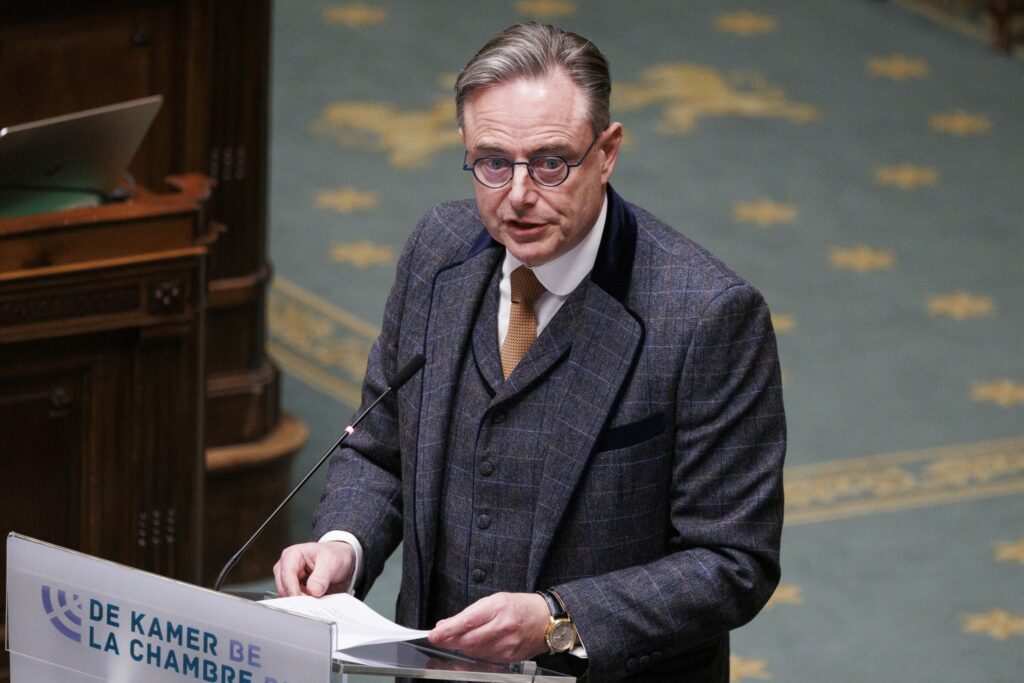
At the House Committee on Foreign Affairs on Wednesday morning, Belgian Prime Minister Bart De Wever (N-VA) outlined a roadmap for a strategically autonomous Europe that balances alliances with economic and military self-reliance.
Speaking about last week's informal European Council in Brussels in light of the US's territorial claims on Denmark's Greenland, De Wever praised the bloc's "swift and effective" reaction to "illegitimate pressure."
However, De Wever remained critical of the EU's lack of strategic autonomy in relation to the United States. "It goes without saying that relations between partners and allies must be shaped respectfully and reciprocally. Unfortunately, that no longer appears self-evident today," the prime minister said.
Holding onto NATO – but moving towards European strategic autonomy
In his speech, De Wever addressed concerns over the future of NATO and Europe's relations with the United States. Reflecting on US President Donald Trump's recent threats against Greenland, he said: "I understand the emotions when people say 'no more transatlanticism and no more NATO."
However, he warned that this response is precisely what "some in the United States" want to provoke. "Reacting to a provocation with a great deal of hostility serves the agenda of those who want a break with Europe. We must keep a cool head and not embark on adventures."
While declaring his continued support for NATO, De Wever called on Europe to "stop drifting on waves created by others".
According to De Wever, the fact that Europe should not close the door on NATO doesn't negate the fact that a real debate is emerging about the development of a European military force that can also act autonomously.
"I think that Belgium, and this is my personal opinion, should answer yes and be prepared for a far-reaching integration of our armed forces into a larger system," he said, while emphasising that reaching strategic independence is impossible without economic growth.
"Those who are enthusiastic about burying NATO must realise that this would require doubling defence spending in the short term," the PM said.
Making the most of the EU's economic strengths
De Wever stressed that while the EU "does not have sufficient military capabilities, we do have the largest market in the world, which we could weaponise."
According to De Wever, during the recent diplomatic crisis over Greenland, Europe demonstrated the force of its economic power. The prime minister referred to the European anti-coercive instrument, which can open the door to far-reaching trade restrictions, and the subsequent reactions of American public opinion and markets.
"We've put the knife on the table and can conclude that Trump didn't dare continue on the path he was taking," said the prime minister.
De Wever identified four elements weakening Europe's economy: high non-tariff barriers, excessive administrative and regulatory burdens, energy import dependence, and a bloc failing to move swiftly on free trade agreements.
He added that together with the Minister of Employment, Economy and Agriculture, David Clarinval, they have identified about 70 administrative simplification projects in cooperation with Wallonia, Flanders, and Brussels regions. "The same must be done at the European level," De Wever said.
Belgium is also set to scale up its efforts to invest in nuclear energy, diversify imported energy sources, and strengthen the European grid. De Wever identified this as a key to achieving European strategic autonomy.
Speaking of the EU Mercosur deal, a long-awaited agreement creating a free trade between the EU and the South American bloc Mercosur (Brazil, Argentina, Paraguay, Uruguay), signed on 17 January, De Wever stated his "100% support".
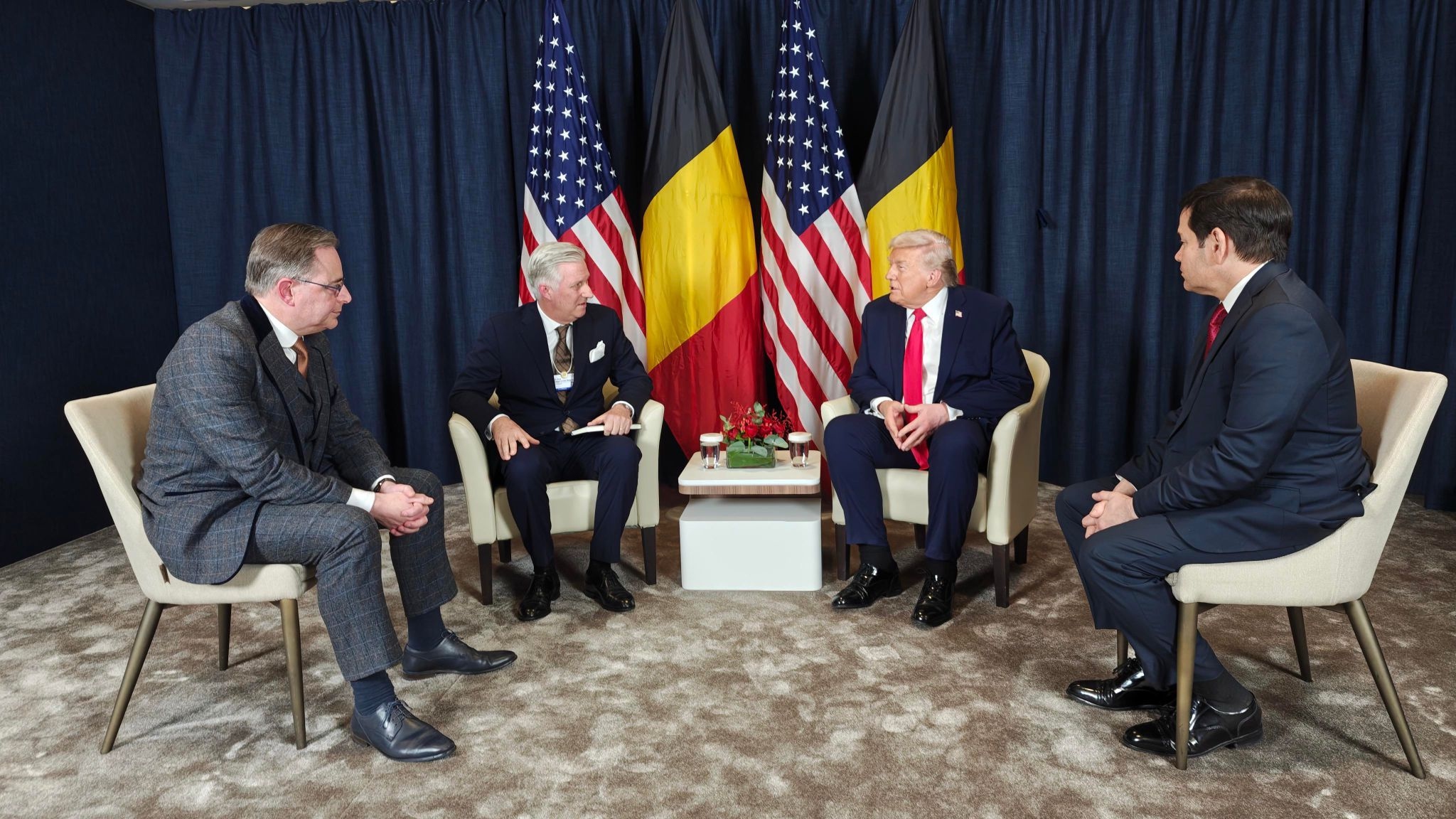
Belgian Prime Minister Bart de Wever, King Philippe of Belgium, US President Donald Trump and US Secretary of State Marco Rubio at the 2026 World Economic Forum annual meeting in Davos, Wednesday, 21 January 2026. Credit: Belga / Belgian Royal Palace
Strengthening Belgium's defences
Pushing for the consolidation of the European defence industry, De Wever blamed continuous reliance on US supplies on squabbling between EU Member States. He referred to an "endless tug of war" among European countries over the development of a single, common, sixth-generation fighter jet.
When asked about the wisdom of Belgium purchasing US weapons systems, De Wever said that Belgium currently has "no alternative" to buying US F-35 fighter jets and NASAMS, as these capabilities "simply do not exist in Europe."
"Saying 'the F-35s out' without a European alternative and not even a prospect of developing one, that's not possible," he said.
He also pointed out that Belgium spends about 7% of its military budget in the United States, arguing it is "very little".
Belgium has so far increased its defence investments to 2% of GDP in 2025, after a decade of falling short on its 2014 NATO summit commitments.
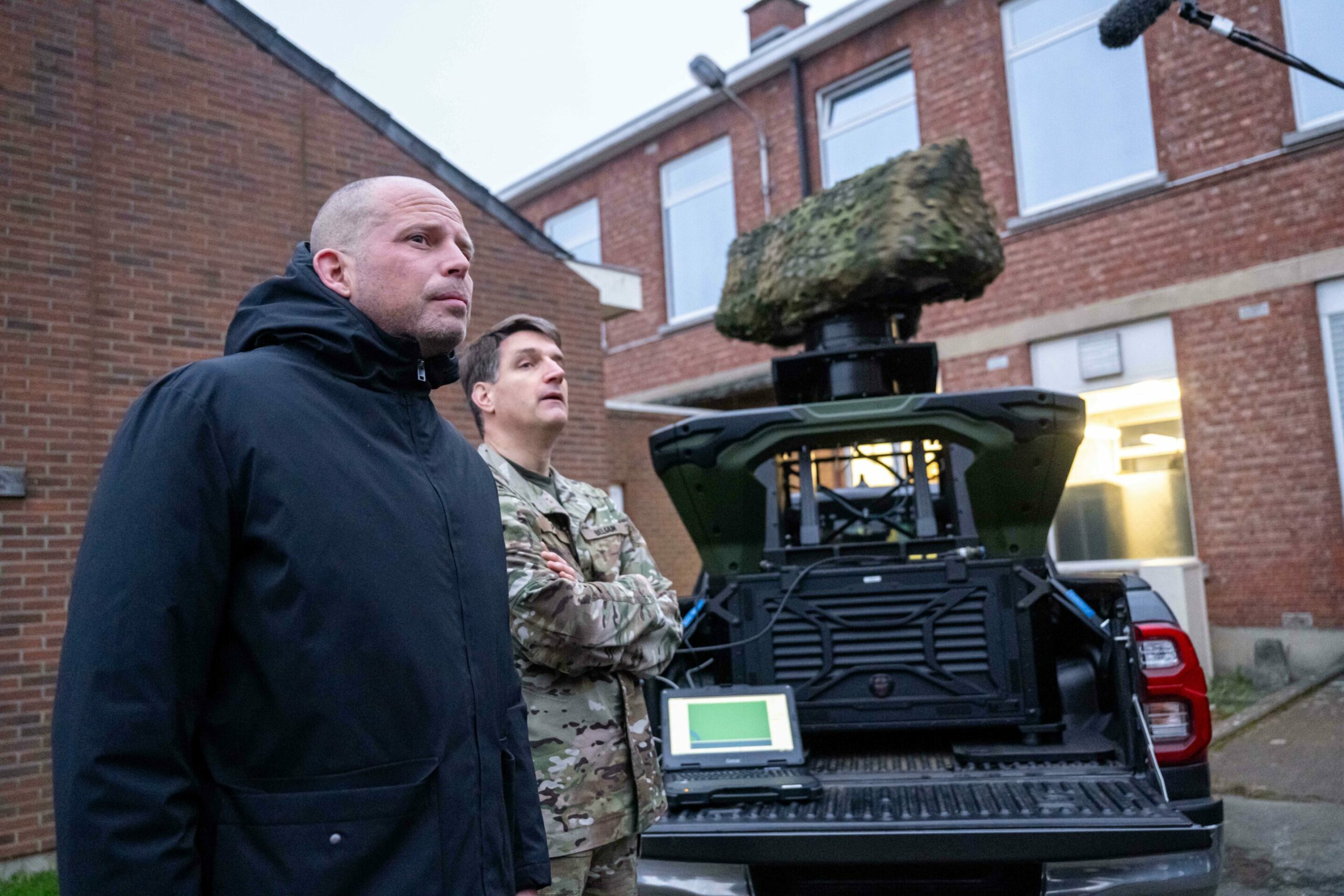
Minister of Defence and Foreign Trade Theo Francken, during a visit to the Hemptinne Command District, with the official handover of the PIORUN air defence system to the Special Operations Regiment (SOR), on Tuesday, 23 December 2025, in Leuven. Credit: Belga / Jonas Roosens
According to Minister of Defence Theo Francken (N-VA), the extra investment in 2025 went mainly to ammunition. Belgium is also set to receive about €8.34 billion in low-interest loans from the European Union under the new Security Action for Europe (SAFE) programme to boost its defence sector.
The Prime Minister also addressed his concerns about the US Board of Peace for Palestine, saying that it is "advisable" for Belgium to wait before recognising Palestine as an independent state.
"I do not have the impression that any other European country currently places confidence in the Board of Peace mechanism," he said. He also questioned the involvement of Russian President Vladimir Putin and Belarusian President Aleksandr Lukashenko, adding that they can hardly be described as "men of peace."
