
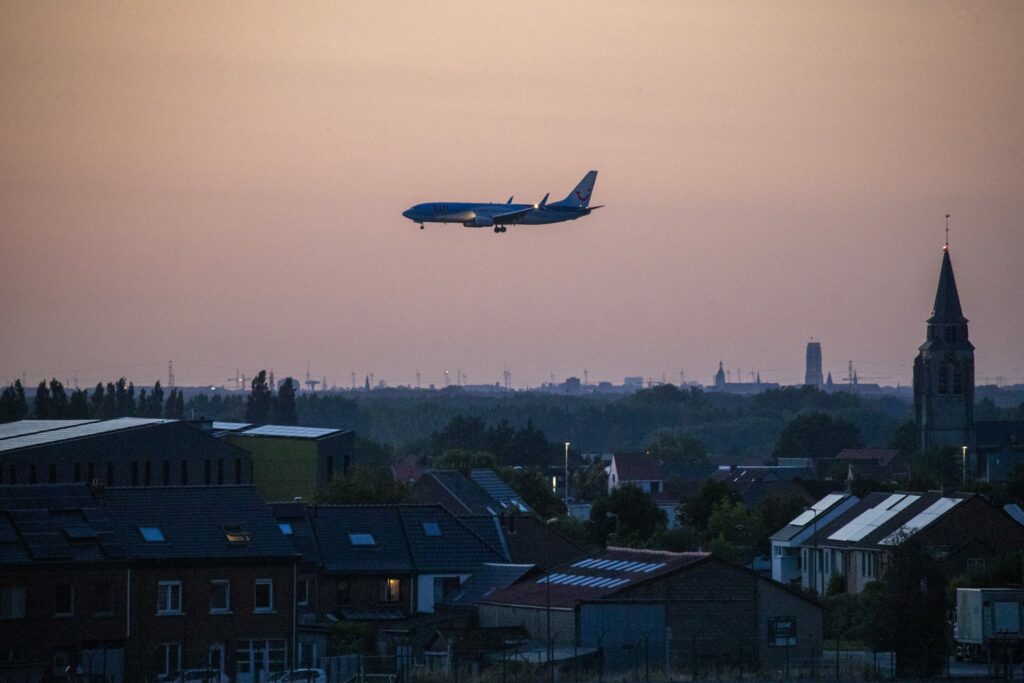
For months, tens of thousands of Brussels residents living in the north and west of the Capital Region have suffered constant nighttime nuisances due to a new air route flying over the Capital Region.
According to an open letter written by affected residents, they currently have just three-and-a-half hours of uninterrupted sleep on every night the route is operating.
During the night of 29 to 30 January 2026, the last landing at Brussels Airport in Zaventem took place at 01:30 with a DHL cargo flight from Milan, operated by a 33-year-old aircraft. The next plane flew over the capital very early in the morning, at 04:48.
"Between these two flights, residents enjoyed less than three-and-a-half hours of respite. From 04:48 onwards, the flights resumed uninterrupted until the early hours of the morning," reads the open letter. It was signed by the groups Collectif Stop au Survol de Bruxelles Nord et Ouest & RNP 07 and Collectif Free Air Brussels Nord.
"Three-and-a-half hours: this is now the reality of a 'night' under RNP 07," the collectives said. "This situation is neither accidental nor exceptional. It will be repeated every time this route is activated by easterly winds."
A political issue
The residents, living in Molenbeek, Koekelberg, Jette, Brussels city centre, Laeken, Schaerbeek and Haren, argue that the specific events of that night illustrate a broader reality: the ongoing sleep deprivation of nearly 450,000 residents and the repeated violation of Brussels noise standards, both day and night.
The Brussels-Capital Region has a specific regulatory framework for aircraft noise, with controls carried out by Brussels Environment, using an official network of sound level meters.
As soon as noise levels exceed 70 decibels (dB), a noise event is recorded. Then, the Sound Exposure Level (SEL) – which measures the total acoustic energy of an aircraft's passage – is calculated. In noise zone 0, the standard is set at 80 dB SEL.
However, public data from noise monitoring shows that more than 90% of aircraft using RNP 07 exceed these standards, both day and night. The collectives argue that these exceedances "are not a matter of subjective perception" but constitute "objective infringements," which are liable to sanctions.

Low-flying plane flying over Brussels. Credit: Schaerbeek
The residents compared Brussels Airport to Orly Airport in France. However, as an urban airport in the heart of a densely populated area, Orly recognised its constraints and strictly regulated its night flights, the collectives argue.
"Brussels is increasingly being treated as a mere flight corridor, where nuisances are concentrated in the name of competitiveness," they said.
They argue that sacrificing the night means sacrificing health and undermining dignity – making this not just a technical, but a political issue. "How much longer will a European capital accept losing sleep and seeing its noise standards flouted day and night?"
The collective also stressed that the RNP 07 was introduced "without debate or transparency."
No respite
The route's activation was initially presented by Mobility Minister Jean-Luc Crucke (Les Engagés) as "strictly temporary" and limited to the works at Brussels Airport over the summer of 2025, and reserved for exceptional situations, they said.
However, the route gradually shifted from temporary to regular use, and now appears to be a "permanent fixture in the Brussels sky under the guise of a European obligation," they said.
This shift took place without any overall health assessment, without any real consultation with the residents and municipalities concerned, and without any democratic debate on the consequences of a straight-line approach over some of the most densely populated areas in the country – with more than 25,000 inhabitants per km².
The Brussels Times contacted Crucke's office for comment, but the minister declined to comment for the time being.
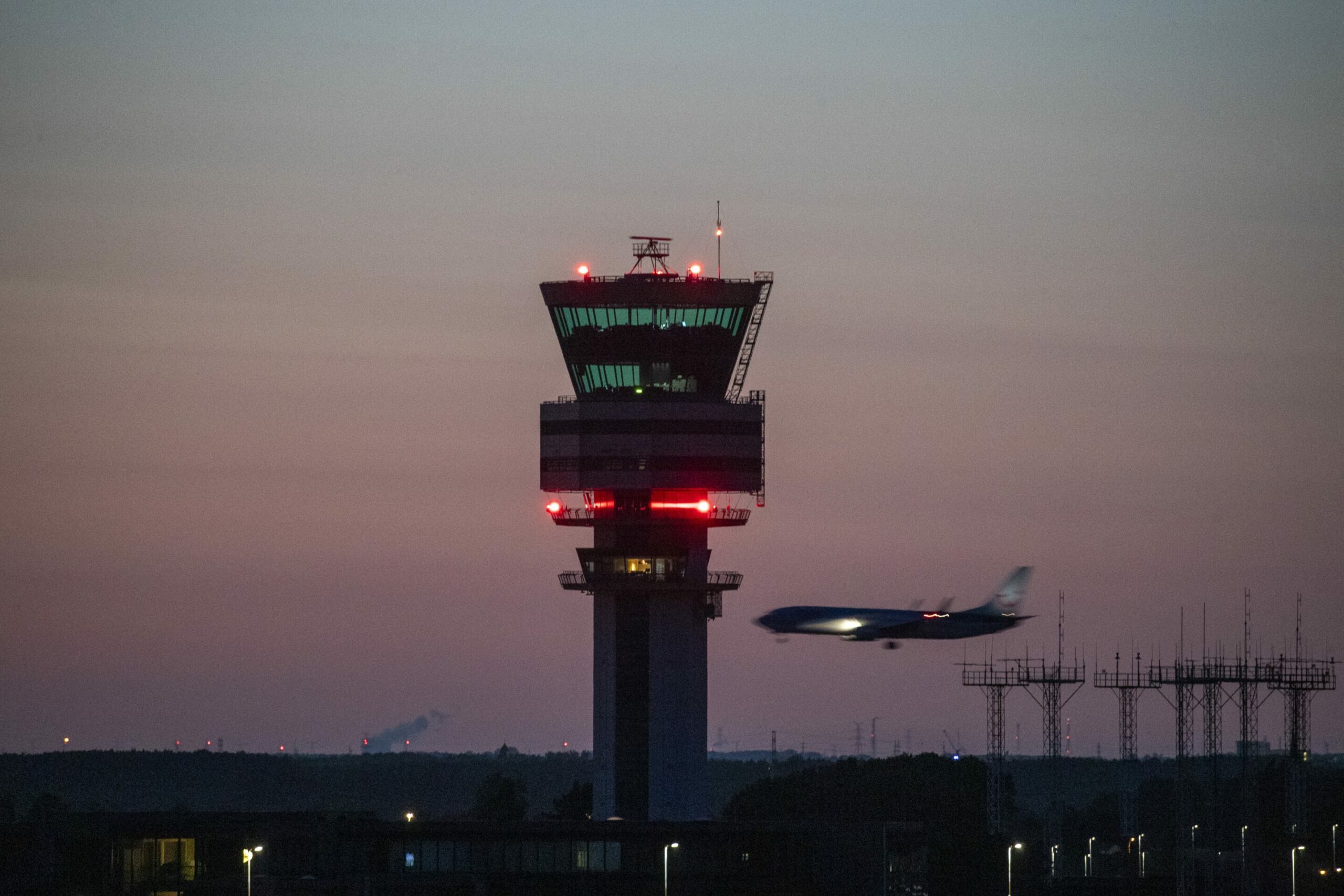
Credit: Belga/Nicolas Maeterlinck
Due to RNP 07's extreme concentration of flight paths, it requires aircraft to "fly over the same area again and again, without respite, day and night," the letter reads. This continuous exposure has documented cumulative effects on sleep, stress, cardiovascular and mental health.
"As a result, nearly 450,000 residents are affected, without transition, without protection and without any clear prospect of a return to an acceptable situation," the collectives said. "This new, concentrated and lasting nature of the problem is a major aggravating factor, both in terms of health and social issues."
This situation has led to unprecedented citizen mobilisation in the neighbourhoods concerned. In just a few weeks, a petition launched by groups opposed to RNP 07 flights already gathered nearly 4,000 signatures from residents directly affected by aircraft noise.
Concentrated nuisance
These signatures, the collectives say, demonstrate a "clear and overwhelming" rejection of an air route imposed without consent, without prior health assessment and in repeated violation of regional noise standards.
They accuse Brussels Airport of pursuing a development strategy that has direct consequences on the health of residents. The airport, they said, continues to welcome many old cargo planes, some of which are more than 20 or 30 years old and particularly noisy.
"It also maintains very short-haul flights, sometimes less than an hour from Brussels – to Paris or Amsterdam – even though less polluting and less harmful rail alternatives exist," they added. "These choices concentrate the nuisance on the same densely populated neighbourhoods, without any proportionate collective benefit."
When contacted for comment by The Brussels Times, a Brussels Airport spokesperson said that the airport is not responsible for flight routes and referred to air traffic control company Skeyes.
Skeyes said that it will not comment on the open letter, and added that, as an air navigation service provider (ANSP), it only implements the imposed guidelines.
