
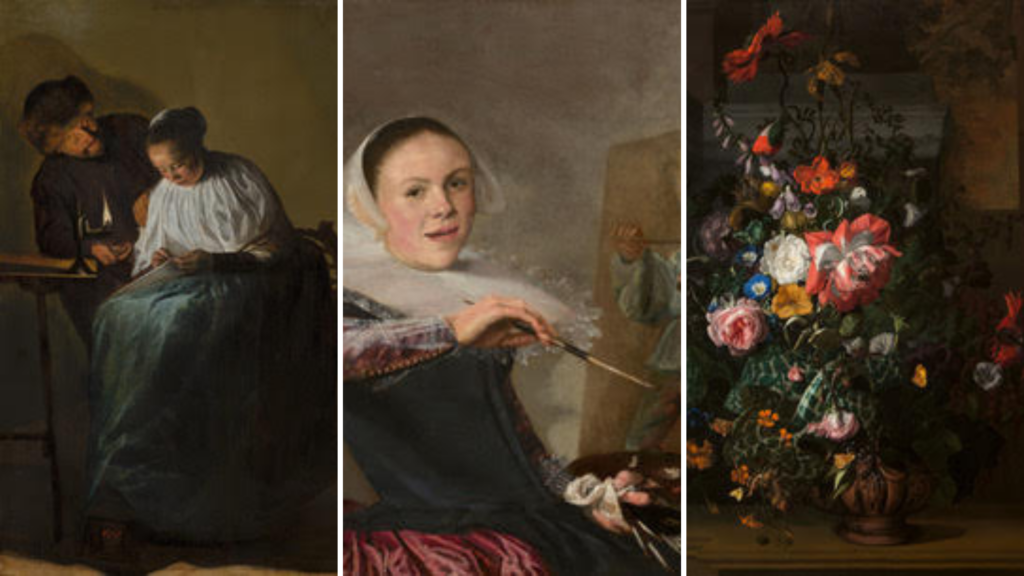
Ask a museum visitor to name a Flemish or Dutch Golden Age artist and the answers come readily: Rubens, Rembrandt, Vermeer, Frans Hals, Van Dyck. Ask them to name a woman from the same era and place, and silence tends to follow.
This silence is not a reflection of history, but a distortion of it, according to the curators of Unforgettable: Women Artists from Antwerp to Amsterdam, 1600-1750, opening at the Museum of Fine Arts Ghent (MSK) today.
The exhibition brings together more than 150 works by women active across the Low Countries during the 17th and early 18th centuries.
It shows that many female contemporaries of what are considered the Old Masters were also admired in their own time – patronised by kings, celebrated in poetry and written into early artists’ biographies – only to fade almost entirely from view.
The exhibition highlights more than 40 women who worked in cities such as Antwerp, Haarlem and Amsterdam. Their art ranges from paintings and prints to lace, botanical illustration and paper cutting, reflecting the extraordinary diversity of artistic production in that era.
The result is a striking reminder that women were not marginal figures in the creative life of the period. On the contrary, they took part in nearly every aspect of the artistic economy – from producing paintings and luxury goods to running workshops and selling artworks in thriving markets.
The exhibition introduces visitors to artists who were anything but obscure in the 17th century. Clara Peeters (1607–1621) was one of the earliest specialists in still life in the Low Countries. Rachel Ruysch (1664-1750) painted lavish floral and botanical compositions, selling works in Amsterdam for prices that could rival those of Rembrandt.
Judith Leyster (1609-1660) was admitted as a master to the Guild of St Luke in Haarlem – one of only a handful of women to achieve formal guild membership in the entire period. Dutch still-life painter Maria van Oosterwijck (1630–1693), attracted an extraordinary list of patrons, including Louis XIV of France, the Holy Roman Emperor Leopold I and England’s William III.
The sculptor Maria Faydherbe (1587-1643) from Mechelen is a figure of particular tenacity. Working outside the formal guild system, she appeared twice before the city’s aldermen to assert that she was as skilled as any male guild master, dismissing her critics as dozijnwerckers – hack workers. The all-male guild members were so affronted that they petitioned the aldermen to settle the matter with a competitive sculpting contest.
One of the exhibition’s most revelatory sections concerns the intersection of art and science. Rachel Ruysch, Alida Withoos (1660-1730), and Maria Moninckx (1673-1757) produced works for collectors who tracked cutting-edge developments in natural history. Withoos and Moninckx contributed botanical illustrations to the Moninckx Atlas, a visual herbarium of exotic plants grown at the Amsterdam Hortus medicus.
The curators argue that women were not merely passive muses or subjects for artists, but active participants in the flourishing artistic economy of the Low Countries. Many took commissions, ran workshops and sold works in the bustling art markets of Antwerp and Amsterdam. Their work contributed significantly to the region’s visual culture during a period of exceptional prosperity.
Women’s works were not peripheral curiosities. In the 17th century, they formed a crucial part of the luxury economy of the Low Countries, whose prosperous cities supported a flourishing market for art and luxury goods. Lace-making, in particular, was a major industry and one dominated by women.
By placing such works alongside paintings and prints, the exhibition challenges the rigid hierarchy between “high” and “decorative” arts that later art historians imposed. Removing those boundaries reveals just how central women were to artistic production in the early modern period.
And yet, despite this success, most of these artists are largely unknown today. Their reputations faded over the centuries
The reasons for this are complex. In part, their disappearance reflects the ways art history itself was written. For generations, historians focused overwhelmingly on male painters and sculptors, while other artistic media – particularly those associated with women – were pushed to the margins. They also focused on certain “high” forms such as painting and sculpture, tended to marginalise other artistic media in which women were particularly active. As a result, many female creators fell out of the canonical narrative.
For the MSK, the show continues a growing focus on women artists in art history. It follows earlier research initiatives and exhibitions that have sought to broaden the traditional narrative of European art beyond its male-dominated canon.
Opening on the eve of International Women’s Day, Unforgettable offers both a scholarly reassessment and a public rediscovery. By bringing these artists back into view, the exhibition invites visitors to reconsider the cultural landscape of the 17th-century Low Countries – and to recognise the many women who helped shape it.
Unforgettable: Women Artists from Antwerp to Amsterdam, 1600–1750 runs at the Museum of Fine Arts Ghent (MSK) from March 7 to May 31, 2026
