

Remember Pirate Bay? Almost every internet user has, at one point, found themselves faced with the 'moral dilemma' of downloading or streaming a film, game or song for free.
A lack of availability, rising subscription prices and too many streaming options are now driving people back towards downloading pirated content, but of course, such actions are illegal in Europe – and Belgium is no exception.
While the country's legislation has it clear as day – downloading, streaming or sharing any content obtained from a non-legitimate source is strictly illegal – this doesn’t mean, however, that it is not being regularly done.
Will you get in trouble for pirating in Belgium?
Despite the prohibitions, the country's enforcement of copyright is quite lenient towards the consumer. In Germany or the US for comparison, you can get an unpleasant surprise in your letterbox – a warning threatening huge fines drafted by hired firms tracking your IP address.
Belgium, however, is too busy hunting the suppliers, criminal organisations hosting pirated content on private servers. This leaves torrent downloads or illegal streamings on the consumer's side in a de-facto grey zone.
This method of enforcement is considered more efficient in the long-run and is preferred by the EU.
It entails blocking addresses of websites hosting pirated content through telecom providers, like Proximus or Orange. This way, many less dedicated users will run out of freely available websites to pirate from and illicit content providers will lose out on money.
How do Belgians ‘sail the seas’?
Leading worldwide piracy tracking service MUSO has provided The Brussels Times with unique data on Belgium.
Between January and December 2025, there were 896 million visits to websites related to digital piracy, putting Belgium in 10th place out of the 27 EU Member States.
The latest development in the field is taunted online as the "piracy renaissance". The alleged new uptick in ripping content is often attributed to the phenomenon of subscription fatigue, often linked to fragmentation of content, unavailability, overblown pricing and poorer quality of streaming platforms.
The biggest industry targeted by pirating in Belgium is TV-related – television, anime, live sports, and live broadcast content, representing over 52% percent of the total. Illicit streaming has become increasingly popular, with dozens of new websites popping up to cater to users searching "watch x for free".

An illustrative image for a legitimate IPTV router. Credit: Wikimedia Commons
Another more recent development is pirated Internet Protocol Television (IPTVs), which delivers television content, live channels, and video-on-demand (VOD) over IP networks.
These little boxes are not necessarily illegal, as the term simply means television content derived through the internet rather than satellite.
However, organised crime circles have created a business model of selling their own customised routers, connected to various streaming services through their own private servers. Recently, Europol has been dismantling many operations in the UK, Romania, Italy and other countries.
In this model, users purchase a way to access all available streaming services at once, through a mechanism owned by an illegal provider, while paying a reduced subscription fee directly to them through PayPal or cryptocurrency.
Other fields targeted by piracy are publishing, with a surprising scope of 35,5%, and much smaller shares for the film industry, software and music.
After streams, the second most popular option is usually to download pirated content. Traditionally, so-called P2P protocols were used for downloads, a complex network of computers that "seed" files to each other once downloaded. Once someone pirated a book or a game, their computer would host the download to others.
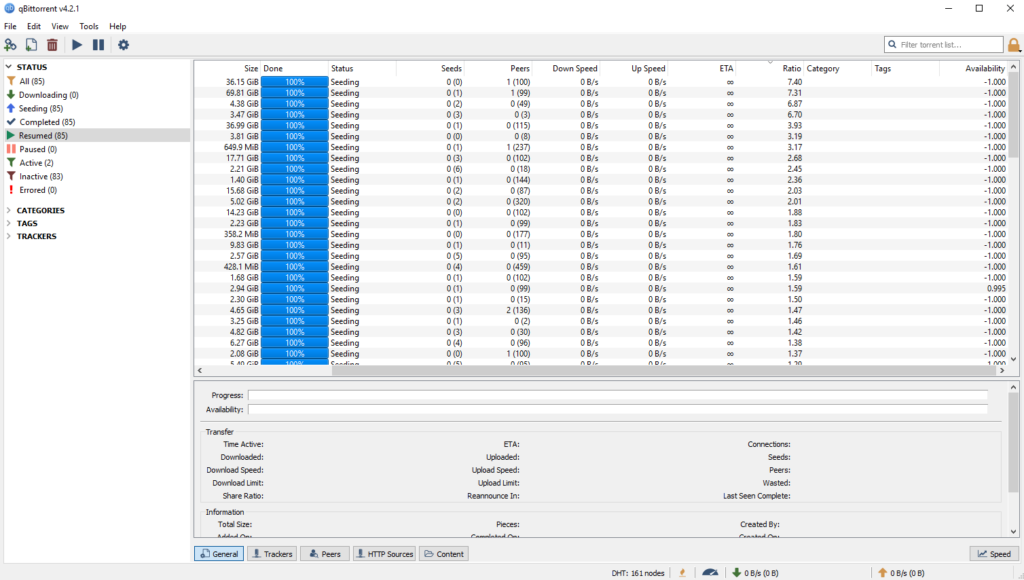
A screenshot of a P2P torrent interface. Credit: Wikimedia Commons
Today, P2Ps and related apps like uTorrent amount to a very tiny fraction of activity. Pirates prefer hosting servers similar in concept to Google Drive. The links to downloads are then spread to forums, some public and as large as 2.5 million users, like the r/Piracy subreddit.
Apps like Telegram and Discord are cutting out their own niche, especially within the younger crowd. So-called stream rippers are also becoming prominent; these are tools capable of downloading (ripping) songs, videos or other content from online streaming services such as Spotify, as files.
Who brings the content in?
The Brussels Times interviewed an EU-based piracy expert, whose name we had to anonymise due to the sensitivity of the subject. The man we talked to spent over a decade closely monitoring developments in the field of piracy, and he claims that it has changed drastically throughout this time.
"I've observed that the original ‘scene’ [nickname for an underground network of piracy groups – Ed.] consisted of hobbyists who enjoyed ripping movies or cracking software and sharing their achievements on private servers," the interviewee told us.
"Right now, the modern ‘scene’ is different. The people cracking software or uploading movies do it publicly. They are leakers and crackers with their own groups and codes, more associated with modern-day, publicly accessible piracy."
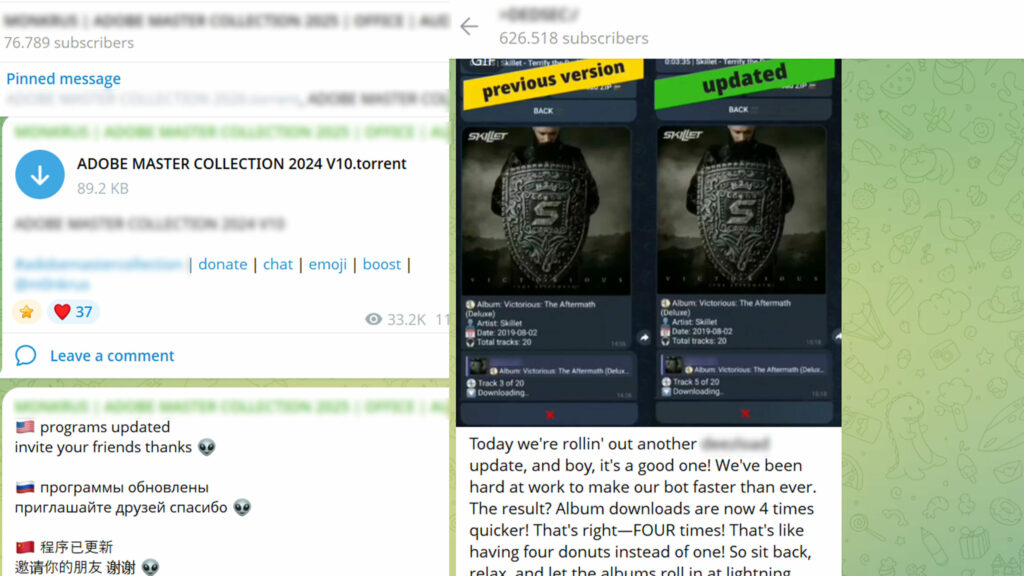
Public telegram groups run by enthusiasts promoting (1) pirated Adobe software and (2) song “ripping” of Spotify. Credit: screenshot by Kosmos Khoroshavin
"The people who put the stuff online are usually different from the people who host and operate the websites. Today, the hosting side is largely run by big criminal networks."
"You see a lot of them operating from Asia – Vietnam, the Philippines, and probably China. There are also large Russian sites, and Ukraine has had quite a reputation over the years. You also see sports streaming sites coming from Northern Africa."
Are pirates (morally) bankrupt?
The debates about the ethics of piracy have only intensified in recent years. The classic arguments against piracy say it amounts to theft, stifles innovation, funds organised crime and puts consumers at risk.
However, proponents believe that market failure and the monopolies of large companies on online content are what drive the phenomenon. In their eyes, piracy is an act of rebellion against the perception of unjust practices, some even using pirating practices to archive content online.
Credit: Eric Vidal / EP
The discussions about piracy are not going to die out any time soon. Today, there is a complex situation where anti-piracy protection is finally getting an edge against illegal downloads or streams, while, more people are resorting to illicit content as a means of protest.
Interestingly, Benelux was one of the first places in the world to pioneer digital piracy, as internet connections were stronger compared to other countries in the early internet days.
Therefore, it may as well once again become the forefront of the so-called "piracy renaissance", but if not, the EU's regulatory muscle could soon see to it.
Sabam, the Belgian association of authors, composers and publishers, was contacted by The Brussels Times for an interview, but declined the request.
