
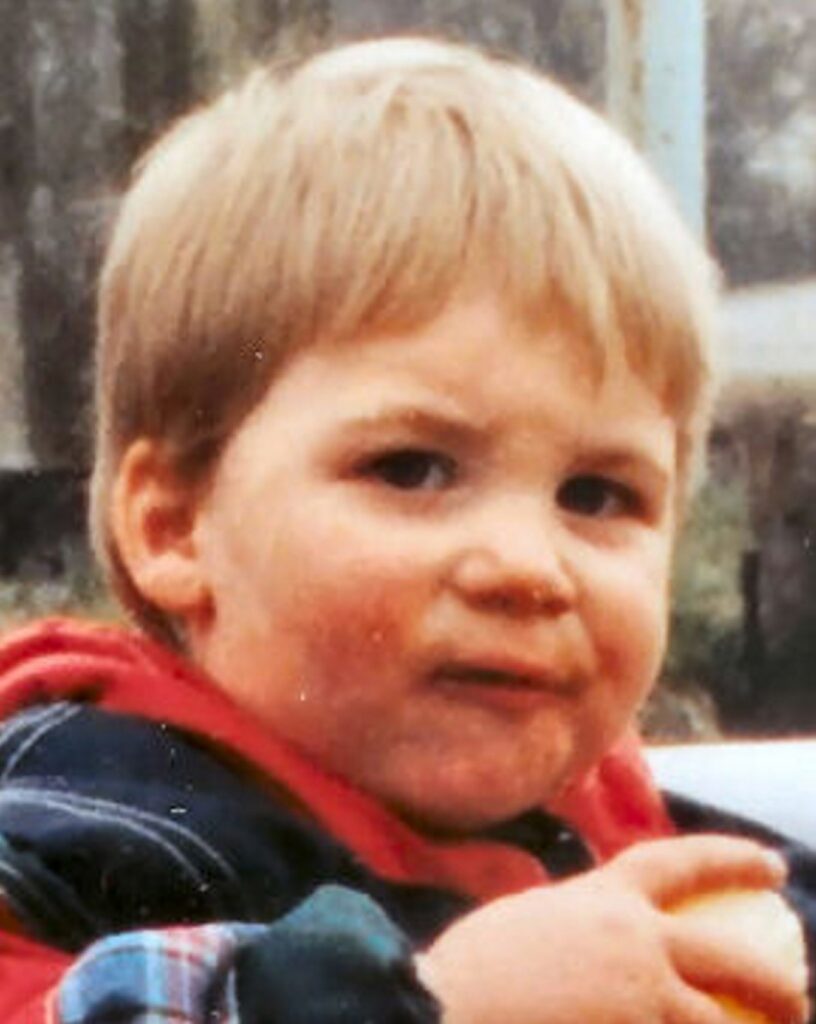
Sunday marks 30 years since two-year-old Liam Vanden Branden disappeared near the Zennegat in Mechelen, one of Belgium’s most notable cold cases.
On 3 May 1996, Liam was watching television with his brother and cousin at his mother’s house in Mechelen when his aunt noticed he was no longer in front of the TV. The house, located near the Zennegat—where the Zenne, Dijle, and the Leuven-Dijle Canal converge—prompted an immediate response. Police quickly arrived and launched a large-scale search.
Efforts to find the boy spanned the surrounding area. “We searched everywhere, both in the water and on land,” recalls Alain Remue, the former head of the federal police’s Missing Persons Unit. Divers combed the sluices, kilometres of riverbanks were searched, and even a helicopter was deployed. Despite this, the case remains unsolved three decades later.
One primary theory is that Liam fell into the water. “The Zennegat flows into the Rupel, which then leads into the Scheldt—a tidal river with a significant impact on a human body, especially that of a two-year-old,” says Remue. He believes this is why no remains were ever found, adding, “In cases like this, nature works against us. The chances of finding evidence are extremely slim.”
Liam’s father, Dirk, acknowledges this theory but remains unconvinced. “There were many people working near the water that day, and no one saw Liam. I can’t prove it, but I think it’s possible that someone took him,” he says. “Whether it was someone with bad intentions—something that deeply saddens me because I couldn’t protect him—or someone longing for a child.”
In 2012, Dirk’s suspicion briefly seemed plausible. Interpol had asked Belgium’s prosecutors to provide new DNA samples from Liam’s mother for an investigation involving "forest boy Ray". The boy, who appeared in Berlin in 2011 claiming to have lived in the woods for years, turned out to be a Dutch national named Robin van Helsum with no connection to Liam’s disappearance.
The case of Liam was the first major challenge for the Missing Persons Unit, just months before the infamous Dutroux investigation unfolded. “Liam’s disappearance remains one of my professional frustrations,” admits Remue. “I learned it’s better to deliver bad news to families than no news at all.”
Dirk echoes this sentiment. “I still hope for good or bad news one day. Preferably good news, of course. But after 30 years, even bad news would bring closure. Then we could stop hoping, say goodbye, and finally find peace.”
