
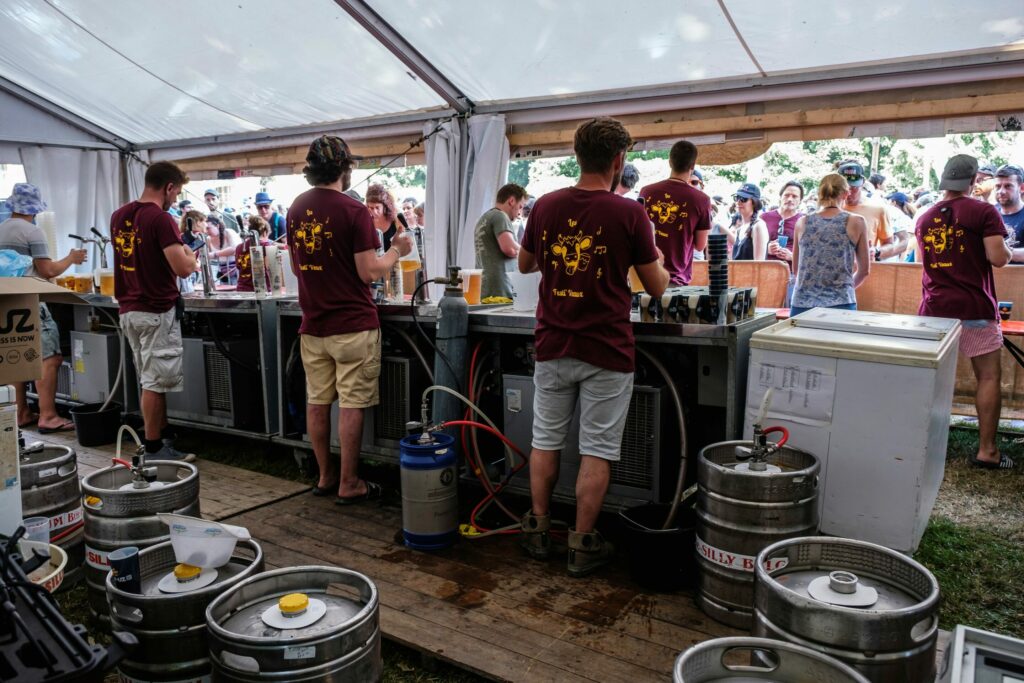
Belgium's Federal Government has given the green light to an extension of the flexi-job scheme to all sectors, which will come into force on 1 July – despite strong concerns from trade unions over the effect on the country's budget.
The flexi-job system, introduced in 2015, was designed to allow people working at least four-fifths of full-time hours to earn extra income under tax-favourable conditions.
Those with a flexi-job can earn up to €18,440 from it per year, and do not have to pay taxes or employee contributions on those earnings. Meanwhile, the employer pays a reduced rate of just 28% in employer contributions on top of the person's wages.
Initially, flexi-jobs were only available in the hospitality sector, but the scheme has been systematically extended in recent years to include, among others, the retail sector, department stores and certain roles in the care sector.
In 2025, over 150,000 people held a flexi-jobs, the vast majority of them in the hospitality or retail sectors.
Opt-outs
Now, the Federal Government, led by Prime Minister Bart De Wever (N-VA), has decided to extend flexi-jobs to all private and public sectors.
This does not apply to protected professions and certain care roles. Additionally, unions and sector organisations have the option to reject or regulate flexi-jobs at the sector level.
Funeral directors, property managers and estate agents, as well as the agricultural and horticultural sectors, have already indicated that they will activate this opt-out, announced Employment Minister David Clarinval (MR).
The Federation of Belgian Enterprises (VBO/FEB) reacted positively to the decision, stating that this is "exactly the kind of structural reform our economy needs."

Credit: ANP/Rias Immink/Belga
Unions, however, are less supportive of the decision. The socialist trade union ABVV-FGTB is particularly opposed to the move, stating that the system is undermining public finances and will lead to a loss of millions of euros in revenue for the government.
"It does not get any more cynical than this," said ABVV-FGTB chair Bert Engelaar. "Right at the foot of yet another steep budgetary hill, where the government claims it is seeking to find €7 billion or more, it is slashing its own tyres with a system that punctures public finances."
By the union's calculations, the government will lose €132 million in social security contributions and €253 million less in personal income tax in 2026 alone – together accounting for a loss of €380 million.
These funds are lost because these jobs do not contribute at the standard rates. If "standard" contributions (income tax and social security contributions) were collected on flexi-jobs, the Federal Government could generate €380 million in revenue this year alone, according to the union.
Cutting social protection
The union added that the cost of the system threatens to spiral completely out of control in the coming years, rising to more than half a billion euros per year.
"The expansion of flexi-jobs is unjustifiable in any case, and certainly not in times of budgetary constraints," said Engelaar. "It is abundantly clear that the Federal Government is paying no heed to the National Bank’s warnings about falling revenues and is simply continuing to bleed our country dry."
By reducing revenue, deficits are created, which are later exploited to cut social protection and public services. "It is perverse: because pensions are low, a flexi-job is financially attractive, but the system is set up in such a way that it actually undermines the funding of pensions."
With this decision, the government is continuing to focus on side jobs and extra hours, without any vision for creating high-quality, sustainable jobs or increasing the employment rate, Engelaar argued.
"Highly-skilled flexi-jobbers risk taking jobs that could be filled by those with fewer qualifications, while those working part-time involuntarily risk being unable to increase their hours," he warned.
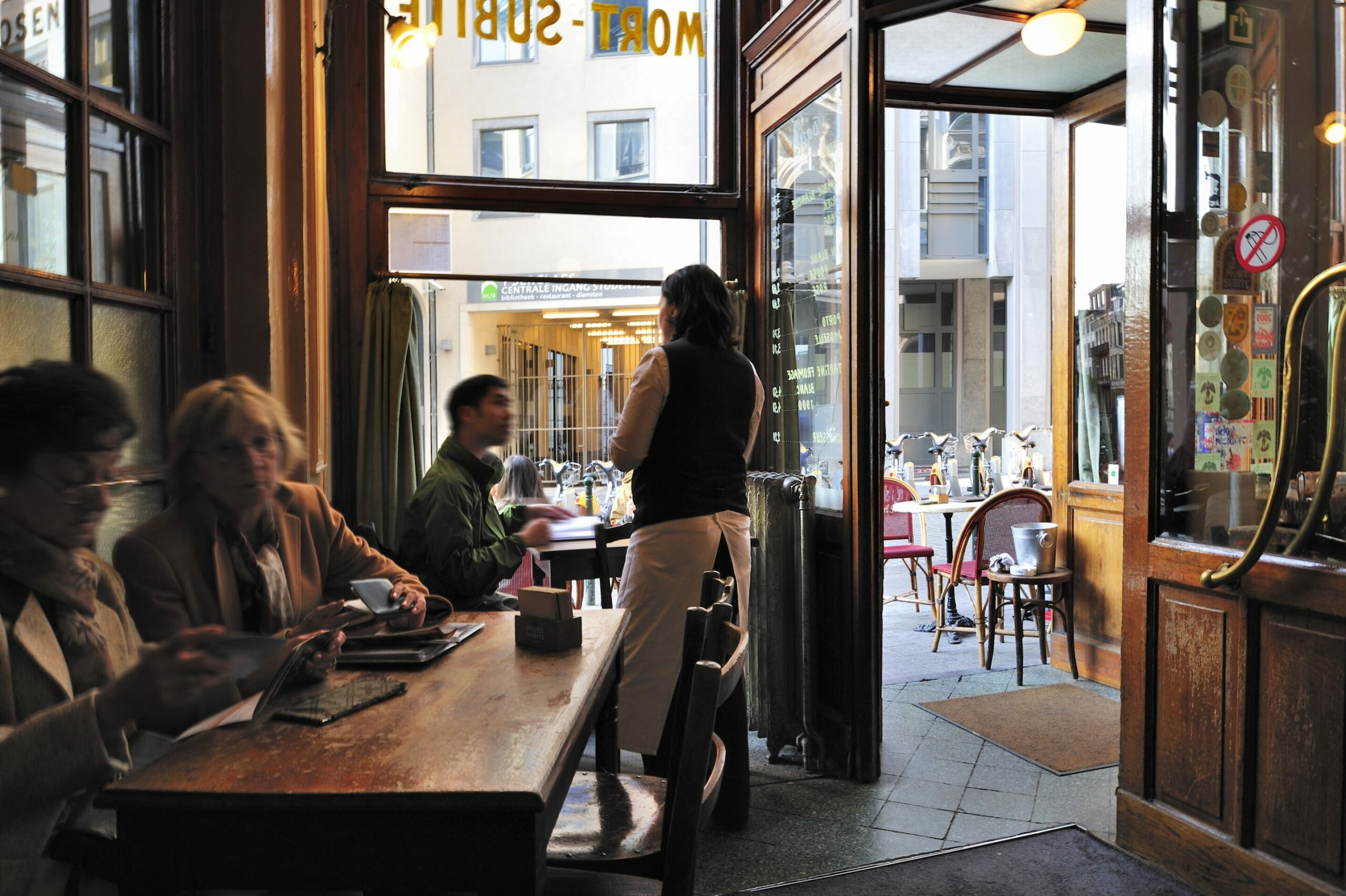
Waitress taking order of two elderly women in the café brasserie A la Mort Subite in Brussels, Belgium. Credit: Belga
The National Bank also recently pointed out that flexi-jobs exacerbate labour shortages in sectors facing particular pressure. According to National Social Security Office (RSZ) figures, nearly a fifth of all flexi-job workers in Belgium work primarily in education or healthcare.
From a labour market perspective, the expansion of flexi-jobs also raises fundamental questions, as emphasised by the Council of State.
The system introduces a structurally more favourable status alongside regular employment, without there being a demonstrable need at the level of the labour market as a whole, which leads to an uneven playing field between employees.
"It is unjustifiable that someone should take home a lot more of their wages than a colleague for doing exactly the same work," said Engelaar.
In short, the Council of State states that it has serious doubts about the compatibility of the extension of flexi-jobs with the constitutional principles of equality and non-discrimination.
The ABVV-FGTB is therefore considering legal action against the extension.
