
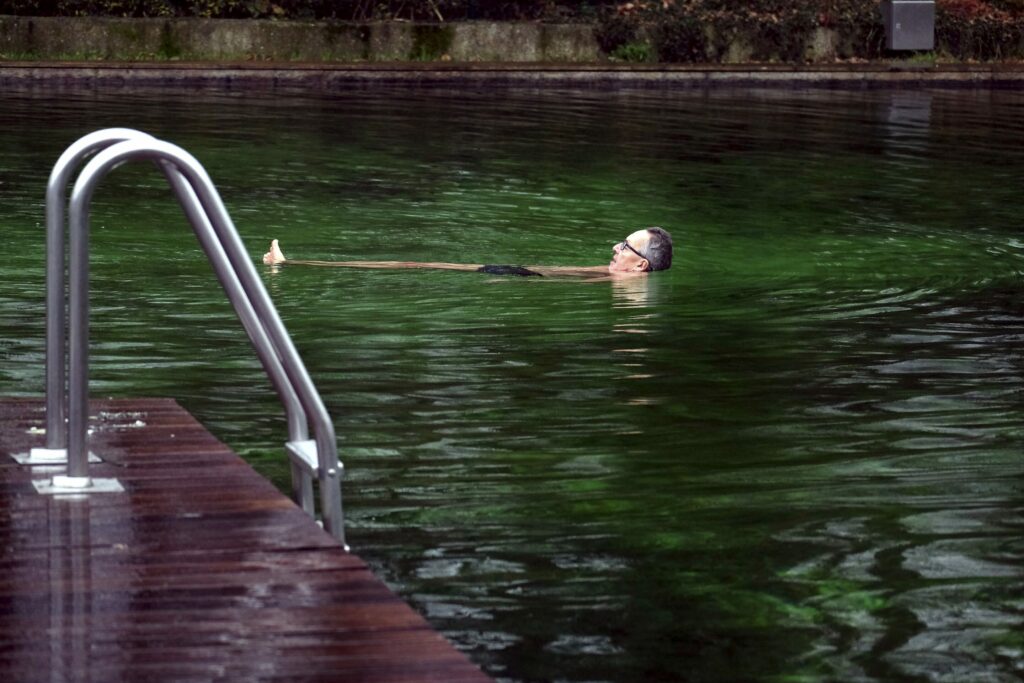
Flanders is aiming to give open-water swimming a boost by removing the requirement for an environmental permit to install certain basic infrastructure in areas that local authorities want to use for public swimming.
Open-water swimming is on the rise across Europe as towns and local authorities are rediscovering their lakes, rivers and canals as places for socialising, relaxation and cooling off.
Towns and local authorities can designate free swimming zones, which are areas where people can swim at their own risk and therefore without lifeguards.
To encourage towns and municipalities to designate such swimming zones, the Flemish Government is now removing a number of administrative barriers.
For example, from now on, no environmental permit will be required for certain basic infrastructure. This includes, amongst other things, jetties, pontoons, signage, access facilities, information boards, basic sanitary facilities and infrastructure for people with disabilities. However, buildings will still require a permit.
"With this simplification, we are once again removing a number of barriers. In this way, we hope to persuade local authorities to create additional opportunities for cooling off, relaxation and sport close to home," said Flemish Environment Minister Jo Brouns (CD&V).
'A drop in the ocean'
The decision still has to go through the further approval process; it is currently being submitted to the Council of State for advice, after which it can be definitively approved.
Green MP Mieke Schauvliege dismisses Brouns' move as "a drop in the ocean" and as "announcement politics that changes nothing in practice".
"This will not increase the number of swimming areas in the short term," said Schauvliege. "We must, above all, open up all swimming areas that are currently accessible only to clubs to the general public."
She also reiterated that the approach in Flanders needs to be reversed. At present, swimming is prohibited everywhere unless otherwise indicated, whereas in the Netherlands, for example, swimming is permitted everywhere unless it is explicitly prohibited.
"It is high time that Brouns actually reversed this principle instead of coming up with a random idea every day," she said.
