
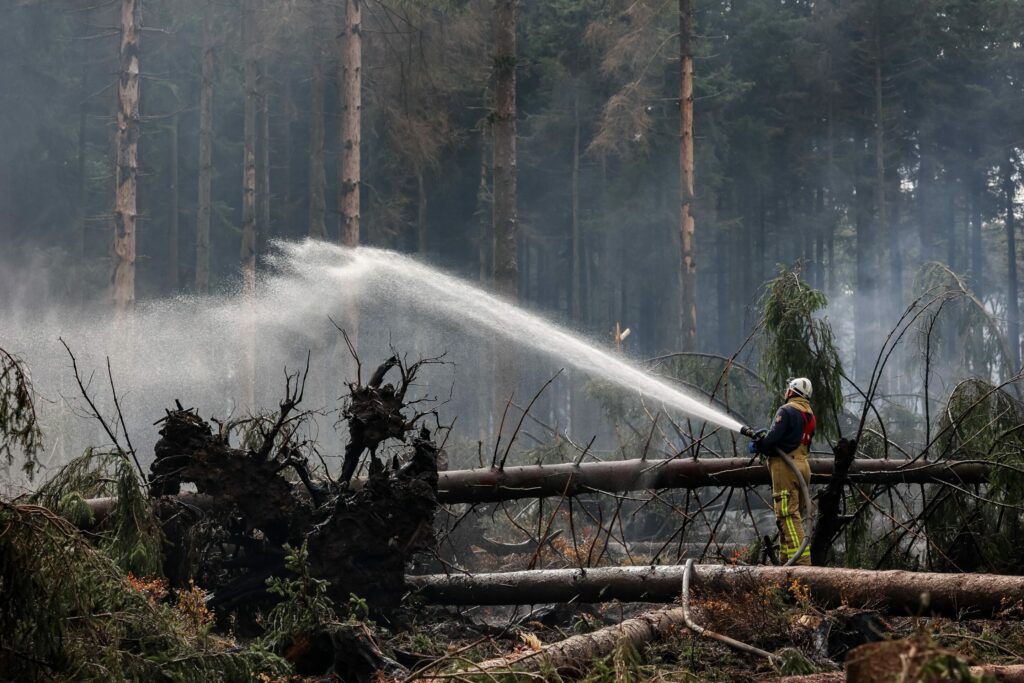
Belgium recently went through one of its largest wildfires ever, which devastated 3,000 hectares of moorland in the High Fens nature reserve.
Now, about a month after the fire broke out, its aftermath still lingers above the Belgian community.
The natural disaster might have come a surprise for many, given Belgium’s history with wildfires, or the lack thereof.
One of the main reasons for the devouring flames, according to Koenraad Van Meerbeek, an associate professor at KU Leuven, is not just the drought that Belgium encountered this summer, but also the drainage of the region for forestry purposes.
In Belgium’s damp climate and infrastructure designed to manage water rather than fire, it comes as no surprise that the country was not very well prepared for putting out the wildfire in the natural reserve.
“We didn’t have many wildfires in the past, so we don’t have the big infrastructure like countries where wildfires are more common,” Van Meerbeek told The Brussels Times.
Despite its rainy climate, Belgium has carried out extensive landscape modifications that have affected its current fire resilience.
'Zombie fires'
The High Fens consist of peatland, which is usually like a swamp with a lot of vegetation. Due to the high temperatures and lack of rain in the last couple of months, the naturally wet land dried out. Dry peat is particularly susceptible to fire, explained Van Meerbeek.
Dry peat is also the reason for what Van Meerbeek called “zombie fires.” He said that highly flammable, organic soil can burn very slowly underground, which can consequently reignite the fire at the surface, after it has been put out. “This is why it’s hard for firefighters to ensure that the fire is completely out,” said Van Meerbeek.
Besides the drought, the landscape in Belgium has been drained for agricultural and forestry purposes. There are spruce plantations in the area that “don’t like their feet wet.”
On top of the drained soil, Belgian rivers have been straightened in the 19th and 20th centuries also for agriculture and water management. “We designed our landscape to remove water as soon as possible,” Van Meerbeek added.
The natural form of many rivers is a meandering, curvy structure, which keeps water in the landscape, improving the ecosystem but also reducing the chances of wildfires in valleys by keeping the soil and vegetation wet.
Scientists also refer to wildfire exposure as the “wildland-urban interface”, where urban structures and development intertwine with natural vegetation. This includes villages such as Malmedy and Waimes close to the High Fens and homes or holiday houses around Achouffe and Viroinval close to the valleys of the Ardennes.
“This is an important consequence of how we designed our landscape,” Van Meerbeek said.
Potential landscape solutions
Reducing the risk of wildfires requires multiple actions and is not something that can happen immediately. For Van Meerbeek, one potential solution to these issues is restoring the natural structure of water ways and reducing the drainage for agricultural and forestry purposes.
“Making sure the water infiltrates the soil means it replenishes the groundwater and rewets the soils and the vegetation,” he noted.
Additionally, needle-leaf trees like pine and spruce are much more flammable in comparison to broad-leaf trees, said Van Meerbeek. “Making sure there is a mix of different tree species instead of only having spruce or pine trees can also lower the wildfire risk.”
A third potential measure to prevent wildfires, Van Meerbeek said, is the use of fire lanes – parts of the landscape where vegetation or forests is removed in strips. Once the fire reaches that piece of land, it cannot continue.
“It’s just a strip throughout the landscape to stop it,” he says. However, there is a problem with fire lanes. During a big wildfire, they can become ineffective, because sparks can spread far.
Infrastructure and what could further help
While landscape changes can help with reducing the risk of wildfires, there’s still the need to be able to respond in the event of an emergency. During the High Fens fire, help arrived from the Netherlands and Sweden, which sent helicopters to help with putting out the fire.
Belgium didn’t have the necessary aerial firefighting capacity to send to the hot spot.
According to Koen Goffings, coordinator for civic safety and resilience at Hogeschool PXL, the purchase of helicopters is not a straightforward decision, especially because Belgium is a country with little history of wildfires.
“Which politician will be held accountable when we have 20 helicopters on the ground and they never have to fly?” he noted.
While helicopters are one part of the solution, for Goffings, they are just a treatment to a larger problem – namely prevention and resilience.
When Belgium needed help, the EU deployed its Civil Protection Mechanism to support the local firefighters. The Netherlands, Norway, and Germany sent helicopters to drop water over the areas and reinforced Belgian firefighting capacity. This, according to Goffings, was enough to tackle the blaze.
While infrastructure proves to be of utmost importance for putting out wildfires, detection equipment for wildfires is also important. During a wildfire event, such technology can spot hot zones, which would require more water.
“Drones with a thermal camera can detect where the fire is still burning even when it’s not visible due to smoke,” said Sam Ottoy, guest professor at KU Leuven and PI Urban Ecosystems at Hogeschool PXL.
Drones equipped with a LiDAR (light detection and ranging) sensor can be used to map fuel characteristics, which can support preventive actions. At the same time, Ottoy pointed out, if not used for tackling wildfires, thermal drones could be utilised for search and rescue missions. “If we look for these synergies, we could also invest money in a way that the infrastructure has different applications."
For Ottoy, building capacity is another way to improve wildfire resilience. “We see a growing tendency for wildfires happening in different places at the same time,” he said. “If a fire has to be managed in multiple locations, eventually you’ll have to make decisions. This is why investing in prevention should be our first line of defence.”
