
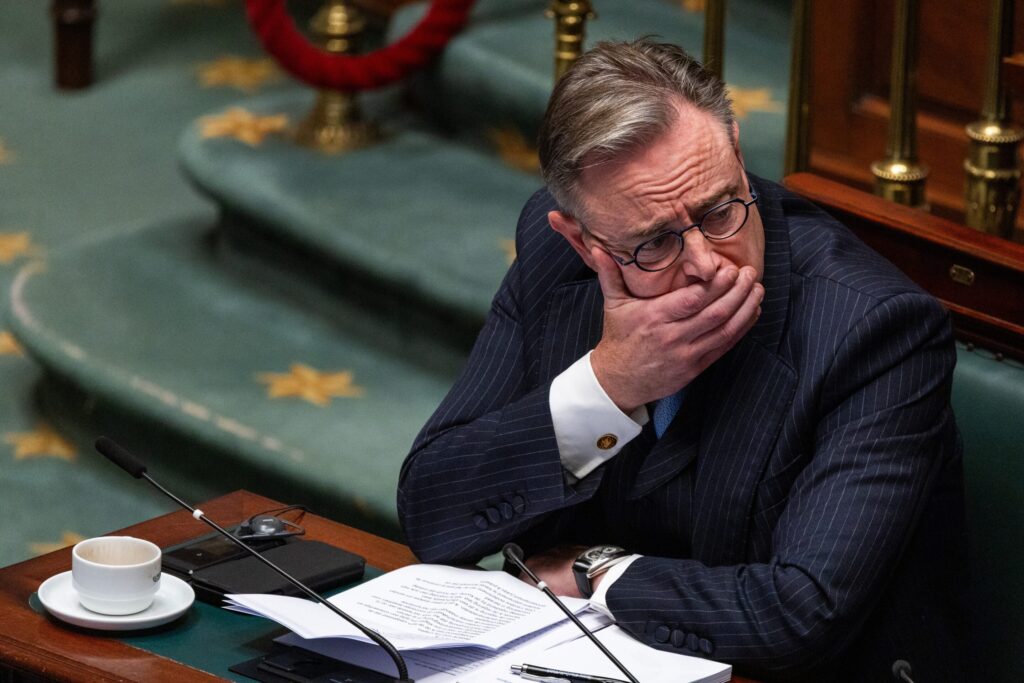
Belgium will start next year under an emergency budget system of provisional twelfths after Prime Minister Bart De Wever (N-VA) confirmed there was no budget deal, calling it a horrible failure for the government.
Parties in the Federal coalition had been negotiating for around two months to find a budget deal that would reduce the deficit by €10 billion by 2029.
De Wever had previously warned that he would not accept an emergency budget for a second year in a row, after negotiations broke down on a 2027 budget.
“Given the seriousness of the budgetary situation and developments on the financial markets, a scenario involving provisional twelfths is not an option,” he stated less than a month ago.
The Prime Minister gave no indication in parliament on Thursday of what would happen next after submitting his resignation to the King on Monday. King Philippe held off on deciding De Wever's fate while meeting the leaders of the governing parties. He completed those consultations on Thursday at midday.
The King is due to meet De Wever on Friday, and must now decide whether to accept the Prime Minister’s resignation or give the government more time to reach a budget agreement.
De Wever did not signal which outcome he expected. He only confirmed the meeting, saying: “We will then see how things may develop in the days and weeks ahead.”
The Prime Minister said he had not abandoned his aim of securing an agreement on a multi-year budget path to prevent a serious deterioration in the public finances.
The leader of the Francophone liberal MR party, Georges-Louis Bouchez, dismissed the prospect of the government collapsing. “Going to the polls would be the worst thing for the country,” he warned, insisting that “all the government’s partners want to carry on.”
'A horrible failure'
“For the government, this is a horrible failure,” De Wever said on Thursday when questioned in parliament.
He emphasised that, according to the IMF, his government has done its homework on the budget so far, and he continues to defend that record. But at the same time, he reiterated that it is not yet enough, and there is already a risk of interest rates snowballing in the short term.
“We must therefore tackle our problems now, and that can only be done by making difficult choices and putting an end to the mismanagement of the past,” he said. “I only want to be Prime Minister of a government that prioritises this task; otherwise, it is completely pointless.”
Without a full budget agreement, a system of provisional twelfths will be put in place for the second year running. At the start of 2026, an emergency budget was in place for three months, after the federal government only managed to find a budget deal at the end of November 2025.
Under this system, the government may spend no more than one-twelfth of the previous year's annual expenditure.
'When will this farce come to an end?'
Opposition party leaders rounded on the Prime Minister in parliament on Thursday. “A Prime Minister gives hope, champions a vision, and that is what you are failing to do," argued French socialist leader Paul Magnette (PS).
Referencing the election results in the US, Sarah Schlitz (Ecolo-Groen) said, "If there were mid-term elections today, you’d lose your majority. It’s not in your interests to go to the polls. Your only option is to carry on negotiating with this lame-duck coalition."
Meanwhile, the lone DéFI MP François De Smet asked: “When will this farce come to an end?” suggesting that inaction and ego clashes within the government have "cost the country."
Earlier this week, Flemish liberals Anders offered Les Engagés the chance to form an alternative majority government, but they rejected it.
In parliament on Thursday, Kjell Van der Eslt (Anders) offered their support to the government but accused the Prime Minister of being irresponsible: “You’re throwing in the towel whilst the alarm bells are ringing. It’s irresponsible and reckless.”
