
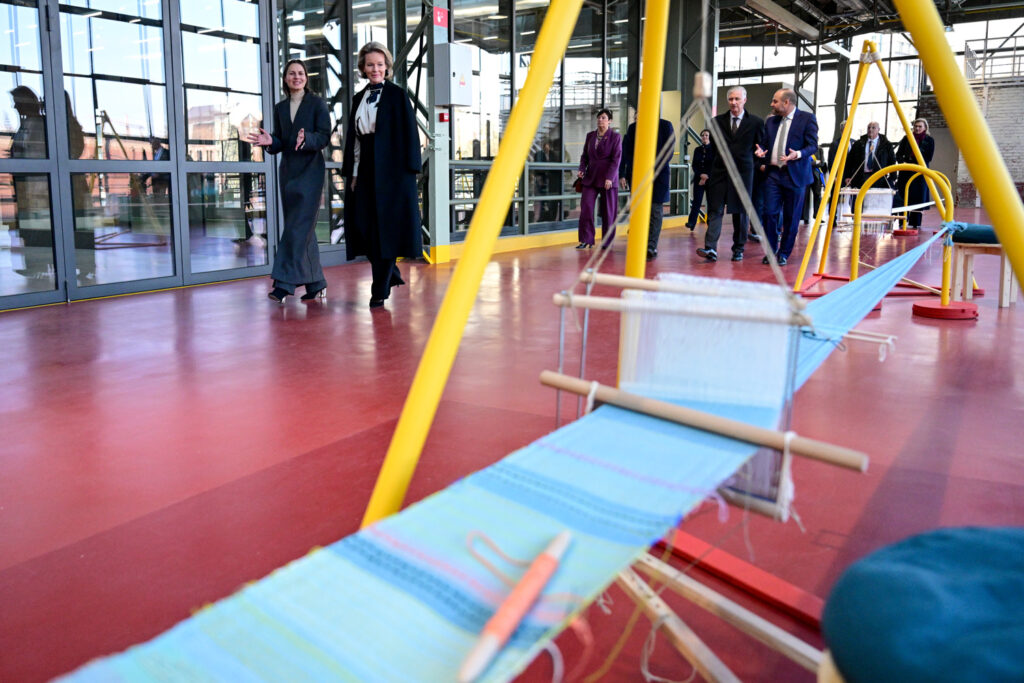
Kanal-Centre Pompidou opened to the public in Brussels on Saturday, more than 11 years after the Brussels Region announced its purchase of the former Citroën-Yser garages.
The modern and contemporary art museum, originally expected to open in 2018 or 2019, has spanned several political terms, faced repeated delays and prompted years of political and budgetary debate.
Its opening comes two days before the departure of Director-General Yves Goldstein, who has led the project since 2017.
The site covers about 40,000 square metres and includes a 12,000-square-metre modern and contemporary art museum, a 7,000-square-metre architecture centre and around 13,000 square metres of indoor public space that will be freely accessible.
The redesign preserves the industrial character of the former car complex, including a showroom restored to its original proportions, while a rooftop terrace offers 360-degree views across the capital.
Related News
- Kanal: Brussels’ next great transformation
- 'Brussels is afraid to be ambitious': Kanal museum’s quitting director has no regrets
The project was first announced in March 2015 by then Brussels minister-president Rudi Vervoort at the MIPIM property fair in Cannes. The modernist complex was formally acquired from PSA on 29 October that year for €20.5 million. At that stage, the plan envisaged a museum alongside housing.
Backed by Vervoort’s government, and with Goldstein moving from chief of staff to project leader, the museum was presented as a way to help revive the canal area and reconnect its two banks. Vervoort said at the time that he expected more than 500,000 visitors a year.
After federal state secretary Elke Sleurs, who was responsible for the federal museums, declined to support the scheme by refusing to lend contemporary artworks from federal collections, the Brussels Region, the Kanal Foundation and Paris’s Centre Pompidou signed a partnership agreement in December 2017.
The building welcomed its first visitors on 5 May 2018 during Kanal Brut, a pre-opening programme that drew more than 400,000 people. A few weeks earlier, noAarchitecten, EM2N and Sergison Bates had won the international competition to transform the site with their proposal, A Stage for Brussels.
The full opening was successively announced for 2022-23, 2024 and 2025 before eventually being fixed for November 2026. The timetable was disrupted by the pandemic, the war in Ukraine, supply difficulties and unexpected construction issues.
In September 2025, Goldstein told the Brussels parliament that the cost had risen to €231.5 million from an initial budget of €150 million.
He said the increase was mainly due to indexation worth €41.8 million, settlements and disputes worth €26.7 million, and €13 million for interior fittings and furniture.
The management contract provided for annual operating funding of €35 million once the museum was fully running. Goldstein said the project’s viability would be at risk below €29 million.
The Kanal Foundation estimated annual economic benefits at €135 million, tax returns at €33.3 million and direct and indirect employment at 780 jobs.
Political controversy has followed the project from the start.
Ecolo and Groen called for greater public participation, N-VA challenged both the choice of building and the region’s authority to lead the project, while MR criticised what it said was a lack of transparency and consultation.
As a flagship project of the Vervoort governments, Kanal became a target for budget criticism ahead of the 2024 elections, notably from CD&V and Les Engagés, and again during coalition talks.
In May 2025, CD&V MP Benjamin Dalle argued for an end to the Paris partnership, and in December MR leader Georges-Louis Bouchez questioned the museum’s financial logic.
The new coalition agreement reached in February 2026 nevertheless confirmed that the museum would open. In May, the government released the remaining €28 million in operating support for 2026 and approved a €60 million loan to complete the works.
Even so, the museum’s funding model is set to change. Regional operating support is due to fall gradually from €28 million in 2026 to €24 million in 2027, €22 million in 2028 and €10 million in 2029.
The government wants a model that relies more heavily on both public and private funding, a shift that will be one of the main challenges for the museum’s future leadership.
Minister-President Boris Dilliès has said he wants Kanal to become a symbol of Brussels’ international profile. On Tuesday, he described it as one of the most beautiful and ambitious projects the capital has seen in recent decades, invoking the Tate Modern, MoMA and the Guggenheim Bilbao.
Beyond Belgium’s domestic debate, the museum has attracted international attention. The New York Times included it in September among architectural projects worth travelling for. The Guardian featured it in November 2025, while the BBC listed it in February among six major museum openings expected worldwide in 2026, the only one in Europe.
The inaugural exhibition, A Truly Immense Journey, brings together around 350 works, mainly from the Centre Pompidou, whose partnership with Kanal runs until 2031, as well as from Kanal’s own collections.
