
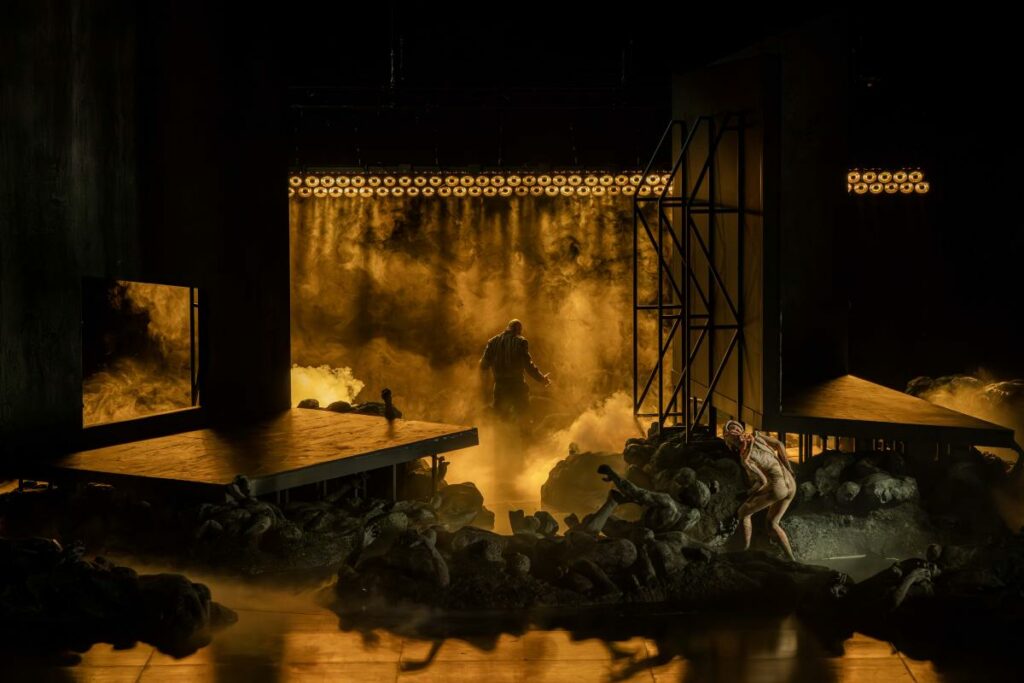
The curtain has barely fallen, and already it is clear that La Monnaie/De Munt has pulled off something remarkable.
In landing acclaimed composer Iain Bell for the world premiere of Medusa, the Brussels opera house – already storied in Belgian history as the theatre whose 1830 production of La Muette de Portici ignited the revolution that created the nation – has added another chapter to its long record of theatrical ambition.
This is Bell's sixth opera, and by any measure it is his most visceral, most beautiful and most necessary.
Bell, born in London’s East End in 1980, is not the stereotypical operatic figure. Raised outside the classical tradition, he grew up on MTV rather than Mozart – absorbing the narrative instincts of artists like Kate Bush and Annie Lennox. “I’m trying to create something that punches you in the stomach,” he tells me before the premiere.
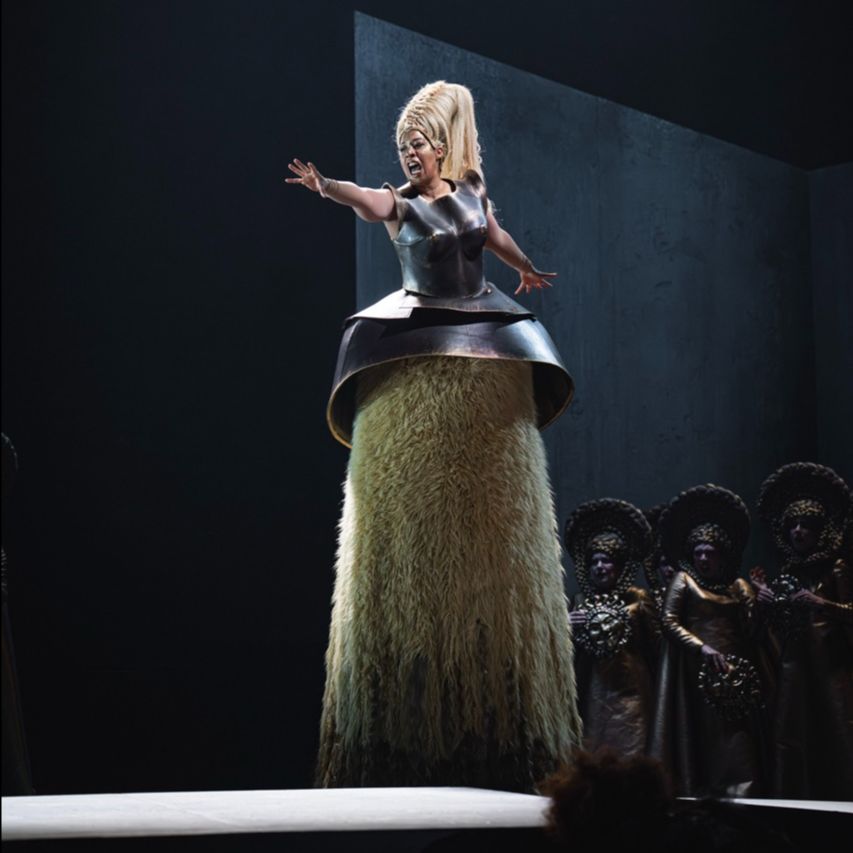
Medusa at La Monnaie. Credit: La Monnaie
Medusa had been a dream of his for over a decade, conceived shortly after his triumphant debut at Vienna's Theater an der Wien in 2013 with A Harlot's Progress. But life – including a run of commissions, from Welsh National Opera to New York City Opera – kept intervening.
Then Christina Scheppelmann, newly appointed as general director of La Monnaie, sent him a text. A word and a year: “Medusa. 2026”. The opera had found its home.
A misunderstood figure
The story Bell chose to tell is not the one most people think they know. Medusa is one of mythology’s most recognisable figures – and one of its most misunderstood.
Traditionally reduced to a monstrous head of snakes, she has inspired centuries of artists, from Leonardo da Vinci and Peter Paul Rubens to Caravaggio and Pablo Picasso. Yet her own voice has largely been absent.
Yes, she is the Gorgon with snake hair and a petrifying gaze, dispatched by Perseus. But that is only the ending. What Bell and his collaborator, librettist Lydia Steier, have excavated is the Ovidian backstory – the Metamorphoses account of a young woman, a priestess of Athena, who is raped by the god Poseidon in the goddess's own temple. She is then punished by Athena for the defilement.
Transformed into a monster by the deity who should have protected her, she is cast out, hunted, and finally destroyed by a hero seeking glory. Her crime was to be a victim. Her punishment was to be made monstrous for it.
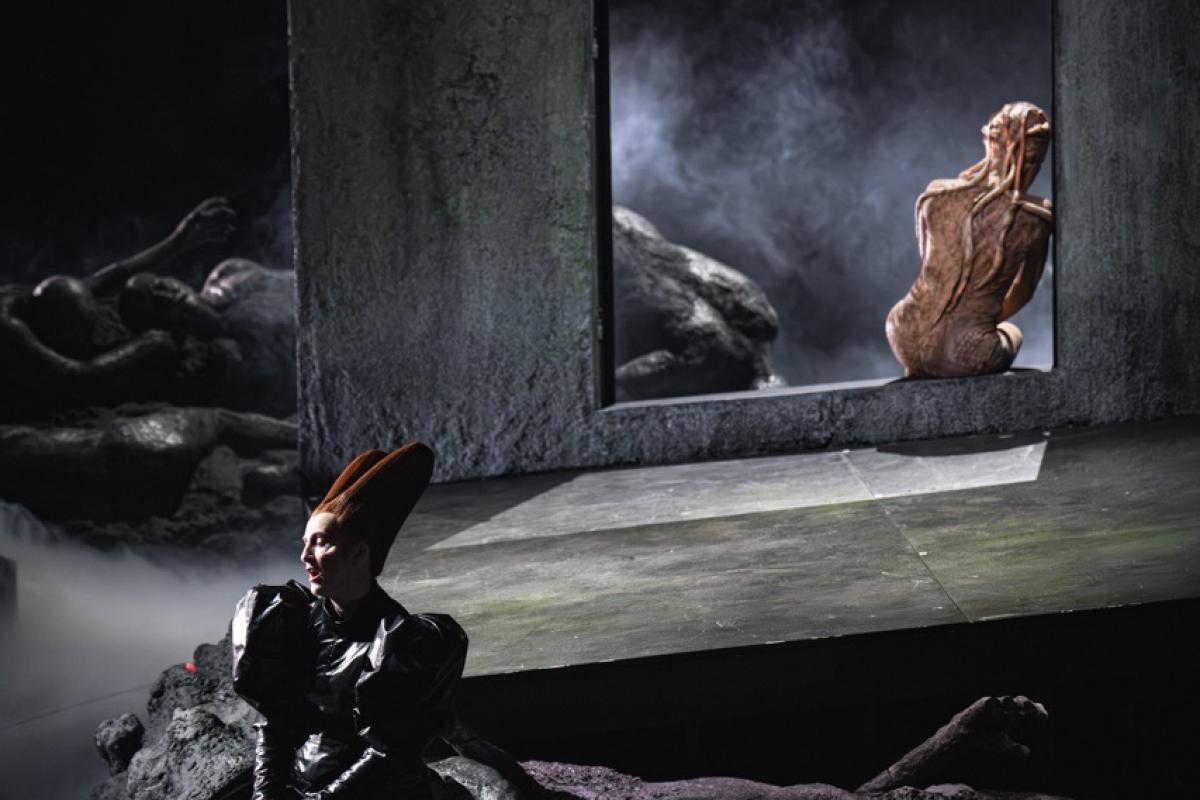
Medusa at La Monnaie. Credit: La Monnaie
Relevance to a modern audience
"You don't have to do anything to make it relevant," Bell says quietly. "You don't have to pick at any threads. It's just there." He nods to the Epstein scandal and the MeToo movement: the continuing spectacle of abuse survivors pilloried and ridiculed by those in power.
"Medusa was ostracised. She was alienated and rendered a monster. That happens – in a non-symbolic way. People are silenced, rendered figures of ridicule and shame. That's what we see in this piece, very strongly."
What makes this production incandescent is how fully that vision is realised on stage. Steier – who wrote the libretto that Bell called, without hesitation, "the best I have ever set, across six operas" – has created something that looks like mythology reborn.
The instruction from Bell to the design team was precise: no togas, no black temples, nothing clichéd. Go, he said, to "future fantasy" – the ancient past refracted through something wilder and stranger. They delivered. The snakes of Medusa's legend are not a theatrical prop here but part of the singer's body, extensions of her physicality, writhing and illuminated. It is at once faithful to the myth and utterly unlike anything you have seen before.
At the centre of it all is soprano Claudia Boyle as Medusa – a performance of shattering emotional range, from innocence through violation to ferocious, grief-stricken power. Around her, a superb cast includes Angela Denoke and Paula Murrihy as her sisters Stheno and Euryale, and Konstantin Gorny as a Poseidon of chilling, entitled menace – a character Bell describes as "the most unpleasant I've ever written."
The musical language Bell uses for the rape scene – perhaps the most demanding passage in any contemporary opera – is, counterintuitively, one of the most delicate in the score. Over the implied violence, he layers a string quartet playing a lullaby of Medusa's childhood, sung by her sister as though the young woman herself is clutching at beauty to survive the unsurvivable.
"In speaking to sexual abuse survivors," Bell says, "many said that that – holding on to something – was how they lived through the moment." In the wrenching moments after the act, the music and singing halt, the only sound being Medusa’s sobs and whimpers.

Director Iain Bell. Credit: La Monnaie
Praise for La Monnaie
Performed in English with surtitles in French and Dutch, the production is at a suitably grand scale, with a full orchestra conducted by Michiel Delainghe, and a lavish ensemble of soloists.
Bell, who has been living near Place Sainte-Catherine for six weeks of rehearsals, confesses he is "pre-grieving" having to leave. He says La Monnaie is "the best organised opera house I've ever worked in, and I've been very lucky." Coming from a composer who has worked at the Royal Opera House, Houston Grand Opera and English National Opera, that is not faint praise.
Medusa is not an easy night at the opera, nor should it be. What Medusa ultimately achieves is to take the extreme – the mythological, the operatic, the melodramatic in the truest sense – and turn it into a mirror.
In the second act, Medusa stands alone on a stage strewn with stone statues: the men, the heroes, the powerful, turned to rock by her gaze. In reclaiming a monster, Bell has created something far more human. And in doing so, he has given Brussels a premiere that feels destined to travel.
Medusa runs at La Monnaie/De Munt until May 19.
