
Belgium's industries have started to feel the impact of the United States' trade tariffs on European Union imports. Between May and July, the value of total exports to the US fell by 12.1%, according to the latest figures by the National Bank of Belgium (NBB).
After the trade deal announced by US President Donald Trump and European Commission President Ursula von der Leyen at the end of July 2025, a joint EU-US statement on 21 August confirmed that a general tariff of 15% will be levied on EU goods imported into the US.
"The trade deal creates risks for European and Belgian companies, as the US is a major trading partner," the NBB states on its website. "The US accounts for approximately 7.6% of total Belgian goods exports, making it the fourth largest importer of Belgian goods, after Germany, France and the Netherlands."
Last year, Belgium exported €27 billion in goods to the US, more than half of which (€15 billion) were pharmaceuticals. It also sold €15 billion in services to Washington, however these are not subject to tariffs.
Cars, chemicals and diamonds
In particular, Belgium's export of chemical products, transport equipment (such as passenger cars) and diamonds are the most affected sector. While the tariffs also apply to the pharmaceutical industry, generic medicines are exempt (but these only account for a small proportion of Belgium’s pharmaceutical exports).
Across May, June and July, the value of total exports to the US fell by 12.1%, according to the NBB. In July alone, they even dropped by 13.9%. Exports of passenger cars have been hit particularly hard (-45%) in recent months, while the chemical and pharmaceutical sectors saw declines of 30% and 20%, respectively. The Belgian diamond and technology sectors also saw sharp declines in exports.
However, the decline in the second quarter of 2025 is not unexpected as many American companies took action before the tariffs took effect, said Peter Vanden Houte, chief economist at ING, in a press release.
"Trump had announced these tariffs long ago, and that is why these companies imported products from Europe – including Belgium – on a massive scale in the first few months of the year," he said. "They stockpiled large quantities, and so now, we are seeing a decline."
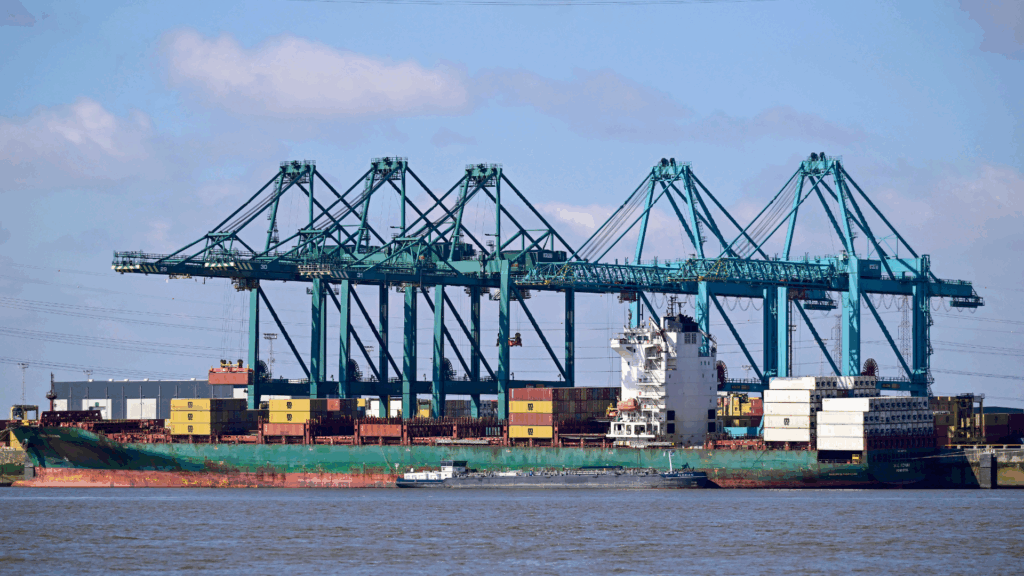
A container ship in the Port of Antwerp harbour on Monday 31 March 2025. Credit: Belga/Dirk Waem
According to the NBB report, the first effects of the import tariffs were already being felt before August; since April, there has been a clear slowdown in exports to the US.
Although the decline was somewhat predictable, Vanden Houte still speaks of "significant market disruption" due to trade tensions with the US. "The uncertainty surrounding import tariffs is a major problem," he said.
Given Trump's tendency to sometimes change tack quickly, some companies in Belgium and the rest of the EU are waiting to see if further changes are made to the tariffs and other import formalities before they export any more of their goods to the US.
"There is currently a general tariff of 15%, but it is not clear which products are exempt yet. This uncertainty is making companies nervous," Vanden Houte said. "They are waiting to see what happens before making major decisions, and that is having a less positive impact on our economy."
Trade deficit of €2.2 billion
As Belgian exports fell more sharply than imports from May to July, the trade surplus decreased by almost €2 billion, compared to the same period in 2024. The NBB says this loss is entirely attributable to trade with countries outside the EU, and the US in particular.
In the last three months, a trade deficit of €2.2 billion was recorded for trade with the US, compared to a surplus of €0.6 billion in the period May to July 2024.
For the time being, however, the Belgian economy continues to grow "at a robust pace," according the NBB. In its spring projections, the bank predicted quarter-on-quarter growth of 0.2% for the third quarter of 2025. In its most recent Business Cycle Monitor, this figure was even revised upwards slightly to 0.3%.
Business confidence improved further in August, as did consumer confidence, continuing a trend that began in April 2025. "We therefore do not currently see any signs of an economic slowdown in our indicators, but we will of course continue to monitor the situation closely."
